🇬🇧 ロンドンのミトライ
イギリス · イーゴル・ミトライの公共彫刻
ロンドンはミトライの最初の大型公共委嘱の地の一つです。1983年にテスタ・アッドルメンタータがカナリーワーフに設置され、英国での公共空間との長い関係が始まりました。大型のチェントゥリオーネ Iも同地区に永久設置されています。
主要作品と設置場所
- チェントゥリオーネ I — カナリーワーフ · 永久設置
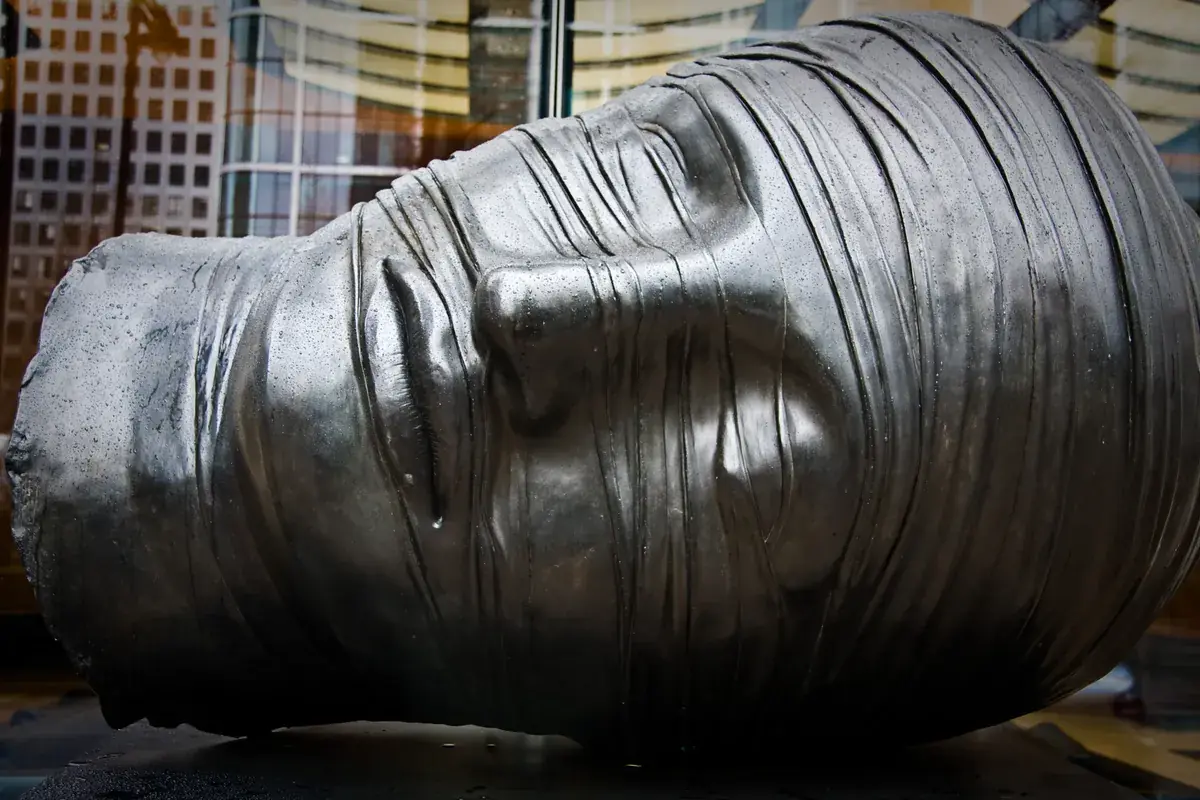
- テスタ・アッドルメンタータ — カナリーワーフ · 1983年 · 眠る頭部のモノメンタル彫刻
Eros Bendato — Bound Eros — is one of Mitoraj's most celebrated subjects: the face of the god of love, eyes bandaged, bound and blinded. The subject appears across his entire career in multiple scales and editions, from the monumental Kraków installation in Rynek Główny to smaller collector editions. The Canary Wharf example is a permanent installation within the public estate.
The bandaging of Eros — the binding of love, of desire, of the sensory — is one of Mitoraj's most legible symbolic gestures. In the context of a financial district, the image of Eros blinded acquires a specific irony that the artist almost certainly intended: the city that runs on appetite, placed next to the god of desire, rendered sightless.
See also: Full Eros Bendato guide — buy & sell · Eros Bendato in Kraków
Canary Wharf's Mitoraj Collection in Context
The three Mitoraj works at Canary Wharf form the most concentrated public collection of his bronzes in the UK. They were acquired across different phases of the Canary Wharf development, with the Testa Addormentata predating the main development surge and the Centurione and Eros Bendato arriving as the estate matured. The Canary Wharf Group, which manages the estate, has maintained a consistent commitment to major international sculpture — Henry Moore, Antony Gormley, and Pierre Vivant are among the other artists represented in the permanent collection.
For visitors, all three Mitoraj works are accessible as part of Canary Wharf's public realm, which is freely open daily. The estate is best accessed via the Jubilee line (Canary Wharf station) or the Elizabeth line (Canary Wharf station), with the DLR also serving the area.
The UK Mitoraj Collector Market
British buyers have been among the most consistently active in the international Mitoraj secondary market. Christie's, Sotheby's, and Bonhams London have all achieved strong results for Centurione, Persée, and Eros Bendato bronzes. The UK market particularly favours the smaller desktop editions — Centurione I and II, Tête Secrète, Kea — which circulate through both the major auction houses and specialist dealers.
If you are based in the UK and own a Mitoraj work — bronze, marble, lithograph, or drawing — I buy directly and privately. I respond to every enquiry personally within 24 hours and handle all transactions with complete discretion.

Mitoraj's relationship with the London market deepened considerably through the 1990s and 2000s, when his works began appearing regularly at major auction houses including Sotheby's and Christie's. Bronze casts of recurring subjects — Eros Bendato, Testa di Icaro, and the various Centurione variants — achieved consistent results that positioned him firmly within the upper tier of European figurative sculpture on the secondary market. Editions were typically cast in limited numbers at the Pietramar foundry in Pietrasanta, with certificates issued directly through Mitoraj's studio, a provenance detail that serious buyers have learned to verify carefully given the complexity of his edition structures. The London trade also played a role in introducing Mitoraj to a generation of British private collectors beyond the institutional sphere: works acquired through West End dealers in the 1990s have since appeared at regional auction houses, suggesting a broader geographic dispersal than the public record alone indicates. ContiniArtUK, which represented Mitoraj in the United Kingdom from the early 2000s and maintained close ties with his Pietrasanta studio, remains one of the primary reference points for British collectors seeking authentication documentation or provenance research on works that passed through the London market during his lifetime.
Mitoraj's relationship with the London market deepened considerably through the auction houses during the 2000s and 2010s, with Sotheby's and Christie's both handling significant bronze editions as secondary-market interest matured. Works such as Ikaro and Perseo achieved consistent results in the £80,000–£350,000 range depending on scale and casting provenance, reflecting the premium placed on pieces cast at the Fonderia Mariani in Pietrasanta under Mitoraj's direct supervision. The edition structure of his bronzes — typically numbered in small runs of six to nine, often with artist's proofs — has made provenance documentation particularly important to British institutional and private buyers, who increasingly sought certificates tracing a work's casting date and foundry records. The ContiniArtUK gallery, having established its Mayfair presence in 2014, continued to represent the estate after Mitoraj's death in October of that year, maintaining a stock of works and facilitating loans to British institutions. This sustained commercial presence distinguished London from other major European cities, where Mitoraj's public visibility was often greater — Paris, Rome, and Kraków each hold larger concentrations of his work — but where the private collector infrastructure was less formally organised around a single dedicated representative. For collectors researching acquisition, it is worth noting that Canary Wharf's public art programme retains acquisition records and condition reports for its permanent collection, making the three London bronzes among the better-documented Mitoraj works in public ownership in the United Kingdom.
Mitoraj's relationship with the British market deepened considerably through the 1990s and 2000s, with his works appearing at major London auction houses including Sotheby's and Christie's, where bronzes from the Eros Bendato and Perseo series have consistently attracted strong bidding from European and Middle Eastern collectors. The secondary market for Mitoraj in London reflects a broader pattern: works in larger editions, particularly the smaller table-scale bronzes such as Tindaro Screpolato and Ala di Notte, circulate relatively frequently, while the monumental unique or low-edition castings — comparable to those held at Canary Wharf — rarely reappear once placed. His London gallerist presence was further consolidated when ContiniArtUK, which had represented Mitoraj exclusively in the UK for several years before the 2014 Mayfair opening, facilitated a number of significant private placements into country estates and corporate collections across England and Scotland. The gallery's Cork Street premises, where Mitoraj exhibitions had been held in earlier years, introduced his work to a generation of British collectors who had not encountered the large-scale public installations in Pompeii or Pietrasanta. For serious collectors approaching the London market, provenance documentation and casting certificates from the Pietrasanta foundries — principally the Fonderia Mariani — remain the critical authentication reference, particularly as the volume of unauthorised reproductions of well-known Mitoraj compositions entering the European market increased noticeably after his death in October 2014. The Estate, managed from Pietrasanta, has worked to maintain catalogue raisonné standards, though a comprehensive published catalogue covering the full monumental
Beyond Canary Wharf, Mitoraj's presence in London extends to the commercial gallery record that shaped his British reputation. Sperone Westwater and, more significantly, the Piccadilly-based Gurr Johns handled significant transactions during the 1990s, a period when London's appetite for monumental bronze was at its peak and Mitoraj's prices at auction were climbing steadily through the £40,000–£120,000 range for mid-scale works. Christie's South Kensington catalogued several Mitoraj bronzes during this decade, helping establish a documented secondary market that gave institutional buyers confidence when acquiring large-format pieces. The Victoria and Albert Museum holds study material relating to Mitoraj in its archive, though no finished work entered the permanent collection — a gap that collectors and curators have occasionally noted given the scale of his public presence nearby. For British private collectors, the most actively traded editions have historically been the Testa di Centurione and Ikaro series in the 60–80cm range, which appear with reasonable frequency at Bonhams and at European specialist houses. Provenance tracing for UK-acquired Mitoraj works benefits from the fact that many passed through a small number of identifiable dealers and auction rooms, making chain-of-title documentation more straightforward than for works acquired directly in Italy or through Continental intermediaries during the same period.
Beyond Canary Wharf, Mitoraj's presence in London extends to the secondary market, where the city's major auction houses have handled his bronzes with increasing regularity since the mid-2000s. Sotheby's, Christie's, and Bonhams have all offered significant examples, with Testa di Donna and Perseo editions appearing most frequently in their Italian and European sculpture sales. London remains one of the strongest Western European markets for Mitoraj's mid-sized bronzes — those in the 40 to 80 centimetre range — where collector demand from both private buyers and corporate acquirers tends to concentrate. The city's architecture firms and estate developers have historically been active purchasers, viewing his fragmented classical figures as a sophisticated counterpoint to modernist buildings, a logic that explains the Canary Wharf commissions as much as any curatorial rationale. For UK-based collectors, provenance tracing through London auction records is often more straightforward than for Continental purchases, as the major houses maintain accessible sale archives going back decades. It is worth noting that British private collections holding Mitoraj works tend to be discreet — few have been formally published or exhibited — meaning that estate sales and private treaty transactions occasionally surface pieces with no prior auction history. Collectors active in this space benefit from registering interest directly with the specialist departments at the major houses, as privately brokered sales of Eros Bendato and Centurione editions do occur outside public catalogue listings. The London market's relative transparency compared to Italian regional sales makes it a practical entry point for new Mitoraj collectors establishing their first acquisition.
Beyond Canary Wharf, London holds further evidence of Mitoraj's sustained presence in Britain. Christie's and Sotheby's have both handled significant Mitoraj bronze editions at their London salerooms, with Ikaro — the winged, fragmented figure that became one of his signature mythological subjects — appearing at auction multiple times from the late 1990s onward. The London market for Mitoraj tends to favour the mid-scale bronzes: works substantial enough to anchor a garden or entrance hall, yet practical for private ownership in a city where outdoor space is measured carefully. Editions of Tindaro Screpolato, the cracked archaic head from which a modern face emerges, have proven particularly consistent sellers in the UK, appealing to collectors who respond to the work's compressed historical argument — ancient form breaking open to reveal something equally ancient beneath. The Royal Academy's 1993 Summer Exhibition, which included Mitoraj's work among its selected pieces, introduced him to a broader British audience at a moment when his reputation was consolidating across Europe. Dealers operating in the secondary market for twentieth-century European sculpture — including several with premises in Mayfair and St James's — have noted steady demand from British buyers, particularly for works produced between 1985 and 2005, a period that encompasses much of Mitoraj's most resolved output. Provenance documentation matters here, as it does across the wider market for cast bronze editions: buyers are advised to request foundry records, exhibition history, and any correspondence with the Pietrasanta studio when considering a purchase. Mitoraj worked primarily with the Fonderia Mariani in Pietrasanta, and works bearing that foundry stamp carry additional confidence for serious collectors. The London auction results from this period are publicly
Beyond Canary Wharf, London holds further Mitoraj connections that matter to serious collectors. The city's auction houses have been central to the secondary market for his bronzes since the late 1980s, with Sotheby's, Christie's, and Bonhams all handling editions with some regularity; notable London sales have included Tindaro Screpolato fragments and multiple scales of Ikaro, the winged figure whose truncated form became one of his signature motifs of the 1990s. The Marlborough Gallery, which represented Mitoraj during key years of his international expansion, facilitated significant UK private acquisitions during this period, placing works with London-based collectors who remain active in the market today. For those researching provenance, exhibition catalogues from Marlborough's London shows — particularly those from the early 1990s — are among the more reliable documentary sources for edition numbering and casting foundry details, as Mitoraj worked primarily with the Fonderia Mariani in Pietrasanta, and catalogue records from this era often clarify which foundry produced a given piece. The Royal Academy's 1994 summer exhibition also featured his work, introducing Centurione subjects to a broader British audience at a moment when his continental reputation was already well established. Collectors acquiring through UK auction should be aware that London sales have occasionally seen works described loosely by subject name without specifying the edition number or scale variant — distinctions that can meaningfully affect value, since Mitoraj produced the same subjects across substantially different dimensions. A Testa di Sera at 30 centimetres and one at 90 centimetres share a title but occupy very different positions in the market. Consulting the catalogue
Beyond Canary Wharf, London holds a secondary presence of Mitoraj's work in the private and institutional sphere that serious collectors should be aware of. The Halcyon Gallery, which maintained one of the more active relationships with Mitoraj's studio before his death in Pietrasanta in October 2014, placed a number of his bronzes with British private buyers during the 2000s and early 2010s, with Ikaro and Perseo among the subjects that circulated through the London market during that period. Christie's London handled Mitoraj bronzes at auction on several occasions in the years following his death, where demand from European and Middle Eastern collectors pushed estimates on mid-sized works — typically in the 60 to 80 centimetre range — to hammer prices between £40,000 and £120,000 depending on edition number and surface finish. Works from smaller editions, particularly those numbered below ten or cast under the artist's direct supervision at the Pietrasanta foundries, consistently outperform open-edition bronzes in the secondary market. British collectors entering the market today will find that provenance documentation — specifically certificates confirming the casting foundry, edition number, and the artist's studio authentication — is the single most consequential factor in establishing value and resale confidence. The Mitoraj estate, administered through contacts in Pietrasanta, remains the authoritative source for authentication queries, though response times vary and independent expert assessment is often recommended for works acquired without complete documentation chains. London's position as a hub for the international art trade also means that several of the major works now held in private British collections were acquired not through UK galleries but through purchases at Art Basel, the TEFAF Maastricht fair, or directly through Italian dealers with long-standing ties to the
Beyond Canary Wharf, Mitoraj's presence in London extended into the commercial gallery circuit during the 1980s and 1990s, most notably through Annely Juda Fine Art, which represented his work to British collectors during a period when interest in his figurative bronze idiom was growing steadily against the prevailing conceptual currents of the London art world. The Annely Juda connection placed Mitoraj alongside a programme that included major European modernists, lending his work a critical legitimacy in the British market that pure commercial galleries could not have provided. Collectors who acquired through this route in the late 1980s — when edition bronzes in the mid-scale range could be purchased for figures that now appear remarkably modest — have seen values appreciate substantially, particularly for signed works from the Testa di Ikaro and Perseo series. The London auction market for Mitoraj has been led primarily by Sotheby's and Christie's, with Bonhams also handling secondary market works, and the pattern across sales from approximately 2005 onward shows consistent demand for patinated bronze editions in the 30–80 centimetre range, which remain the most liquid segment of his market. Works with clear foundry marks — principally from the Fonderia Mariani in Pietrasanta, with which Mitoraj maintained a long working relationship — and accompanied by certificates of authenticity from the Mitoraj estate or his former studio carry a measurable premium over otherwise comparable pieces. British collectors should also be aware that a number of works entered the UK market via Italian dealers during the 1990s without full documentation, and due diligence on provenance is accordingly more important for Mitoraj than for many artists of equivalent standing. The estate, administered
Own a Mitoraj Work in the UK?
Send me a photograph. I respond personally within 24 hours — directly, discreetly, without intermediaries.
Contact Me DirectlyMitoraj in Other Cities