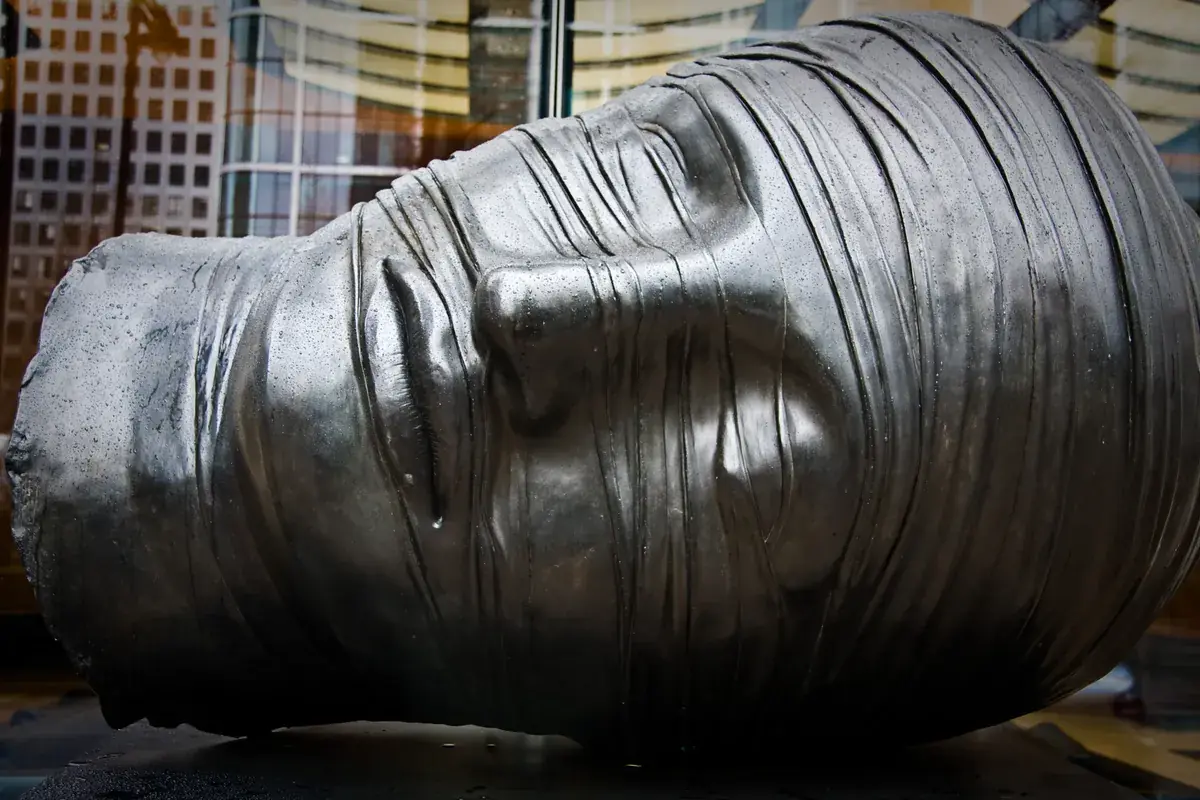
Igor Mitoraj in London
London holds three confirmed permanent Mitoraj bronzes — all at Canary Wharf, the financial district in east London developed from the 1980s onwards. The collection spans from 1983 to the 2000s and includes one of Mitoraj's earliest documented monumental works, a Centurione I casting, and an Eros Bendato. Together they form the most significant public Mitoraj presence in the United Kingdom.
London has a particular significance in Mitoraj's British reception. His 1994 placement of Tsuki-no-hikari in front of the British Museum — part of the "Time Machine" exhibition curated by James Putnam — was the start of a long relationship between the artist and British institutional collectors. In 2014, just months before his death, ContiniArtUK opened its Mayfair gallery with a major retrospective. Notable British collectors of Mitoraj include TRH Prince and Princess Michael of Kent.
Testa Addormentata (Sleeping Head) — 1983
Testa Addormentata — the Sleeping Head — is among the earliest of Mitoraj's monumental bronze works to enter a permanent public collection. Cast in 1983, just a few years after Mitoraj had definitively committed to sculpture at the Pietrasanta foundries, it predates the Centurione series and shows an earlier, more directly classical approach to the fragmented head subject. The surface is smooth, the form more complete than the bandaged, excavated heads of the 1980s and 1990s — yet the same preoccupations are already present: the closed eyes, the sense of a consciousness withdrawn from the world, the monumental scale applied to something intimate and inward.
The Canary Wharf development — which transformed the derelict West India Docks into London's second financial centre through the late 1980s and 1990s — made a deliberate commitment to public art as part of its identity. The Testa Addormentata was acquired as part of this programme, placing Mitoraj's work in daily contact with the tens of thousands of workers and visitors who pass through the estate.
Centurione I — Permanent
Centurione I at Canary Wharf is a monumental casting of the series that became Mitoraj's most recognisable subject worldwide. First created in 1987 in an edition of 250 (desktop scale), the Centurione I subject was subsequently cast in larger and monumental formats for public collections. The Canary Wharf example is a significant permanent installation, positioned within the estate's public realm.
The Centurione — the face of a Roman soldier, helmeted, fragmented, with the eyes absent or sealed — resonated particularly with the corporate architectural context of Canary Wharf. The fragment of ancient authority placed among the glass towers of modern finance creates a visual argument about the continuity of power, its limits, and its costs.
See also: Full Centurione series guide · Centurione II
Eros Bendato (Bound Eros) — Permanent
Eros Bendato — Bound Eros — is one of Mitoraj's most celebrated subjects: the face of the god of love, eyes bandaged, bound and blinded. The subject appears across his entire career in multiple scales and editions, from the monumental Kraków installation in Rynek Główny to smaller collector editions. The Canary Wharf example is a permanent installation within the public estate.
The bandaging of Eros — the binding of love, of desire, of the sensory — is one of Mitoraj's most legible symbolic gestures. In the context of a financial district, the image of Eros blinded acquires a specific irony that the artist almost certainly intended: the city that runs on appetite, placed next to the god of desire, rendered sightless.
See also: Full Eros Bendato guide — buy & sell · Eros Bendato in Kraków
Canary Wharf's Mitoraj Collection in Context
The three Mitoraj works at Canary Wharf form the most concentrated public collection of his bronzes in the UK. They were acquired across different phases of the Canary Wharf development, with the Testa Addormentata predating the main development surge and the Centurione and Eros Bendato arriving as the estate matured. The Canary Wharf Group, which manages the estate, has maintained a consistent commitment to major international sculpture — Henry Moore, Antony Gormley, and Pierre Vivant are among the other artists represented in the permanent collection.
For visitors, all three Mitoraj works are accessible as part of Canary Wharf's public realm, which is freely open daily. The estate is best accessed via the Jubilee line (Canary Wharf station) or the Elizabeth line (Canary Wharf station), with the DLR also serving the area.
The UK Mitoraj Collector Market
British buyers have been among the most consistently active in the international Mitoraj secondary market. Christie's, Sotheby's, and Bonhams London have all achieved strong results for Centurione, Persée, and Eros Bendato bronzes. The UK market particularly favours the smaller desktop editions — Centurione I and II, Tête Secrète, Kea — which circulate through both the major auction houses and specialist dealers.
If you are based in the UK and own a Mitoraj work — bronze, marble, lithograph, or drawing — I buy directly and privately. I respond to every enquiry personally within 24 hours and handle all transactions with complete discretion.

Mitoraj's relationship with the London market deepened considerably through the 1990s and 2000s, when his works began appearing regularly at major auction houses including Sotheby's and Christie's. Bronze casts of recurring subjects — Eros Bendato, Testa di Icaro, and the various Centurione variants — achieved consistent results that positioned him firmly within the upper tier of European figurative sculpture on the secondary market. Editions were typically cast in limited numbers at the Pietramar foundry in Pietrasanta, with certificates issued directly through Mitoraj's studio, a provenance detail that serious buyers have learned to verify carefully given the complexity of his edition structures. The London trade also played a role in introducing Mitoraj to a generation of British private collectors beyond the institutional sphere: works acquired through West End dealers in the 1990s have since appeared at regional auction houses, suggesting a broader geographic dispersal than the public record alone indicates. ContiniArtUK, which represented Mitoraj in the United Kingdom from the early 2000s and maintained close ties with his Pietrasanta studio, remains one of the primary reference points for British collectors seeking authentication documentation or provenance research on works that passed through the London market during his lifetime.
Mitoraj's relationship with the London market deepened considerably through the auction houses during the 2000s and 2010s, with Sotheby's and Christie's both handling significant bronze editions as secondary-market interest matured. Works such as Ikaro and Perseo achieved consistent results in the £80,000–£350,000 range depending on scale and casting provenance, reflecting the premium placed on pieces cast at the Fonderia Mariani in Pietrasanta under Mitoraj's direct supervision. The edition structure of his bronzes — typically numbered in small runs of six to nine, often with artist's proofs — has made provenance documentation particularly important to British institutional and private buyers, who increasingly sought certificates tracing a work's casting date and foundry records. The ContiniArtUK gallery, having established its Mayfair presence in 2014, continued to represent the estate after Mitoraj's death in October of that year, maintaining a stock of works and facilitating loans to British institutions. This sustained commercial presence distinguished London from other major European cities, where Mitoraj's public visibility was often greater — Paris, Rome, and Kraków each hold larger concentrations of his work — but where the private collector infrastructure was less formally organised around a single dedicated representative. For collectors researching acquisition, it is worth noting that Canary Wharf's public art programme retains acquisition records and condition reports for its permanent collection, making the three London bronzes among the better-documented Mitoraj works in public ownership in the United Kingdom.
Mitoraj's relationship with the British market deepened considerably through the 1990s and 2000s, with his works appearing at major London auction houses including Sotheby's and Christie's, where bronzes from the Eros Bendato and Perseo series have consistently attracted strong bidding from European and Middle Eastern collectors. The secondary market for Mitoraj in London reflects a broader pattern: works in larger editions, particularly the smaller table-scale bronzes such as Tindaro Screpolato and Ala di Notte, circulate relatively frequently, while the monumental unique or low-edition castings — comparable to those held at Canary Wharf — rarely reappear once placed. His London gallerist presence was further consolidated when ContiniArtUK, which had represented Mitoraj exclusively in the UK for several years before the 2014 Mayfair opening, facilitated a number of significant private placements into country estates and corporate collections across England and Scotland. The gallery's Cork Street premises, where Mitoraj exhibitions had been held in earlier years, introduced his work to a generation of British collectors who had not encountered the large-scale public installations in Pompeii or Pietrasanta. For serious collectors approaching the London market, provenance documentation and casting certificates from the Pietrasanta foundries — principally the Fonderia Mariani — remain the critical authentication reference, particularly as the volume of unauthorised reproductions of well-known Mitoraj compositions entering the European market increased noticeably after his death in October 2014. The Estate, managed from Pietrasanta, has worked to maintain catalogue raisonné standards, though a comprehensive published catalogue covering the full monumental
Mitoraj's relationship with the London market deepened considerably through the 1990s and 2000s, driven in part by the championing of major auction houses and specialist dealers who recognised the crossover appeal of his work to collectors rooted in both classical antiquity and contemporary bronze sculpture. Christie's and Sotheby's London have handled multiple Mitoraj bronzes at auction, with Eros Bendato editions and Centurione castings consistently attracting competitive bidding from European and Middle Eastern buyers. The secondary market for his work is complicated by the existence of multiple foundry editions — typically numbered in small series, often cast at the Tommasi Foundry in Pietrasanta — and collectors are advised to scrutinise provenance documentation carefully, as the numbering conventions varied across different phases of his career. Beyond Canary Wharf, London institutions have hosted Mitoraj's work on a temporary basis at significant moments: the Tsuki-no-hikari placement at the British Museum in 1994 was followed years later by further loan exhibitions that circulated through regional British venues, extending his audience beyond the capital. The ContiniArtUK gallery, which opened on New Bond Street in Mayfair in 2014, became the primary point of access for British collectors seeking authenticated works directly through a gallery relationship, offering both bronze editions and Mitoraj's lesser-known works on paper, which command a distinct and somewhat undervalued segment of the market. His drawings — executed in a confident, archaeological draughtsmanship that mirrors the excavated quality of his sculpture — are regarded by specialists as an important complement to the three-dimensional work, and several British private collections hold examples acquired through the Contini network. For collectors approaching the London market today
Mitoraj's relationship with the London market deepened considerably through the 1990s and 2000s, with Sotheby's and Christie's both handling significant secondary-market transactions of his bronzes during this period. His works have consistently performed well at auction in the United Kingdom, with larger casts of the Eros Bendato and Centurione series attracting particular attention from European private collectors who regard London as the natural marketplace for postwar and contemporary figurative sculpture. The Mayfair gallery presence established by ContiniArtUK — which had represented Mitoraj during the final decade of his life — gave London a focal point for the primary market that had previously been centred on Paris and Milan, and the gallery's ongoing programme of Mitoraj exhibitions has helped sustain institutional awareness of the work after his death in October 2014. Among the British institutions that have engaged seriously with Mitoraj's legacy, the British Museum occupies a specific place: the 1994 collaboration with curator James Putnam, which placed Tsuki-no-hikari on the museum's forecourt, was documented in Putnam's broader work on the dialogue between contemporary artists and ancient collections, situating Mitoraj within a lineage of artists — including Eduardo Paolozzi — who engaged directly with the museum's classical holdings. Mitoraj himself spoke of the Greek and Roman galleries at the British Museum as formative for his understanding of fragmentation not as destruction but as archaeology — the idea that a broken figure retains its meaning precisely because the imagination completes what the stone or bronze cannot. This reading of classical ruins as a generative rather than mournful tradition underpins the Canary Wharf works, where the fragmentary bronzes are
Mitoraj's relationship with the British market deepened considerably through the 1990s and into the 2000s, driven in part by sustained interest from auction houses and private dealers operating in London. Sotheby's handled several significant Mitoraj bronzes during this period, with works appearing across both their London and international sale rooms; a casting of Eros Bendato achieved notable results in the early 2000s, helping establish a clearer secondary market price framework for the edition bronzes that collectors and institutions rely upon today. The Pietrasanta foundry system — principally the Fonderia Mariani, with which Mitoraj maintained a long working relationship — produced works in controlled editions, typically of six to nine casts, meaning that multiple institutional and private owners can hold legitimate examples of the same title. This matters particularly for London-based collectors assessing provenance: a bronze carrying foundry stamps, edition numbers, and documentation traceable to Mitoraj's Pietrasanta studio carries substantially different weight than unnumbered or undocumented casts that have occasionally appeared on the market. The Art Loss Register, based in London, has been used by reputable dealers handling Mitoraj works to provide additional due diligence clearance, a practice that became more standard across the Italian sculpture market following several high-profile disputes in the 2000s. Beyond Canary Wharf, private Mitoraj holdings in Britain are concentrated among collectors who acquired works directly through ContiniArtUK or through the artist's own studio sales in Pietrasanta and Paris, with a smaller number entering British collections via Italian dealers exhibiting at Masterpiece London and similar fairs during the 2010s. The relative scarcity of Mitoraj's monumental works — as distinct from smaller table bronzes and
Mitoraj's relationship with the London market deepened considerably through the auction houses during the 2000s and 2010s, with Sotheby's and Christie's both handling significant bronze editions that have helped establish reliable price benchmarks for serious collectors. Works on paper — the large-format pastels and drawings Mitoraj produced in parallel with his sculpture, often depicting the same fragmented classical subjects — have attracted particular attention at auction, sometimes outperforming estimates when fresh to the market. His bronzes, typically cast in editions of seven or eight with two artist's proofs, follow a consistent pattern: smaller works such as Tindaro Screpolato and Eros Bendato in tabletop scale have traded in the £40,000–£120,000 range depending on patina, casting quality, and provenance, while monumental single casts or low-edition large works command multiples of that figure. The Canary Wharf bronzes, as unique or near-unique civic commissions rather than standard edition pieces, sit outside the auction market entirely, their value tied to the estate, the Fondazione Mitoraj in Pietrasanta, and the specific institutional arrangements that govern public art in the United Kingdom. The Fondazione, established to preserve and document Mitoraj's legacy following his death in October 2014, has been active in authenticating works and maintaining the catalogue raisonné — a resource of direct relevance to any collector conducting due diligence before acquisition. Pietrasanta itself, the Tuscan town where Mitoraj spent much of his working life and where he is buried in the church of Sant'Agostino, has become a site of pilgrimage of sorts for collectors and admirers; several of his large bronzes
Mitoraj's relationship with the London market deepened considerably through the auction houses during the 2000s and 2010s, with Sotheby's and Christie's both handling significant bronze casts that established reliable secondary-market benchmarks for his work. A casting of Eros Bendato sold at Sotheby's London in 2008 achieved a result that confirmed the edition's standing among his most commercially durable subjects — a position it has held across subsequent sales. The market distinguishes carefully between edition sizes and foundry periods: bronzes cast at the Fonderia Mariani in Pietrasanta during Mitoraj's most active decades, typically identifiable by their patination and foundry stamps, command a consistent premium over later posthumous castings authorised by the estate. For London-based collectors, provenance tracing back to ContiniArtUK or to earlier placements through the Marlborough Gallery — which handled Mitoraj's work in Britain during the 1990s — has historically provided an additional layer of institutional confidence. Beyond Canary Wharf, there are privately held Mitoraj bronzes in a number of notable London residences and at least one significant casting recorded in a City institution's corporate collection, though these remain undisclosed at the owners' request. The scale of works that entered British collections during the 1990s reflects the period's broader appetite for Italian figurative sculpture among a generation of collectors who had encountered Mitoraj's work either through his gallery exhibitions or through the growing visibility of his large-scale placements in European public spaces — Pompeii, Agrigento, Paris — that generated sustained press coverage in British broadsheets through the decade. Testa di Medusa and Centurione
Own a Mitoraj Work in the UK?
Send me a photograph. I respond personally within 24 hours — directly, discreetly, without intermediaries.
Свържете се с Мен ДиректноSee also: Centurione series · Eros Bendato · All cities worldwide · Interactive Europe map
За тази колекция
This site documents one private collector's search for works by Igor Mitoraj (1944–2014) — the Polish-French sculptor celebrated for his fractured classical figures in bronze and marble. Mitoraj studied in Kraków under Tadeusz Kantor, trained in Paris at the École nationale supérieure des beaux-arts, and established his permanent studio in Pietrasanta, Tuscany in 1983. His work is held in public collections across Europe and the Americas, and his auction record — €6.89 million for a monumental Tindaro Screpolato at Sotheby's Paris in 2019 — places him among the most sought-after post-war European sculptors. If you have a Mitoraj work available, please use the contact button to get in touch.