
~20 min read
Igor Mitoraj in Milan

to open WhatsApp — then
send photos directly.
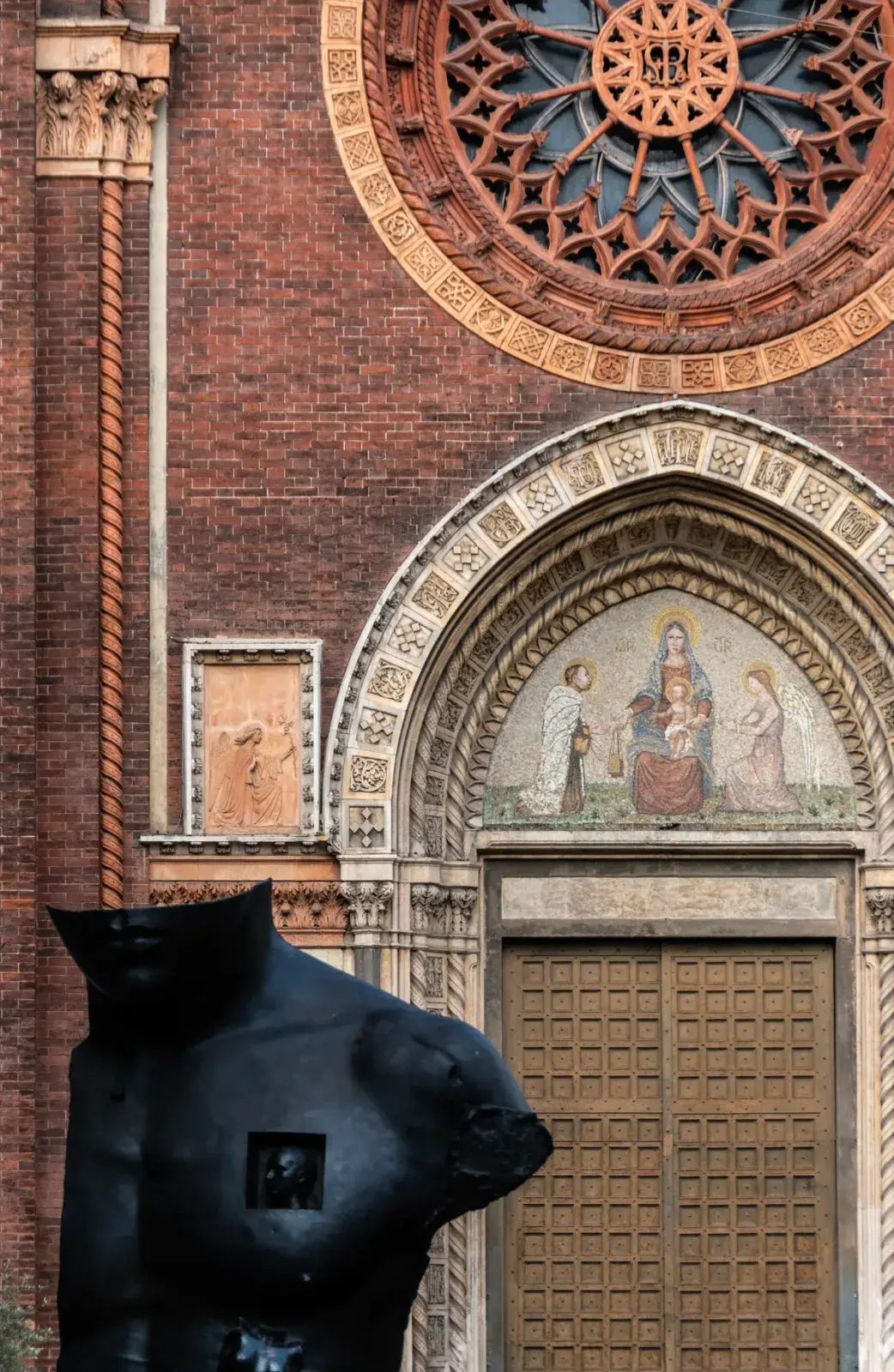
Milan holds two confirmed permanent Mitoraj presences — a monumental torso in the courtyard of Piazza del Carmine, in the Brera neighbourhood, and works associated with Teatro alla Scala, the world's most famous opera house. Milan's relationship with Mitoraj was shaped both by its position as Italy's contemporary art market capital and by the city's long tradition of integrating significant sculpture into its urban fabric. For a sculptor who worked at the intersection of ancient mythology and modern aesthetics, Milan — where fashion, finance, and culture converge — was a natural and significant presence.
Milan was the first Italian city to embrace Mitoraj's work in the public realm. Grande Toscano has stood at Piazza del Carmine since 1986 — nearly four decades — making it one of the longest-standing permanent Mitoraj installations anywhere in the world. Over the years it has become genuinely embedded in Milanese urban life: a meeting point, a recognised landmark. The connection runs deep: Mitoraj also worked with Teatro alla Scala on set designs, and several major Milanese companies including Trussardi and Agusta held his works in their collections.
Monumental Torso — Piazza del Carmine · Permanent
The monumental torso at Piazza del Carmine is one of three casts of the same work, placing it in the rarest tier of Mitoraj's monumental editions. Where the large public bronze editions ran to 250 or more examples, a three-cast monumental work is closer to a unique piece than to a multiple — each of the three owners holds something genuinely singular.
Piazza del Carmine is a quiet residential square in the Brera neighbourhood — Milan's historic artists' quarter, home to the Pinacoteca di Brera and surrounded by galleries, antique dealers, and design studios. It is one of the most culturally concentrated neighbourhoods in Italy, and placing a major Mitoraj torso there puts his work in permanent conversation with one of the densest concentrations of Italian artistic heritage in the country.
The torso subject — the classical figure reduced to its trunk, the arms and head absent, the body presenting itself as pure form — is among Mitoraj's most sustained preoccupations. Where the Centurione series focuses on the face and the act of looking, the torso series focuses on the body as structure: the architecture of muscle and bone, the volume of the human form when stripped of its identifying features. In monumental scale, a torso becomes architectural — a building-scale object that reorganises the space around it.
The Piazza del Carmine installation is accessible as part of the public square and can be visited freely at any time.
Teatro alla Scala — Works Associated
Teatro alla Scala — La Scala — is the most celebrated opera house in the world, and its permanent art collection and institutional spaces have included Mitoraj works as part of the cultural fabric of the institution. La Scala's association with Mitoraj reflects both the alignment between his mythological subjects — drawn from the same Greek and Roman sources that underpin the opera repertoire — and his position as the pre-eminent Italian sculptor of his generation despite his Polish origins.
Opera and Mitoraj's sculpture share a repertoire: Orpheus, Daedalus, Prometheus, Eros, the figures of classical antiquity who people both the operatic stage and his foundry in Pietrasanta. The Scala connection places his bronzes in a context where the myths they embody are performed in their most elaborate form nightly during the season.
La Scala is located on Piazza della Scala in central Milan, directly adjacent to the Galleria Vittorio Emanuele II and a short walk from the Duomo. The Museo Teatrale alla Scala, which occupies part of the building, is open to visitors and houses a significant collection of objects relating to the history of opera and the performing arts.
Milan & the Italian Mitoraj Market
Milan is the engine of the Italian art market. The major Italian auction houses — Wannenes, Pandolfini, Il Ponte, Finarte — all operate from Milan or with strong Milan presences, and the city's collector base has been consistently active in the Mitoraj secondary market since the 1980s. Italian buyers, particularly Milanese collectors, were among the first to recognise Mitoraj's significance — in part because his studio in Pietrasanta made him effectively an Italian sculptor, and in part because the design-conscious Milanese aesthetic found his fusion of classical form and contemporary fragmentation immediately legible.
The Milanese collector market for Mitoraj centres on the bronze editions — Centurione, Persée, Tête Secrète, Eros Bendato — and on works on paper, particularly lithographs and sanguines, which circulate through the city's dense network of specialist galleries. If you are based in Milan and own a Mitoraj work, the collector base here means you have options: auction, private sale, or direct sale to another collector. I buy directly, without commission, and respond to every enquiry within 24 hours.
Brera & the Mitoraj Context
The Brera neighbourhood deserves its own note as a context for the Piazza del Carmine installation. The Pinacoteca di Brera — Milan's great state art gallery, housed in the Palazzo di Brera a few hundred metres from Piazza del Carmine — contains Mantegna's Dead Christ, Raphael's Marriage of the Virgin, Caravaggio's Supper at Emmaus, and Piero della Francesca's Brera Madonna. These are works that share with Mitoraj a preoccupation with the human body under extreme conditions — sleeping, dying, transfigured — and with the capacity of classical form to carry symbolic weight.
To walk from the Pinacoteca di Brera to Piazza del Carmine and encounter Mitoraj's monumental torso is to make a short journey between two registers of the same obsession. It is one of the more quietly rewarding experiences available to the Mitoraj collector or enthusiast visiting Italy.
The Brera placement carries particular significance within Mitoraj's commercial biography. The district's concentration of private galleries — notably including Galleria Blu, which represented Mitoraj in Italy across several decades — meant that Grande Toscano functioned as something close to a permanent advertisement in the heart of the city's serious art market. Collectors who visited Brera's dealers in the late 1980s and through the 1990s would have encountered the torso repeatedly, and gallery records from the period suggest that a disproportionate share of Italian private acquisitions during those years originated with buyers based in or regularly visiting Milan. The works that entered Milanese collections during this period tend to be bronzes from the middle tier of the edition structure — works in the range of seven to twelve casts — rather than the very large monumental pieces, reflecting both the practical constraints of urban apartment and villa settings and the preference of Milanese collectors for works that could be handled, insured, and if necessary sold through the city's established auction infrastructure. Sotheby's and Christie's both conducted significant Mitoraj sales in Milan before consolidating their Italian operations into Florence and Rome respectively, and several important works changed hands through those rooms. For a collector researching provenance on a Mitoraj bronze with a documented Italian ownership history prior to 2005, a Milanese origin — whether through Galleria Blu or private treaty — is a strong indicator of early and serious acquisition rather than later speculative buying.
The Brera district's significance to Mitoraj extends beyond the placement of Grande Toscano in Piazza del Carmine. Throughout the 1980s and 1990s, several of the galleries concentrated along Via Brera and Via Solferino were among the first Italian commercial spaces to represent his work, introducing the sculptor to the Milanese collector base at a moment when his international reputation was still forming. Galleria Blu, one of Milan's most historically important postwar galleries, showed Mitoraj's bronzes during this period, helping to establish the market vocabulary — monumental scale, patinated bronze, mythological fragmentation — that would define his commercial identity for the following three decades. Milan's collectors, many of them drawn from the fashion and industrial dynasties that characterise the city's wealth, responded particularly to the works in which classical references were most legible: winged heads, truncated torsos, masked faces. These were buyers already comfortable with scale and with the idea of sculpture as architectural counterpoint, whether in corporate headquarters, private gardens, or the kind of substantial historic apartments that characterise the Brera and Magenta neighbourhoods. The secondary market for Mitoraj bronzes remains notably active in northern Italy, with Milan functioning as an informal hub: auction results from Cambi and Il Ponte — both houses with significant presences in the city — show consistent demand for works from the 1980s and early 1990s, the period when his formal language was most concentrated and before the very largest public commissions shifted attention toward spectacle over refinement. For collectors assessing the market today, works documented with early Milanese exhibition provenance carry a particular resonance, connecting a specific object to the moment the sculptor's relationship with the city was first being established.
Mitoraj's relationship with the Milanese market extended well beyond public commissions. Throughout the 1990s and into the 2000s, his bronzes appeared regularly at the major Italian auction houses — Finarte and Sotheby's Milan among them — where works on paper and smaller cast pieces established a consistent secondary market for Italian collectors before his international auction profile solidified. The Brera placement of Grande Toscano was itself a signal moment: public sculpture commissions in Milan during the mid-1980s were rare, and the selection of a living Polish-born artist working in Pietrasanta represented a significant institutional endorsement at a time when Mitoraj was still consolidating his European reputation. Collectors who acquired works in the years immediately following that 1986 installation — particularly the medium-format bronzes produced at the Tommasi Foundry in Pietrasanta — were entering at a moment of genuine critical momentum. The Pietrasanta connection matters for provenance purposes: works cast there carry documentation traceable through the foundry's own records, which remain a key reference point for authentication. Mitoraj divided his time between Pietrasanta and Paris for much of his mature career, and the Italian works — especially those produced between 1985 and 1995 — are considered by specialist dealers to represent the most technically refined period of his bronze casting. His Milanese collectors tended to come from the fashion and industrial design sectors rather than from traditional fine art patronage, which partly explains why several significant private holdings have remained discreet and have rarely appeared at auction. The Agusta collection, for instance, was assembled with a deliberate preference for works that functioned within architectural interiors rather than as standalone gallery pieces — a collecting philosophy that reflects how Mitoraj's sculpture was understood in Milan: not as an autonomous gallery object to be appraised in isolation, but as a sculptural element that took on its full meaning only in dialogue with the architectural interiors of the homes, offices, and design studios in which it was placed.
Mitoraj's relationship with the Milanese art market extended well beyond single commissions. Galleria Tega, one of Milan's most respected dealers in modern and contemporary sculpture, represented his work during key periods of his career and placed pieces with significant northern Italian collectors throughout the 1980s and 1990s. This distribution network meant that Lombardy became one of the densest concentrations of privately held Mitoraj bronzes anywhere outside France and Poland — works that rarely appear at auction because they tend to pass between collectors directly or through estate transfers. The medium-format bronzes that circulated through Milan during this period — pieces such as Eros Bendato and Perseo in their smaller editions — now represent some of the most actively sought Mitoraj works on the secondary market, precisely because their provenance is so often traceable to named collections rather than anonymous trade. Mitoraj himself maintained a close working relationship with the city's cultural institutions beyond La Scala: he collaborated with the Piccolo Teatro di Milano on production design in the early 1990s, and his work featured in group exhibitions at Palazzo Reale that positioned him alongside artists such as Arnaldo Pomodoro and Emilio Greco in the context of Italian figurative tradition. That framing — situating Mitoraj within a lineage of Italian sculpture despite his French-Polish origins — was largely a Milanese critical construction, and it significantly shaped how his market developed in Italy compared to how collectors in France or the United States approached his work. For collectors researching provenance today, Milan-connected pieces often carry documentation from the Galleria Tega archive or from the offices of Mitoraj's Italian representative, Galleria 128, which issued certificates that are now treated as the benchmark authentication standard for works from the artist's mature Italian period, and which secondary-market specialists routinely cite when establishing provenance for bronzes that pass through Milanese auction or private treaty channels.
The Brera placement of Grande Toscano was not incidental. By the mid-1980s, Mitoraj had established his principal studio in Pietrasanta, the Tuscan marble town where he would work for the remainder of his life, and his relationship with northern Italian collectors and institutions was intensifying rapidly. The 1986 installation at Piazza del Carmine coincided with a period in which Mitoraj was moving decisively from gallery representation toward civic and institutional commissions — a shift that would define the second half of his career. His Milanese gallerist during this formative period was Paolo Sprovieri, whose programme helped position Mitoraj within the serious collecting circles that converged on Milan's Brera and Montenapoleone districts. It was through these networks that works entered the Trussardi and Agusta collections, both of which were acquiring significant contemporary sculpture during the same decade. The market context matters for collectors: Mitoraj bronzes placed in distinguished corporate or civic collections before 1990 carry a demonstrably different provenance trajectory than later editions, and the three-cast limit on monumental works means that auction appearances are genuinely rare events rather than periodic catalogue fixtures. The second and third casts of the Piazza del Carmine torso have appeared in major European sales on only a handful of occasions since the work was editioned, and each appearance has attracted institutional as well as private bidding. Beyond the bronze works, Milan retains a distinct place in Mitoraj's theatrical legacy. His collaboration with Teatro alla Scala extended to set and costume designs for productions staged during the 1990s, work that placed him alongside a lineage of visual artists — from Giorgio de Chirico to Lucio Fontana — who contributed to the visual identity of La Scala and the wider Milanese stage tradition, situating his theatrical work within a recognisably twentieth-century Italian genealogy of artist-designers operating between the gallery and the proscenium.
Mitoraj's relationship with the Milanese art market deepened considerably through the 1990s and into the 2000s, a period during which several of the city's most significant private galleries — including Galleria Tega, which operated from Via Manzoni and handled works by major European sculptors — facilitated the placement of bronzes with collectors across Lombardy and the Veneto. The works that entered Italian private hands during this period tend to be mid-scale bronzes from the 1980s and early 1990s: heads, fragments, and winged figures in editions that typically ran between eight and twelve casts, signed and numbered on the base. These are now among the most actively traded Mitoraj works at auction, with Italian houses including Pandolfini in Florence and Finarte in Milan having handled multiple examples over the past decade. Condition reports from these sales consistently note the distinctive green-brown patination that Mitoraj developed in collaboration with his Pietrasanta foundry, Fonderia Mariani — a surface treatment that deepens with age and distinguishes authentic bronzes from later restrikes or unauthorised casts, which have occasionally surfaced in secondary markets. Collectors assessing a Mitoraj bronze from this period should verify the foundry stamp, the edition numbering, and — where available — the original certificate issued through the Mitoraj studio or his principal Italian representative. Works that passed through established Milanese collections carry additional provenance weight, particularly given the sculptor's documented personal engagement with clients and institutions in the city during his most commercially active years. It is worth noting that Mitoraj maintained a working studio in Pietrasanta throughout this period, and his visits to Milan for openings, theatre productions, and client meetings were regular enough that several bronzes in private Milanese collections carry personal dedications inscribed by the sculptor on the base or on the accompanying certificate — a small but significant provenance detail that has become a reliable marker of works acquired directly through Mitoraj's own studio relationships in the city.
The bronze at Piazza del Carmine belongs to a body of work Mitoraj developed during the late 1970s and 1980s that drew explicitly on the Hellenistic tradition of the fragmentary figure — torsos, heads, and limbs rendered incomplete not through damage but by intention, as a philosophical and aesthetic statement about the relationship between ruin and beauty. This period coincided with Mitoraj's deepening engagement with Italy itself: he had established his studio in Pietrasanta, the Tuscan marble town that had served sculptors from Michelangelo onward, and it was there that the foundational language of his mature work took shape. The Pietrasanta connection matters to collectors because it situates Mitoraj within a very specific lineage of craft and material seriousness — his bronzes were cast and finished in ateliers with centuries of accumulated expertise, and the quality of patination and surface work on pieces from this period reflects that context directly. Within the Milan art market, Mitoraj's standing has remained consistently strong at auction, with major bronzes from the monumental and large-scale editions regularly appearing at the Italian houses and at Sotheby's and Christie's European sales. Works from the three-cast monumental tier, such as the Piazza del Carmine piece, rarely enter the secondary market at all — when they do, provenance documentation and cast numbering become critical factors in valuation, and the existence of a confirmed permanent public installation of the same edition provides useful comparative evidence for any appraisal. Beyond the Milanese corporate collections already noted, the city's role as a hub for Mitoraj's market was reinforced by the Galleria Blu, which represented his work in Italy during key years of his career and helped establish the collector base that would sustain demand across subsequent decades.
Mitoraj's relationship with the Milanese market extended well beyond the institutions and corporate collectors already noted. Throughout the 1980s and 1990s, the city's network of private galleries played a measurable role in establishing his secondary market value in Italy, with Galleria Blu — one of Milan's most respected post-war and contemporary spaces, active on Via Senato — among those that handled his bronzes during the period when his international reputation was consolidating. Auction data from that era reflects a market that was already stratified by scale and edition size: smaller cabinet bronzes such as Testa di Centauro and Ala Spezzata circulated with relative frequency through Italian salerooms, while the monumental and large-format works effectively never appeared at auction, held instead by institutional buyers, major corporate collections, and the handful of private collectors who had acquired them directly through the foundry or through Mitoraj's own studio relationships. This distinction — between the liquid secondary market for smaller works and the near-total illiquidity of the monumental tier — remains one of the defining structural features of the Mitoraj market today, and it is one that serious collectors in Milan understood earlier than most, precisely because they had the Grande Toscano as a daily reference point for what a monumental Mitoraj actually represented in physical and cultural terms. The Brera location itself reinforced this understanding: a neighbourhood accustomed to calibrating the difference between decorative antiquarianism and serious collecting was well positioned to read Mitoraj's classicism as something other than nostalgia. His fragmented figures drew on Hellenistic and Roman sources, but the interruptions — the missing limbs, the bandaged eyes, the truncated forms — were unmistakably of their time, carrying the visual memory of twentieth-century rupture into a formal vocabulary borrowed from antiquity, and it was precisely this temporal doubling that the Brera collecting circle registered as the substance of his contemporary seriousness.
The three-cast limit on the Piazza del Carmine torso reflects a deliberate strategy that Mitoraj and his foundry partners — principally the Fonderia Artistica Battaglia in Milan and, for later works, the Fonderia Mariani in Pietrasanta — pursued with increasing discipline from the mid-1980s onward. Battaglia, one of the oldest bronze foundries in Italy, had worked with major twentieth-century sculptors including Giacomo Manzù, and its involvement with Mitoraj gave his Milanese output a direct lineage within Italian casting tradition. The relationship with Pietrasanta was equally significant: Mitoraj maintained a studio in that Tuscan town for much of his career, and the proximity to both marble quarries and specialist bronze foundries shaped not only his materials but the scale he was willing to attempt. By the time Grande Toscano was installed at Piazza del Carmine in 1986, Mitoraj had already attracted serious institutional attention in France, where the Galerie Enrico Navarra in Paris had become his primary commercial representative — a relationship that would define how his work reached collectors across Europe and, eventually, the Americas and Asia. Navarra's model was to maintain scarcity at the monumental scale while allowing more accessible editions in smaller formats, which is why a collector entering the market today will find a substantial range of bronzes in the thirty to sixty centimetre range — heads, fragments, winged figures — at prices beginning around €15,000 to €40,000 at reputable auction, while monumental works with documented provenance and low edition numbers trade at a fundamentally different level, often privately and without public price disclosure. The secondary market for Mitoraj has been handled most consistently by Christie's and Sotheby's at their London and Paris evening and day sales, with periodic appearances at Bonhams and at specialist Italian houses including Pandolfini in Florence, where editioned bronzes from the Pietrasanta years continue to set the pricing benchmarks for the broader market.
The bronze medium itself deserves attention for any serious collector approaching Mitoraj's work. Unlike many twentieth-century sculptors who delegated foundry relationships to intermediaries, Mitoraj maintained direct working partnerships with specific Italian foundries — most notably the Fonderia Artistica Ferdinando Marinelli in Florence and the Pietrasanta foundries of the Versilia coast, where he lived and worked from the early 1980s until his death in 2014. Pietrasanta, the small Tuscan town long regarded as the world capital of marble and bronze sculpture, gave Mitoraj proximity to artisans with generational expertise in lost-wax casting, and the relationship shaped not only his technical choices but the surface qualities that define his mature work. The distinctive patination on pieces like Grande Toscano — that particular depth of brown-green that reads differently in northern Italian light than it does in direct Mediterranean sun — was achieved through collaboration with foundry chemists over years of refinement, and it remains one of the most immediately recognisable signatures in postwar European bronze. For collectors, provenance that traces directly to the Pietrasanta foundries carries weight: it indicates works produced under Mitoraj's personal supervision rather than posthumous or estate-authorised casts made after 2014. The secondary market has reflected this distinction with increasing clarity since roughly 2018, when auction results began diverging noticeably between works with documented foundry provenance and those without it. Christie's, Sotheby's, and Bonhams have all handled significant Mitoraj bronzes in the intervening years, with hammer prices for monumental works in the range of documented lifetime casts consistently outperforming comparable pieces where foundry documentation was incomplete. The three-cast edition structure of the Grande Toscano torso — three monumental bronzes plus a small number of artist's proofs — means that any single appearance of the work at auction is genuinely exceptional rather than routine, and each such appearance has historically attracted both institutional and private bidding.
The Brera district's particular significance to Mitoraj extends beyond the placement of Grande Toscano in Piazza del Carmine. Throughout the 1980s and into the 1990s, the neighbourhood's concentration of serious private galleries made it one of the primary points of entry for collectors acquiring Mitoraj's smaller bronzes — the medium-format works such as Tindaro, Eros Bendato, and the various Perseo variants that were circulating through the Italian market during that period. Galleria d'Arte Niccoli, operating out of Parma but with strong Milanese collector relationships, handled a number of these placements, and the Brera galleries were consistent venues for the kind of introductory encounters that turned Milanese fashion and finance figures into serious Mitoraj collectors over the following decades. The city's collecting culture in that era was notably different from Rome's or Florence's: Milan rewarded contemporary work that carried historical weight without archaeological earnestness, and Mitoraj's fragmented classical figures — heads truncated at the brow, torsos ending mid-chest, limbs absent not through damage but through apparent intention — matched that sensibility precisely. Collectors in the Milanese corporate world, accustomed to commissioning work that needed to function both aesthetically and as a statement of institutional seriousness, found in Mitoraj a sculptor who could satisfy both demands simultaneously. The Agusta collection, assembled by the aerospace and helicopter manufacturing group headquartered in Cascina Costa di Samarate just northwest of Milan, was among the more substantial Italian corporate holdings of his work, and its existence points to a broader pattern: Mitoraj's bronzes entered Lombard boardrooms and executive headquarters with notable regularity through the 1980s and 1990s, becoming a quietly conventional signal of cultural seriousness among the region's industrial and fashion houses well before his international auction profile fully consolidated.
The broader Milanese market context helps explain why Grande Toscano arrived in the city when it did. By the mid-1980s, Mitoraj had already established a significant commercial relationship with Galerie Marwan Hoss in Paris, which handled much of his European placement, but Italian collectors — particularly those operating within Milan's design and fashion industries — had begun acquiring his bronzes with notable consistency through the early part of that decade. The gallerist Giorgio Marconi, whose Studio Marconi on Via Tadino had been one of the most influential contemporary spaces in Italy since the late 1960s, played a meaningful role in introducing Mitoraj's work to the Milanese collecting community during this period, situating the sculptor alongside Italian and international artists whose practices engaged seriously with classical form. This institutional backing mattered: Milan's serious collectors of that era were not simply buying decorative objects but were making considered statements about where contemporary sculpture could go after the conceptual turn of the 1970s, and Mitoraj's fragmented, mythologically charged figures offered a credible and visually powerful answer. The Trussardi Foundation's early acquisition of Mitoraj's work was consistent with the broader pattern of northern Italian luxury brands treating art collecting as an extension of cultural identity rather than mere patronage — a distinction that shaped which artists received sustained institutional attention and which did not. Mitoraj received sustained attention. His smaller bronzes, works in the scale of thirty to sixty centimetres, were particularly sought after by Milanese private collectors through the late 1980s and into the 1990s, partly because they could function as serious sculptural statements within domestic or corporate interiors without requiring the spatial commitments that his monumental editions demanded. Pieces such as Tindaro, the fragmentary head editions, and the smaller winged torso variants circulated through this market segment with particular consistency, offering Milanese buyers the recognisable Mitoraj vocabulary at a scale that suited apartment libraries, design studios, and corporate reception spaces.
The Brera neighbourhood's specific character as Milan's primary art district makes Piazza del Carmine a more considered placement than it might initially appear. Throughout the 1980s, Brera functioned as the centre of gravity for the Italian contemporary art market, with dealers such as Galleria Blu and Galleria Annunciata maintaining presences in the surrounding streets and attracting serious collectors from across Europe. When Grande Toscano was installed in 1986, Mitoraj was at a pivotal moment in his market trajectory: his 1983 exhibition at Galerie Enrico Navarra in Paris had established him firmly in the international gallery circuit, and Italian institutional interest was consolidating around a small group of sculptors who could work convincingly at architectural scale. The choice to place the work in a residential piazza rather than a commercial or civic plaza reflects a curatorial instinct that has aged well — Grande Toscano was not positioned as a statement piece demanding attention but as something closer to a permanent resident of the neighbourhood, indifferent to the rhythms of the art market around it. This understated approach to siting is consistent with how Mitoraj's most successful permanent installations function elsewhere: Ikaro at the Piazza della Repubblica in Florence, and the works placed within the archaeological zones of Pompeii and Agrigento, all share a quality of apparent belonging rather than imposition. The three-cast edition structure of the Piazza del Carmine work deserves particular attention from a collector's perspective. Mitoraj's monumental bronzes were produced through a small number of specialist Italian foundries, principally in the Pietrasanta area of Tuscany — the town that became his permanent base from the mid-1980s onward, and where the proximity of marble quarries and bronze foundries gave his monumental editions a technical coherence that distinguished them from work produced at greater remove from the artist's direct supervision.
The Brera placement of Grande Toscano situates the work within a neighbourhood that has functioned as Milan's gravitational centre for the secondary art market since the postwar period, and the sculpture's proximity to the auction infrastructure that developed along Via Brera and its surrounding streets is not incidental to understanding how Mitoraj's market position consolidated in Italy through the 1980s and 1990s. Christie's, Sotheby's, and the major Italian houses — Finarte and Porro among them — all handled Mitoraj bronzes during this period, and works placed visibly in Milanese civic space functioned as a form of credential that informed collector confidence at auction. The pattern held consistently: documented civic placement in a recognised European city tended to anchor the biography of an edition and support price stability across subsequent resales. For collectors approaching Mitoraj works on the secondary market today, understanding this geography matters practically, because the provenance chain for many Italian-held works traces back to Milanese gallery relationships established in precisely this era. Galleria dello Scudo, though Verona-based, maintained active relationships with Milanese collectors throughout the 1980s and was among the galleries most responsible for placing Mitoraj's work with serious Italian buyers during the period when his monumental commissions were beginning to generate international attention. The Scala connection reinforced this positioning in a specific way: Mitoraj's set and costume designs for productions at the opera house — including work associated with productions staged during the late 1980s and into the 1990s — brought him into sustained contact with a category of Milanese patron whose collecting instincts were shaped by engagement with performance, architecture, and the applied arts rather than the gallery circuit alone. These collectors tended to acquire differently from pure fine art buyers:
Have questions about this work?
Ask the AI assistant — grounded in this collection's pages, replies in your language.
The broader Lombardy region became significant for Mitoraj's career trajectory during the 1980s and 1990s, a period when Italian collectors and institutions were reassessing the role of classical figuration within contemporary art discourse. Beyond Milan's urban installations, major private collections throughout the region accumulated his works, particularly among industrial families and fashion houses whose patronage extended to contemporary sculpture. The specificity of Mitoraj's approach — his insistence on bronze casting techniques rooted in Renaissance workshops, combined with his thematic engagement with fragmentation and the classical body — resonated deeply with Italian collectors who saw in his work a dialogue with their own artistic heritage rather than a departure from it. Collectors who acquired Mitoraj pieces during this period, whether as monumental bronzes or smaller works on paper, were often making deliberate statements about artistic continuity and the enduring relevance of figuration at a moment when conceptualism and minimalism dominated international discourse. The market for his work developed differently in Italy than in other European countries, with stronger institutional support and a more sophisticated understanding of his historical references. Italian galleries and auction houses recognized that Mitoraj's oeuvre functioned simultaneously as contemporary art and as a form of artistic archaeology — his fragmented torsos and classical references could be collected as serious contemporary work while also serving as aesthetic investments with deep roots in European sculptural tradition. Documentation from major Italian auction houses shows that Mitoraj works have consistently performed well in the secondary market, with bronze monumental editions and significant plaster studies commanding prices that reflect both their material value and their conceptual significance. The relationship between Mitoraj and the Italian art world was further strengthened by his participation in major exhibitions and art fairs, which gave collectors access to works and helped establish the critical frameworks through which his practice could be understood. For serious collectors today, understanding the Italian context of Mitoraj's
Own a Mitoraj Work in Italy?
I buy Mitoraj bronzes, marbles, lithographs and drawings directly — anywhere in Italy, with complete discretion and no intermediaries. Prompt response, fair price.
Any other Mitoraj work also welcome — any subject, condition, or format.
See also: Mitoraj in Rome · Mitoraj in Pompeii · Pietrasanta — studio & museum · All bronzes wanted · Interactive Europe map
About This Collection
This site documents one private collector's search for works by Igor Mitoraj (1944–2014) — the Polish-French sculptor celebrated for his fractured classical figures in bronze and marble. Mitoraj studied in Kraków under Tadeusz Kantor, trained in Paris at the École nationale supérieure des beaux-arts, and established his permanent studio in Pietrasanta, Tuscany in 1983. His work is held in public collections across Europe and the Americas. If you have a Mitoraj work available, please use the contact button to get in touch.
Interested in this work?
Inquire about this work →Thinking of selling a Mitoraj? See our dedicated sell page →