
~22 min read
Igor Mitoraj in Poznań

to open WhatsApp — then
send photos directly.
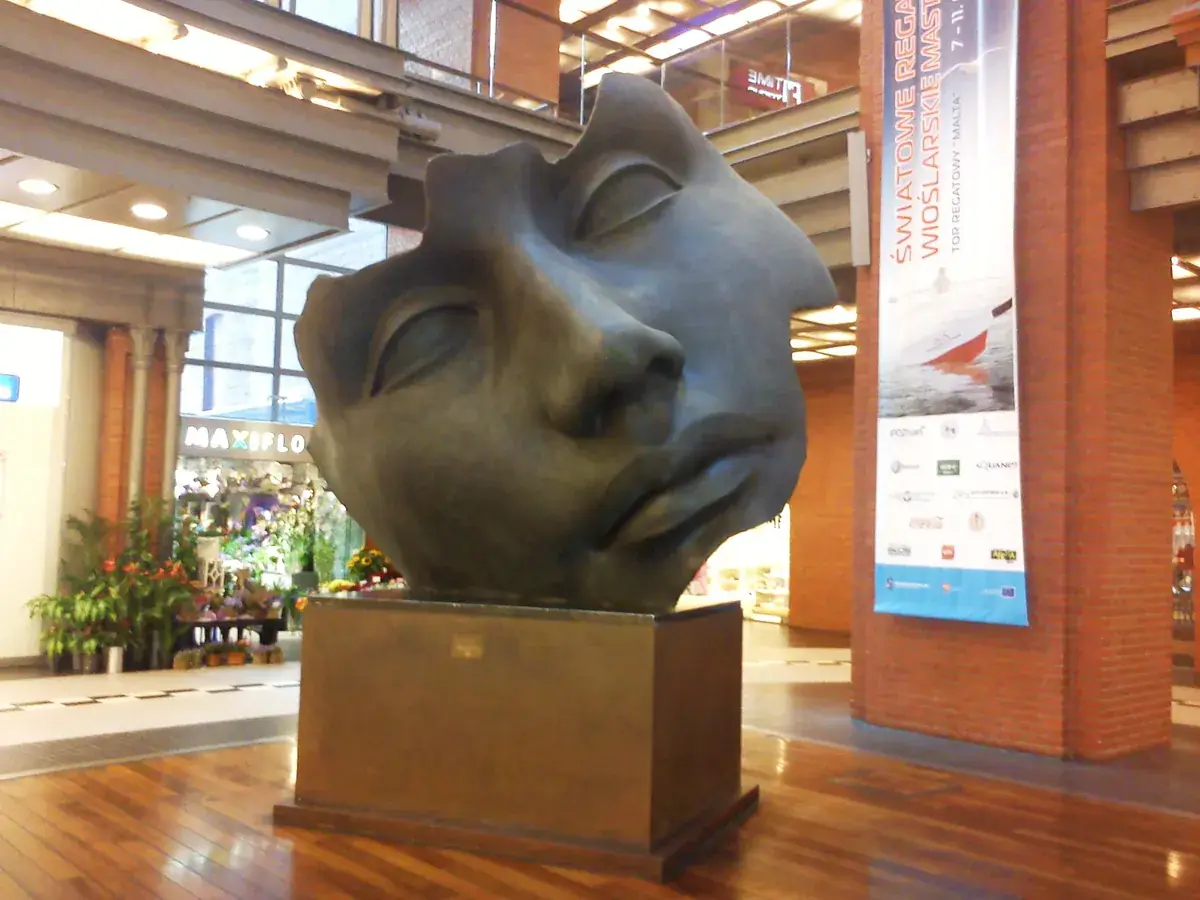
Poznań holds three permanent Mitoraj sculptures — all inside Stary Browar (Old Brewery), one of Poland's most celebrated cultural and commercial destinations on ul. Półwiejska. The complex, conceived by collector and entrepreneur Grażyna Kulczyk on the "50/50" principle — half commerce, half culture — opened in 2003 with a Mitoraj sculpture as its centrepiece. Today, Thsuki-no-hikari in the entrance Atrium has become the city's most spontaneous meeting point: Poznań residents say "meet me under the Mitoraj" and everyone knows exactly where to go.
Stary Browar (the Old Brewery) is not merely a shopping centre — it is one of Poland's most design-conscious cultural spaces, awarded the title of the world's best shopping centre by the International Council of Shopping Centers. Its permanent Mitoraj collection, including Tsuki-no-hikari (Moonlight) and other bronzes, reflects the venue's ambition to blend commerce with serious contemporary art. Poznań's collectors are also among the most active in the Polish art market, and the city regularly features Mitoraj bronzes at auction.
Stary Browar — Art at the Heart of Commerce
Stary Browar occupies a 19th-century brewery complex on ul. Półwiejska, built by the Hugger family from the Black Forest beginning in 1844. The brewery operated until 1980, then fell into ruin. In 1998, Grażyna Kulczyk — one of Poland's most significant private art collectors — purchased the site and proposed a radical idea: a centre where art and commerce coexist on equal terms. The "50/50" concept committed half the building's character to cultural programming: exhibitions, performances, and permanent artworks woven into the fabric of the space.
When the Atrium opened on 5 November 2003, Mitoraj's monumental face-mask was its immediate focal point. Kulczyk's collection, now managed by the Art Stations Foundation, includes works by major Polish and international artists — but it is the Mitoraj sculptures that have become the building's defining visual identity. The complex attracts nine million visitors annually and is consistently ranked among the best-designed shopping centres in the world.
Thsuki-no-hikari (Blask Księżyca / Moonlight) — 1991
Thsuki-no-hikari — Japanese for "Moonlight", in Polish Blask Księżyca — is a monumental bronze face-mask standing in the entrance Atrium of Stary Browar. Mitoraj gave the work a Japanese title in a period when he was exhibiting extensively in Japan and engaging deeply with Japanese aesthetic sensibilities, particularly the concept of beauty emerging from incompleteness — closely related to the Japanese wabi-sabi aesthetic that he admired.
The face is immediately recognisable as Mitoraj's: a fragment of a youthful, idealised head — half-antique, half the sculptor's own features — with the characteristic cracks and deliberate damage that run throughout his work. The lips, always shaped to Mitoraj's own mouth, are just visible. The work is mounted vertically in the Atrium space, rising to a considerable height, and catches the natural light that floods in through the building's glass ceiling.
The sculpture has become so central to Poznań's social geography that "under the Mitoraj" is a universal meeting instruction among the city's residents — as natural as "under the clock" or "at the fountain" in other cities. The Rzechpospolita newspaper described it as "a gigantic face-mask representing a half-antique, half-personal hero." It is the best-known Mitoraj work in Poznań and the most visited by those seeking his work outside Warsaw and Kraków.
Tors nad jeziorem (Torso by the Lake)
Tors nad jeziorem — Torso by the Lake — is the second Mitoraj work in the Stary Browar Atrium, displayed alongside Thsuki-no-hikari. A bronze male torso, characteristic in its fragmentary treatment, the work shares the same vocabulary of classical beauty subjected to deliberate damage and incompletion that defines all Mitoraj's torso series. The title suggests a reflective, contemplative relationship between the sculpture and its surrounding space — the torso seen as if by water, in uncertain light.
The Atrium setting — with its high glass ceiling, warm brick walls from the original brewery, and the flow of visitors — gives both Atrium sculptures a particular vitality. They are not protected in museum silence but embedded in daily life, seen by millions of people going about ordinary business. This was precisely the context Mitoraj preferred for his public work: art encountered without preparation, without the frame of a gallery visit, simply present in the world.
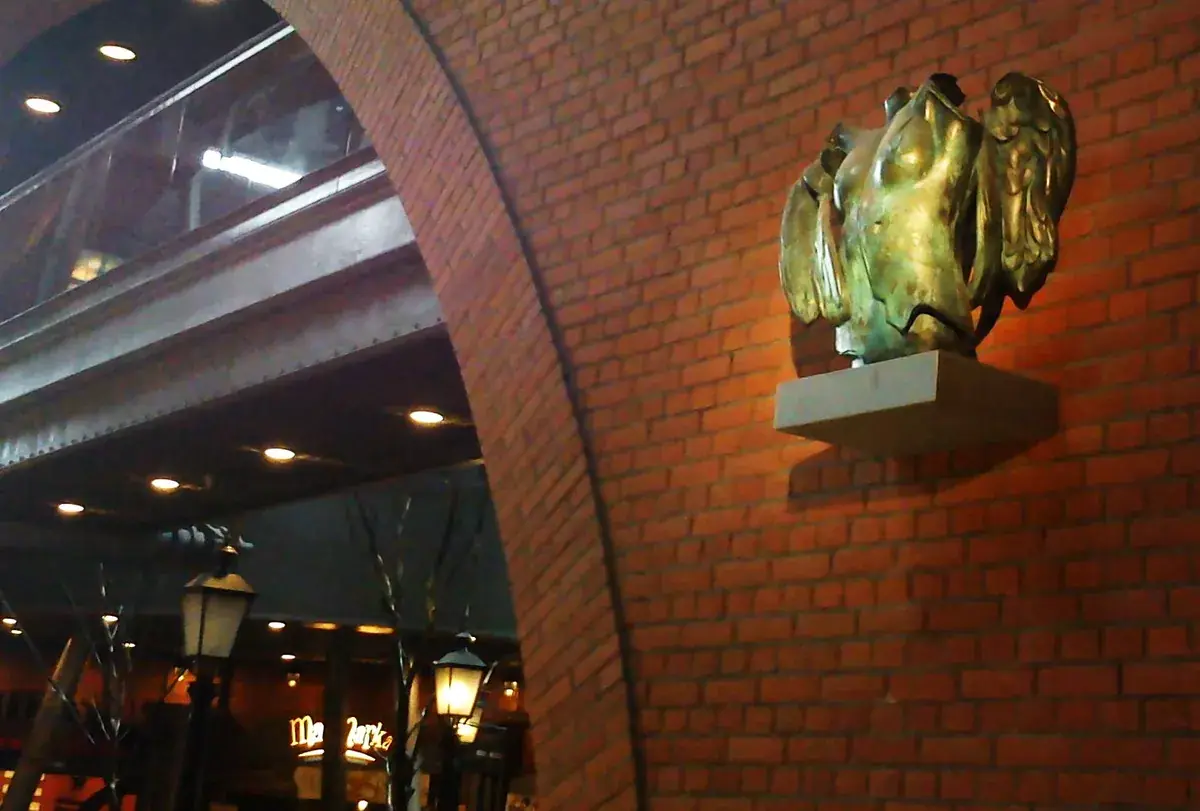
Eros Alato (Eros Skrzydlaty / Winged Eros) — 1984
Eros Alato — Winged Eros, in Polish Eros Skrzydlaty — is one of Mitoraj's earliest treatments of the Eros theme, predating the famous Eros Bendato (Bound Eros) of 1999 by fifteen years. Where the later Eros is horizontal, lying on his side, bound and blindfolded, the 1984 Winged Eros is in a different compositional register — the wings of Eros, the ancient Greek god of desire, present but non-functional, the body fragmented and damaged in Mitoraj's characteristic manner.
The presence of an early Eros Alato in the Kulczyk collection is historically significant: it shows a major collector's investment in Mitoraj's work from an early period, before his international breakthrough exhibitions of the mid-1980s. The 1984 dating places this work in the year of Mitoraj's Castel Sant'Angelo exhibition in Rome — the show that launched his international career. A Winged Eros from that period is a document of the moment when his vocabulary was consolidating.
Academic scholarship on Mitoraj's reception in Poland specifically notes the Poznań Eros Alato as a significant early work in a Polish collection, contrasting its private/cultural-commercial setting with the public square placement of the Kraków Eros Bendato. The debate about where Mitoraj's work "belongs" — in civic space or inside cultural institutions — was particularly acute in Poland in the early 2000s, and the Poznań sculptures were central to that conversation.
Poznań's Relationship with Mitoraj
Poznań's encounter with Mitoraj has been primarily through the Kulczyk collection rather than civic patronage — a significant distinction. In Kraków, the city itself debated and ultimately accepted Eros Bendato as a civic gift; the ownership and meaning of the work were publicly contested. In Poznań, the Mitoraj sculptures belong to a private collection in a privately-owned cultural-commercial complex. They are accessible to millions, but their context is commercial culture rather than civic space.
This distinction is not purely academic. It reflects broader patterns in how Polish cities have related to Mitoraj's work: Warsaw through institutional commissions (the Jesuit church doors, the Olympic Centre); Kraków through civic negotiation and controversy; Poznań through the vision of an exceptional private collector. The Kulczyk collection at Stary Browar is one of the most significant private art collections in Poland, and the Mitoraj works are among its most visible and beloved pieces.
For collectors in the Poznań region, this context matters. The city has a strong tradition of private collecting and a sophisticated art market. If you own a Mitoraj work in the Poznań area — acquired through any channel, in any format — I am an active buyer and would welcome contact.
Beyond the three bronzes installed at Stary Browar, Mitoraj's connection to Polish institutional collecting deepened considerably during the final decade of his life. The National Museum in Poznań holds documentary material relating to his work, and Polish auction houses — among them Agra-Art and Desa Unicum in Warsaw — have handled his bronzes with increasing regularity since his death in Pietrasanta on 6 October 2014. Editions cast at the Versiliese foundry in Tuscany, where Mitoraj worked closely with master founders over decades, carry foundry stamps that serious collectors verify before purchase; works cast posthumously from authorised editions remain legitimate, but provenance documentation from the Mitoraj Estate becomes correspondingly more important. Among the sculptures encountered in the Polish secondary market, Torse d'Icare and Eros Bendato appear most frequently, with the latter — a bound, fragmented head that became one of his most reproduced images worldwide — commanding the strongest prices at Polish auction. Mitoraj's appeal to Central European collectors rests partly on biography: born in Oederan, Germany in 1944 to a Polish mother, he studied at the Academy of Fine Arts in Kraków under Tadeusz Kantor before relocating first to Paris and later to Italy, and this trajectory between Slavic and Mediterranean worlds gave his fractured classical forms a particular resonance for Polish audiences. Kulczyk's decision in 2003 to anchor Stary Browar's artistic identity around his work was therefore not simply an international gesture but a recognition of Mitoraj as, in part, a Polish sculptor — one whose reputation had been built abroad but whose emotional roots remained legible to domestic collectors and visitors encountering his bronzes for the first time on home soil.
Beyond the three bronzes installed within Stary Browar itself, Mitoraj's connection to Poznań is reinforced by the city's position as one of Poland's most active secondary markets for his work. The Poznań auction house Rempex and, more prominently, the Dom Aukcyjny Agra-Art — which holds its major sales in Warsaw but draws significant bidding from Poznań-based collectors — have handled numerous Mitoraj bronzes over the past two decades, with smaller cabinet-scale pieces regularly achieving six-figure sums in Polish złoty. Collectors in the city tend to favour the mid-period works from the 1980s and 1990s, particularly the fragmented head and torso studies that Mitoraj produced in editions from his Pietrasanta foundry, Fonderia Mariani, where he worked closely with master founders to control patination and surface texture across each numbered cast. The edition structures for these works vary considerably: some torso studies were cast in editions as small as three, while the better-known mask reliefs — closer in character to the Stary Browar pieces — sometimes reached editions of seven or nine, a distinction that matters to serious buyers assessing long-term scarcity. Provenance tracing back to Mitoraj's own Paris gallerists, particularly Galerie Enrico Navarra, which represented him from the early 1990s and produced several important catalogues raisonnés of individual series, is considered the strongest indicator of authenticity in the current market. Collectors approaching Mitoraj's work for the first time are frequently advised to cross-reference cast numbers against the foundry records held by the Mitoraj estate, which has been more systematically catalogued since the sculptor's death in Pietrasanta on 6 October 2014.
Beyond the three bronzes installed within Stary Browar itself, Mitoraj's connection to Poznań is reinforced through the city's robust secondary market. Dom Aukcyjny Rempex and Agra-Art — two of Poland's most established auction houses operating out of Warsaw but drawing heavily on Poznań-area consignors — have handled multiple Mitoraj bronzes over the past two decades, with smaller editioned works such as Eros Bendato and Perseo reliably achieving six-figure Polish złoty results at hammer. Poznań collectors, shaped in part by proximity to Stary Browar's permanent installation, have developed a particular appetite for Mitoraj's classical fragment aesthetic: the partial face, the bound or veiled form, the truncated torso. This regional sensibility is not incidental. Grażyna Kulczyk's decision to place a monumental Mitoraj at the physical and symbolic centre of her 2003 project legitimised his work within the Polish collector consciousness in a way that gallery exhibitions alone rarely achieve. Kulczyk herself had encountered Mitoraj's work through European exhibition circuits before commissioning the Atrium piece, and her advocacy helped position him not as a peripheral figure in the Italian bronze tradition but as an artist of genuine international standing whose work rewarded serious acquisition. It is also worth noting that Mitoraj maintained a working foundry relationship with the Fonderia Artistica Battaglia in Milan, one of the oldest bronze foundries in Italy, and that the edition controls enforced through his studio mean that genuinely autographed and numbered casts carry a meaningful premium over unnumbered or posthumously cast examples — a distinction that sophisticated Poznań buyers have increasingly come to understand. Mitoraj himself was openly conscious of these edition controls, and his correspondence with Battaglia in the years before his death repeatedly returned to the question of how authorised numbering should be preserved after he was no longer there to supervise it.
Beyond the Atrium centrepiece, Stary Browar's permanent collection includes Testa di Donna and Eros Bendato, the bandaged head that became one of Mitoraj's most reproduced motifs — a figure he returned to across decades, casting variants in different scales for private collectors, public institutions, and exhibition venues from Paris to Tokyo. The bandaged or fragmented face carries a consistent iconographic logic in Mitoraj's practice: the incomplete form is not ruin but potential, a classical ideal interrupted at the moment of becoming. For collectors, this thematic coherence is part of the market's appeal — works from different periods and foundries can be read as a sustained meditation rather than isolated objects. Mitoraj worked primarily with the Fonderia Artistica Battaglia in Milan, one of Italy's oldest and most technically exacting bronze foundries, and the quality of the casting is a consistent factor in valuations. Works authorised during his lifetime and bearing foundry marks from Battaglia command a measurable premium over posthumous editions, and Polish auction houses — among them Desa Unicum in Warsaw and Agra-Art — have in recent years handled significant single-owner Mitoraj consignments, with hammer prices for mid-scale bronzes regularly exceeding 200,000 PLN. Poznań's own collector base has contributed to this activity: the city's historically strong private patronage culture, rooted partly in the Wielkopolska region's mercantile traditions, means that serious works — rather than decorative editions — have found homes here. Grażyna Kulczyk's decision to acquire major bronzes for Stary Browar rather than loan them or rotate the collection reflects this same conviction: that art gains meaning through sustained presence in a single architectural setting rather than through circulation.
Beyond the three bronzes installed at Stary Browar, Mitoraj's relationship with Polish collectors more broadly reflects a pattern visible across his career: institutions and private buyers who acquired his work in the 1990s and early 2000s — when his international reputation was consolidating around major commissions in Pompeii, Paris, and Kraków — have seen sustained market interest in those holdings. Mitoraj was born in Oława in Lower Silesia in 1944, and although he spent the great majority of his working life in Italy, principally at his Pietrasanta studio in Tuscany, the Polish connection remained meaningful both biographically and commercially. Polish auction houses, including Desa Unicum in Warsaw and Agra-Art, have handled his bronzes with regularity since the late 1990s, and hammer prices for mid-sized editions — works in the 60 to 100 centimetre range — have historically outperformed comparable lots by his Central European contemporaries. The editions themselves merit attention from serious collectors: Mitoraj cast in numbered series, typically through Italian foundries with which he maintained long working relationships, and the precise edition size and casting date materially affect valuation. Works cast during his lifetime at the Fonderia Mariani in Pietrasanta, where he worked closely with master casters, carry particular provenance weight. Collectors approaching the Poznań bronzes as a reference point should note that Tsuki-no-hikari — the large suspended head in the Stary Browar Atrium — belongs to one of his most internationally recognisable series, the fragmented and bandaged figures that became his signature idiom from the 1980s onward, influenced by his encounter with classical antiquity during his first visits to Rome and Greece in the late 1970s.
Beyond the three bronzes permanently installed within Stary Browar, Mitoraj's connection to Poznań extends into the city's active secondary market. Dom Aukcyjny Rempex and Agra-Art — two of Poland's most respected auction houses — have each handled Mitoraj bronzes consigned by Poznań-based collectors, with smaller cabinet works and signed limited editions appearing at regional sales with increasing regularity since the mid-2000s. The sculptures that circulate through the Polish auction market are typically the numbered bronzes cast in editions at the Pietrasanta foundries, including recurring examples of Testa Alata and Eros Bendato in reduced scale — works that first attracted serious Polish collector attention following Mitoraj's major retrospective at Warsaw's Zachęta National Gallery of Art in 1993, an exhibition that introduced his vocabulary of fragmented classical figures to a broad Polish audience for the first time. Collectors in Poznań tend to favour the smaller patinated bronzes suited to domestic or institutional interiors, though the city's corporate sector has also quietly acquired wall-mounted reliefs for office spaces and foyers, a pattern consistent with broader Central European corporate collecting trends of the 1990s and early 2000s. Mitoraj himself visited Poland on several occasions and spoke warmly of the Polish response to his work, noting in interviews that Polish viewers approached the broken and incomplete figures with an intuitive understanding rooted, perhaps, in the country's own fractured historical memory. His sculptures carry serial markings — typically a foundry stamp, an edition number, and Mitoraj's signature cast directly into the bronze — and buyers in the Poznań market have learned to scrutinise these details carefully, since the sculptor's international prominence generated a modest but persistent trade in works of uncertain attribution.
Beyond the three bronzes installed at Stary Browar, Mitoraj's relationship with Polish collectors deepened considerably during the final decade of his life, when Warsaw and Kraków auction houses began handling his works with increasing regularity. Dom Aukcyjny Desa Unicum, Poland's leading auction house, has offered Mitoraj bronzes and drawings at multiple sales since the mid-2000s, with smaller cast reliefs — typically produced in editions of six to twelve — attracting serious competition from domestic collectors who had encountered the larger public sculptures and sought something acquirable for private spaces. These relief works, often depicting the same fragmented classical faces and torsos that define his monumental pieces, provide collectors an entry point into Mitoraj's vocabulary without the spatial demands of a full sculpture. Mitoraj himself maintained a dual studio practice across Pietrasanta, the Tuscan marble-working town where he settled in the 1980s, and Paris, where he had trained under the painter and teacher Tadeusz Kantor at the École des Beaux-Arts in the early 1970s — a formative experience that instilled in him a sense of theatricality evident even in his most static bronzes. His Pietrasanta period was decisive: proximity to the Carrara marble quarries and to master craftsmen who had worked with Henry Moore and Fernando Botero gave Mitoraj access to fabrication techniques that allowed him to realise large-scale works with a surface delicacy more typical of smaller studio pieces. The three Poznań sculptures reflect this mature command — Tsuki-no-hikari in particular demonstrates how Mitoraj used strategic incompleteness, the wrapped or absent eye, the sealed or missing mouth, to suggest interiority rather than damage, a reading that distinguishes his fragmented figures decisively from any straightforward neoclassical revival.
Beyond the three bronzes installed within Stary Browar itself, Mitoraj's relationship with Polish collectors extends into a broader secondary market that has made his work among the most consistently traded of any post-war sculptor in the country. Polish auction houses — including Desa Unicum in Warsaw and Agra-Art — have handled Mitoraj bronzes with regularity since the early 2000s, with smaller cabinet-scale works such as Testa di Amazzone and Perseo appearing in seasonal fine art sales alongside major paintings. These editions, typically cast in numbered series of eight to twelve at foundries in Pietrasanta, Italy — the Tuscan town where Mitoraj maintained his principal studio from the 1980s until his death in October 2014 — vary considerably in scale, and it is the mid-size bronzes, between thirty and seventy centimetres, that attract the most competitive bidding from Polish private buyers. Mitoraj was born in Oława, Lower Silesia, in 1944, and though he spent the majority of his adult life in France and Italy, his Polish identity remained a point of strong cultural identification: he studied at the Academy of Fine Arts in Kraków under Tadeusz Kantor, and it was in Poland that his reputation first crystallised among serious collectors before his international career took hold. This biographical thread — a Polish artist who became one of the most publicly commissioned sculptors in Western Europe — gives his work a particular resonance in the domestic market that is not purely commercial. Collectors in Poznań, a city with a historically strong tradition of private patronage and a well-developed dealer network, have been especially receptive to the figurative classicism that defines his mature output: the fragmented faces, bandaged torsos, and partial figures that became inseparable from his name during the 1990s.
Beyond the three bronzes installed within Stary Browar, Mitoraj's presence in Poznań extends into the secondary market with particular intensity. The city's two principal auction houses — Agra-Art and Sopocki Dom Aukcyjny, both of which conduct regular sales drawing Poznań-based bidders — have handled multiple Mitoraj lots over the past two decades, with works in the artist's characteristic fragmented-classical idiom consistently achieving strong results relative to their pre-sale estimates. Collectors in the Greater Poland region have shown a marked preference for Mitoraj's smaller bronzes and his works on paper — the charcoal and pastel drawings he produced throughout the 1980s and 1990s in his Pietrasanta studio, which offer an entry point into his practice at a fraction of the cost of monumental castings. These drawings, rarely exhibited publicly, document the process by which Mitoraj translated archaeological fragments — broken torsos, eyeless faces, limbless figures half-emerging from stone — into autonomous sculptural forms. His time in Pietrasanta, the Tuscan marble town where he settled in 1979 and maintained a studio until his death in October 2014, was formative in ways that go beyond technique: the proximity to Carrara marble, to Renaissance workshop traditions, and to a community of international sculptors gave his work a gravity and material intelligence that separated it decisively from the neo-classical pastiche with which it is sometimes superficially compared. Mitoraj had studied at the Academy of Fine Arts in Kraków under Tadeusz Kantor — one of the twentieth century's most demanding theatre and visual arts figures — before leaving Poland in 1968 for Paris, where he studied at the École Nationale Supérieure des Beaux-Arts and first encountered the foundry networks that would later anchor his career in Pietrasanta.
Beyond the three bronzes housed within Stary Browar, Mitoraj's relationship with Polish collectors more broadly deserves attention from anyone tracing the market for his work. Polish institutions and private buyers began acquiring Mitoraj seriously during the 1990s, a period when his international reputation — already established through major installations in Paris, Rome, and Pompeii — was translating into sustained auction demand across Europe. The Warsaw auction house Desa Unicum has handled a number of Mitoraj bronzes over the years, with smaller cabinet-scale works and relief plaques appearing at Polish sales alongside the monumental editions more commonly associated with his name. Collectors in Poznań itself have tended to favour the mid-scale bronzes: works large enough to anchor a private interior or garden, yet produced in editions that remain accessible compared to the unique monumental commissions. Among the sculptures at Stary Browar, Tindaro Screpolato — a fragmentary head with a cracked bronze surface revealing an archaic interior — has drawn particular attention from visitors with a collecting interest, since Mitoraj produced the Tindaro motif in several scales and editions over his career, making it one of the more traceable works for those researching his output systematically. The Tindaro series originated in the late 1980s and was exhibited at the Pompidou Centre in Paris, giving it a documented exhibition history that serious collectors value. Grażyna Kulczyk's decision to commission and acquire Mitoraj works for Stary Browar was consistent with her broader pattern of collecting: she has historically preferred artists whose work engages with classical European tradition while operating unmistakably within a contemporary idiom, and Mitoraj — trained at the Kraków Academy of Fine Arts under Tadeusz Kantor — answered that brief with unusual coherence.
Beyond the three bronzes installed within Stary Browar itself, Mitoraj's connection to Poznań is reinforced by the city's exceptionally active secondary market, where his works appear with greater frequency than in almost any other Polish city outside Warsaw. The Poznań auction house Rempex and, more prominently, the Poznań branch of Desa Unicum have handled multiple Mitoraj lots over the past decade, with smaller bronze editions — particularly the Toscano series and reduced casts of Perseo — drawing serious competition from both local and Warsaw-based collectors. Poznan's collecting culture has historically leaned toward sculpture more than painting, a tendency shaped in part by the city's proximity to Berlin and its longstanding ties to Central European craft traditions, and Mitoraj's command of classical form resonates strongly with that sensibility. Grażyna Kulczyk's original acquisition of the large Atrium bronze in 2003 effectively set a precedent: it signalled to the Poznań market that Mitoraj was not peripheral decorative art but serious institutional-grade work, and private collectors followed that signal. The sculptor himself visited Stary Browar during the early years after the opening, and accounts from staff and collaborators at the Art Stations Foundation describe him as unusually engaged with the architectural setting — he reportedly expressed particular satisfaction with how the Atrium's natural light, filtered through its glass roof, moved across the bronze surface at different hours, creating an effect he had not fully anticipated in the studio. This quality of ambient responsiveness is something Mitoraj frequently discussed in interviews: he believed his fragmented figures were never truly finished in the foundry but completed only by the light and space around them, which makes the Stary Browar installation an unusually faithful realisation of the conditions for which the work was conceived.
Mitoraj's relationship with Polish collectors deepened considerably during the 1990s and into the 2000s, a period when his Warsaw and Kraków exhibitions drew serious institutional attention alongside private buyers. His bronze casting process — carried out primarily at the Pietrasanta foundries in Tuscany, where he had maintained a studio since the early 1980s — gave each work a provenance chain that Polish auction specialists learned to scrutinise carefully, with foundry stamps and edition numbers becoming standard points of due diligence for serious buyers. The Poznań market in particular has shown a consistent appetite for smaller Mitoraj bronzes: editions of fragmented heads and torsos in the 30–60 cm range, often produced in series of seven or nine, have appeared repeatedly at Sopocki Dom Aukcyjny and Agra-Art in Warsaw, with Poznań-registered bidders accounting for a disproportionate share of hammer prices in this category. Collectors in the city tend to favour works from the late 1980s and early 1990s — pieces such as Eros Bendato, Tindaro Screpolato, and the smaller Ikaro variants — partly because these coincide with the period when Mitoraj achieved his first major international museum retrospectives, including the 1992 exhibition at the Château de Bagatelle in Paris, which served as a critical marker of institutional legitimacy for subsequent collectors. Mitoraj was born in Oberglogau (now Głogówek) in Silesia in 1944, a biographical detail that resonates with Polish collectors who regard him as a native son despite his French formation at the École des Beaux-Arts in Kraków and later in Paris.
Mitoraj's relationship with Polish collectors predates the Stary Browar installation by more than a decade, rooted in a broader post-1989 opening of the Polish art market to Western European modernism and to émigré artists whose reputations had been built abroad. Born in Oederan, Germany in 1944 to a Polish father and French mother, Mitoraj studied at the Academy of Fine Arts in Kraków under Tadeusz Kantor before relocating to Paris in 1968 and later establishing his principal studio in Pietrasanta, Tuscany — the Carrara marble heartland where he worked alongside foundries capable of casting the large-scale bronzes that define his mature output. His decision to work in Pietrasanta was not incidental: the town's concentration of skilled cavatori and bronze casters allowed him to realise fragments of classical figures at a monumental scale that would have been logistically impossible elsewhere, and it placed him in a tradition linking Renaissance patronage directly to late-twentieth-century studio practice. By the time Grażyna Kulczyk acquired Tsuki-no-hikari for the Stary Browar Atrium, Mitoraj had already completed major public commissions in Paris, Los Angeles, and Pompeii, where in 2016 — three years after his death in Paris on 6 October 2013 — a retrospective exhibition placed thirty of his bronzes among the ancient ruins of the archaeological park, a dialogue between his fractured anatomies and the eruption-preserved city that drew international critical attention and confirmed his standing as one of the most significant figurative sculptors of the postwar period. The Pompeii exhibition, curated in cooperation with the Pompeii Archaeological Park, remains among the most widely documented presentations of his work and continues to shape how collectors and curators frame his late career.
Mitoraj's relationship with Polish collectors deepened considerably during the 1990s, a decade in which his international reputation — secured through major installations in Pompeii, Paris, and Kraków — began translating into sustained private demand within Poland itself. The sculptor, born in Oederan, Germany in 1944 to a Polish father and raised in Kraków, had trained at the Academy of Fine Arts there under Tadeusz Kantor before relocating first to Paris in 1968 and then establishing his principal studio in Pietrasanta, Tuscany, the marble-working town that had shaped generations of European sculptors. It was from Pietrasanta that virtually all of his large bronzes were cast, many at the Fonderia Mariani, whose craftsmen worked closely with Mitoraj to achieve the surfaces — deliberately weathered, fractured, and incomplete — that became his signature aesthetic. The fractured face and severed limb were not merely stylistic choices but carried a consistent philosophical weight: Mitoraj spoke repeatedly in interviews of human vulnerability and the dignity that persists within incompleteness, ideas that resonated with Polish audiences navigating post-communist cultural identity during precisely the years his work was entering the country's major collections. Tsuki-no-hikari, the monumental bronze installed at Stary Browar, exemplifies this language: the title translates from Japanese as "moonlight," and the work's serene, mask-like face — eyes closed, surface broken at the crown — invites a contemplative stillness that functions remarkably well within a commercial atrium precisely because it asks nothing transactional of the viewer. Grażyna Kulczyk's decision to anchor the Atrium with this particular piece rather than a more assertively decorative work signalled a genuine engagement with sculpture as a contemplative rather than ornamental presence.
Mitoraj's relationship with Polish collectors predates the Stary Browar commission by more than a decade, rooted in a broader reassessment of his work that gathered pace after his major retrospective at the Palazzo Reale in Milan in 1993 — an exhibition that introduced many Central European buyers to the full range of his sculptural language, from the intimately scaled Testa di Eros bronzes to the monumental fragmented figures that would later define his public commissions. Polish institutional interest intensified through the 1990s as the country's newly liberalised art market began absorbing works by internationally established artists with biographical ties to the region, and Mitoraj — born in Oederan, Germany in 1944 to a Polish father, raised partly in Kraków, and trained at the Academy of Fine Arts there under Tadeusz Kantor — carried precisely that dual resonance: cosmopolitan in execution, recognisably rooted in the Polish cultural memory. Private collectors in Poznań, Warsaw, and Wrocław began acquiring his smaller editions during this period, often through Parisian dealers or directly from the Pietrasanta foundries where the bronzes were cast, and those early acquisitions established the secondary-market pipeline that sustains Polish auction activity today. The works most consistently sought by Polish buyers at auction fall into two broad categories: the large wall-mounted masks, typically in patinated bronze with a warm brown or greenish surface, and the freestanding busts whose truncated features — half-closed eyes, lips slightly parted, the nose or forehead cleanly severed — evoke the damaged antiquities Mitoraj studied during his decisive eighteen-month stay in Mexico in 1968, a journey that permanently reoriented his aesthetic away from the figurative painting he had pursued under Kantor in Kraków and toward the sculptural fragment that would define the rest of his career.
Have questions about this work?
Ask the AI assistant — grounded in this collection's pages, replies in your language.
Mitoraj's presence in Poznań extends beyond Stary Browar's walls into the broader context of Polish institutional collecting and the sculptor's relationship with Central European museums. The Polish art market's embrace of Mitoraj reflects a broader phenomenon: beginning in the 1990s, as Poland's economy stabilized after the fall of communism, collectors and cultural institutions competed to acquire works by artists who had achieved international prominence while maintaining strong connections to Eastern Europe. Mitoraj, who divided his career between Paris and Italy, represented exactly this profile—a sculptor whose monumental bronzes commanded respect in Western galleries yet whose artistic sensibility remained shaped by his Polish heritage and training at the Warsaw Academy of Fine Arts. The Poznań collector community's particular affinity for his work stems partly from regional pride and partly from the practical advantages his sculptures offer: monumental scale and striking figural forms that photograph well and command attention in both public and commercial spaces, yet with a restraint and classical dignity that prevents them from overwhelming their architectural contexts. Documentation of Mitoraj bronzes passing through Polish auction houses—particularly Desa Unicum in Warsaw and POLIN in Poznań—shows consistent price appreciation over the past two decades, with larger bronzes like Tsuki-no-hikari and Igor variants regularly exceeding their pre-sale estimates. This market strength among Polish collectors has created a secondary effect: the visibility of his work in Poznań's commercial and cultural landscape has attracted scholarly and curatorial attention, with several major museum exhibitions in the region featuring Mitoraj alongside other contemporary sculptors engaged in dialogue with classical tradition. The sculptor's death in 2014 initially created uncertainty in the market, a common pattern with contemporary artists, but institutional acquisitions and sustained collector interest in Poland have since stabilized valuations while adding a historical
Own a Mitoraj Work in Poznań or Greater Poland?
Send me a photograph. I respond personally within 24 hours — discreetly, directly, without intermediaries.
Any other Mitoraj work also welcome — any subject, condition, or format.
See also: Mitoraj in Kraków · Mitoraj in Warsaw · Eros Bendato — buy & sell · All cities worldwide
About This Collection
This site documents one private collector's search for works by Igor Mitoraj (1944–2014) — the Polish-French sculptor celebrated for his fractured classical figures in bronze and marble. Mitoraj studied in Kraków under Tadeusz Kantor, trained in Paris at the École nationale supérieure des beaux-arts, and established his permanent studio in Pietrasanta, Tuscany in 1983. His work is held in public collections across Europe and the Americas. If you have a Mitoraj work available, please use the contact button to get in touch.
Interested in this work?
Inquire about this work →Thinking of selling a Mitoraj? See our dedicated sell page →