
~13 min read
Igor Mitoraj in Bamberg & Germany

to open WhatsApp — then
send photos directly.
Germany holds one confirmed permanent Mitoraj sculpture — Centurione I (1987), standing at the eastern end of the Untere Brücke (Lower Bridge) in Bamberg's UNESCO World Heritage Old Town. It is among the most visited Mitoraj works in Central Europe, and one of the earliest monumental Centurione castings in any public collection. Germany also hosted a significant temporary exhibition in Berlin in 2013. This page documents both.
The Triumphtor commission came at the height of Mitoraj's international recognition. The triptych — three monumental bronze panels — took five years to complete (2003–2008) and represents one of the most significant religious commissions awarded to a contemporary sculptor in 21st-century Europe. The fact that a Polish-born artist was chosen to adorn a German UNESCO World Heritage cathedral with Christian iconography filtered through the classical tradition was itself a powerful cultural statement. Bamberg draws thousands of visitors each year specifically to see the doors.
Centurione I — 1987
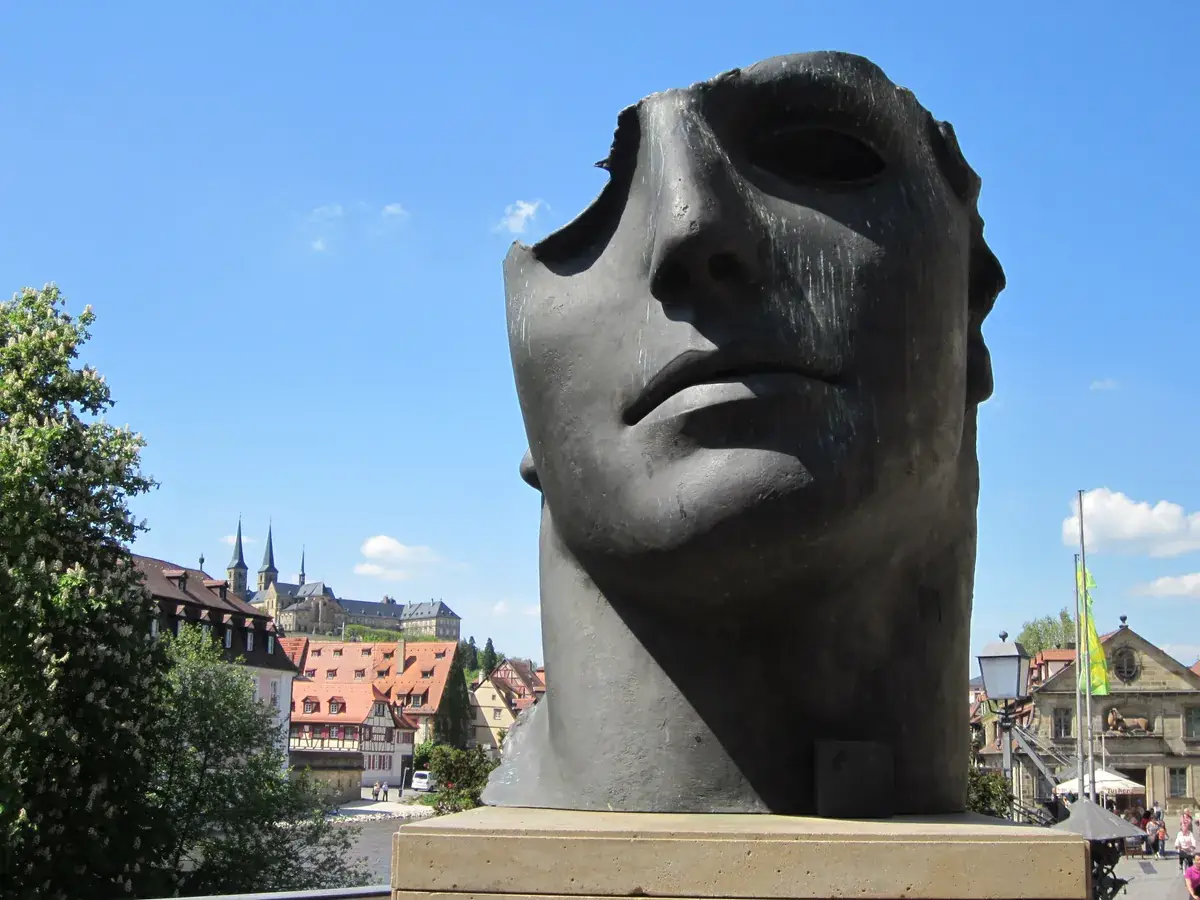
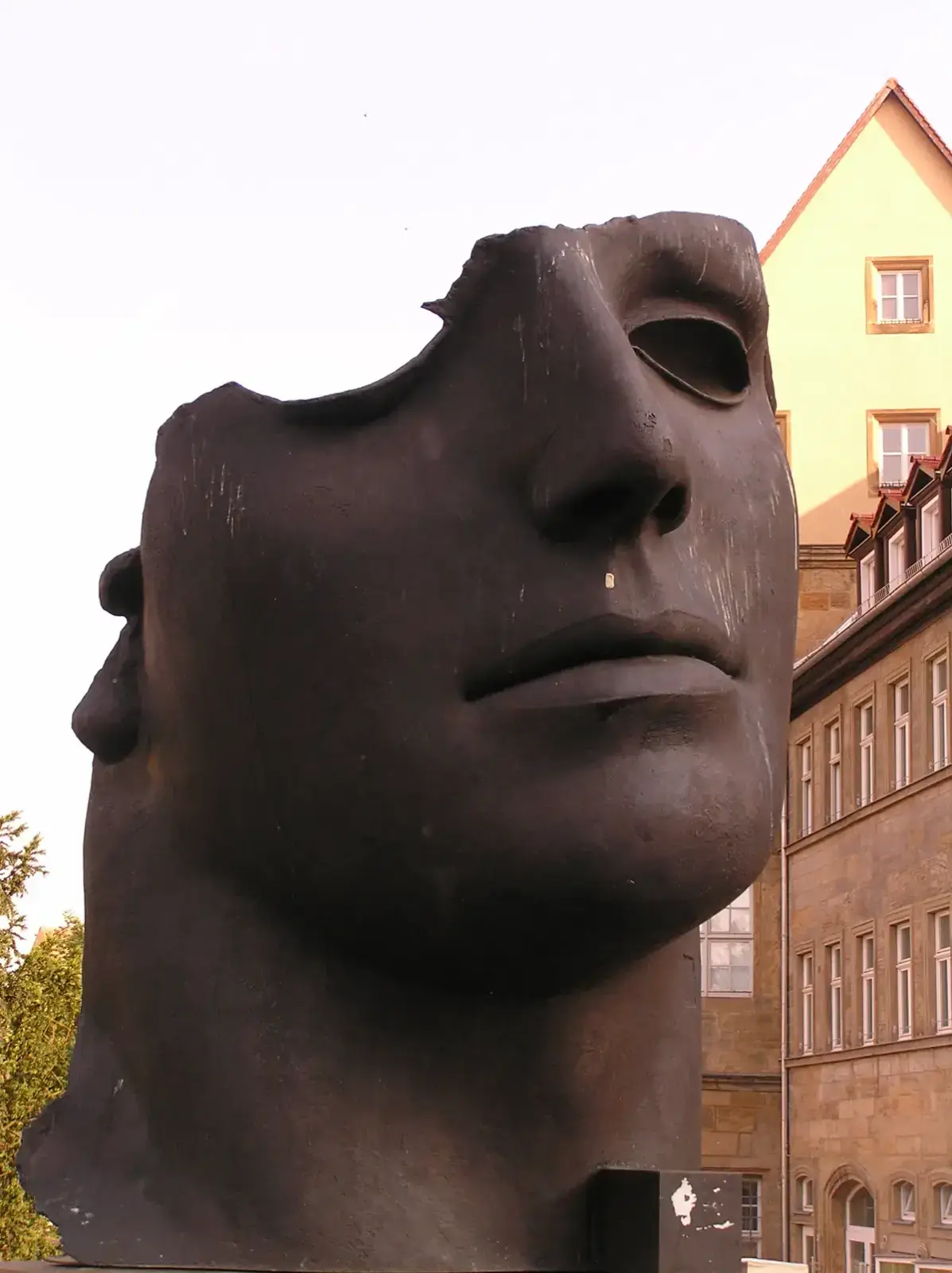
Centurione I stands at the eastern end of the Untere Brücke — the Lower Bridge over the Regnitz river — in the heart of Bamberg's UNESCO World Heritage Old Town. The sculpture is a monumental version of the Centurione I series: an oversized fragment of a youthful face, missing both eyes, most of the forehead, and the entire back of the head. What remains — chin, lips, nose, one complete and one partial eye socket — emerges from the bronze as if from millennia of excavation.
The location is exceptional. The Untere Brücke is one of the most photographed spots in Bamberg, with the mediaeval Old Town Hall rising directly from the river and the towers of Michelsberg Abbey visible on the hill behind. Mitoraj's fragment — a Roman soldier's face, damaged by time — is in constant visual dialogue with the Baroque and Romanesque architecture surrounding it. Visitors approaching from either bank cannot miss it; it has become as characteristic of Bamberg's waterfront as the town hall itself.
The sculpture first came to Bamberg in 2000 as part of a three-month exhibition of Mitoraj's monumental sculptures and drawings. Its reception was strong enough that the Friends of the International Artists' House Villa Concordia e.V. — the cultural association that manages Bamberg's prestigious international artists' residency — acquired it permanently, with support from the Oberfrankenstiftung (Upper Franconia Foundation) and private donors. It has stood on the Untere Brücke ever since.
Reviewers note an unusual perceptual quality: viewed from the north, the hollow interior of the face creates an optical illusion — the concave surface appears convex, making the empty skull seem to follow the viewer as they move. This phenomenon, known as the hollow face illusion, is particularly striking in the Bamberg installation due to the angle at which the sculpture is approached from the bridge.
Centurione I — The Monumental Scale
The Bamberg Centurione I shows what the small-edition desktop bronzes (19 cm, edition of 250) look like when scaled to monumental proportions. The compositional language is identical — the same face angle, the same horizontal band across the eyes, the same sense of a fragment extracted from a larger, lost whole. But at monumental scale, the work acquires a completely different register: it is no longer intimate but confrontational, no longer domestic but civic.
For collectors who own the small Centurione I or II editions, the Bamberg installation provides the most accessible encounter with what Mitoraj intended at full scale. The Bamberg cast was produced from the same compositional model as the desktop editions. The relationship between the table bronze and the monumental work is direct — not a different sculpture, but the same form at a different resolution.
The Centurione series remains among the most actively traded Mitoraj editions on the secondary market. If you own a Centurione I or II bronze — in any condition, with or without its original base — I am actively seeking to acquire additional examples.
Berlin — Ministry of Foreign Affairs Exhibition, 2013
20 Monumental Bronzes — January to July 2013
In early 2013, Igor Mitoraj — then 68 years old and in the final eighteen months of his life — installed twenty monumental bronze sculptures on the grounds of Germany's Federal Foreign Office (Auswärtiges Amt) at Werderscher Markt in central Berlin. The exhibition ran from 16 January to 31 July 2013. All works were produced at the Pietrasanta foundries where Mitoraj maintained his studio.
The placement at the Foreign Office was institutionally significant: the building, designed by architects Müller Reimann Architekten, is one of the most prominent government buildings in reunified Berlin, on the axis between the Brandenburg Gate and the Gendarmenmarkt. A contemporary sculptor being given that forecourt — and that institutional endorsement — was a statement of the German cultural establishment's regard for Mitoraj's work.
The exhibition was not open to the public in the conventional sense: visiting required advance appointment. This made it primarily accessible to diplomatic, cultural, and collector circles rather than general tourism — which in retrospect gives it a particular significance as an institutional rather than popular event.
Germany & the Mitoraj Collector Market
German buyers have been consistently active in the Mitoraj secondary market. Auction houses including Hampel Fine Art Auctions in Munich and Van Ham in Cologne have achieved strong results for Centurione and Persée series bronzes. The German collector base tends to favour the architectural quality of the torso series — Persée, Asclépios — and the graphic clarity of the Centurione heads.
The Bamberg installation has given German audiences direct experience of Mitoraj's monumental scale since 2000, contributing to consistent regional awareness of his work. Collectors in Bavaria, Baden-Württemberg, and the Rhine-Main corridor are among the most active German buyers at European auction houses for his small-edition bronzes.
If you are based in Germany and own a Mitoraj work — bronze, marble, lithograph, or drawing — I buy directly and privately, without commission. I respond to every enquiry personally within 24 hours.


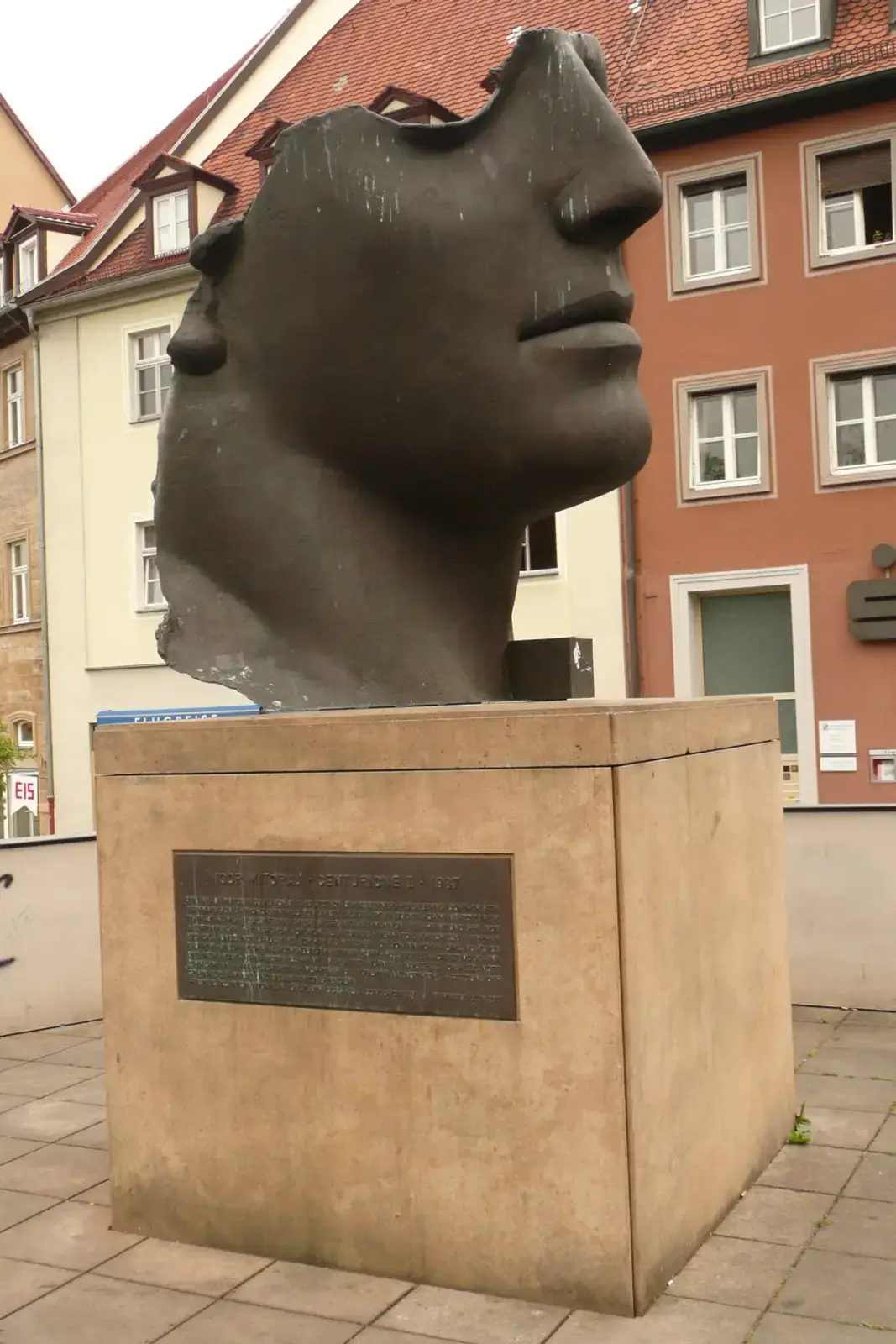

The placement of Centurione I on the Untere Brücke was not incidental. Bamberg has a centuries-old tradition of placing sculpture on its bridges — the bridge itself once carried a column bearing the Virgin Mary, and the city's civic identity has long been intertwined with monumental religious and commemorative stonework in public space. When the Förderverein Villa Concordia e.V. — the Friends of the Villa Concordia, the international artists' residency funded by the Bavarian State Ministry — facilitated the acquisition in the late 1980s, they were consciously situating a contemporary work within that layered tradition. The choice of the Centurione type was particularly resonant: a Roman military fragment placed in a Franconian city whose own Roman-era roots predate its medieval cathedral. For collectors and market observers, the acquisition timing is significant. By 1987, Mitoraj had already held major exhibitions in Paris and New York, and foundry editions of the Centurione series were entering European private collections at prices that would multiply considerably over the following decade. Monumental bronzes from this period — works cast at the Fonderia Artistica Ruocco in Naples, with whom Mitoraj maintained a long working relationship — now appear at auction and in specialist gallery inventories at prices reflecting both their scale and their art-historical position within late twentieth-century figurative sculpture. The Bamberg casting predates the broader institutional recognition Mitoraj would receive in the 1990s, giving it particular documentary value for researchers tracing the early dissemination of his monumental work into permanent civic collections.
The Bamberg Exhibition — Context and Works Shown
The 2000 Bamberg exhibition that brought Centurione I to the Untere Brücke was a multi-venue presentation of Mitoraj's monumental sculpture and drawings across the UNESCO World Heritage Old Town. Unlike the Kraków installation of 2003–2004, which concentrated works on a single large square, the Bamberg exhibition distributed pieces through the city's historic fabric — on bridges, in courtyards, against mediaeval and Baroque architectural backdrops — creating a sequence of encounters that rewarded extended exploration rather than a single viewing event.
The sculptural works shown included several of the Centurione series at different scales, along with torso fragments from the Persée and Asclépios families and at least one of the large bandaged-head formats that Mitoraj was developing in parallel during this period. The drawings and works on paper — a less-discussed but significant aspect of his practice — were displayed in interior spaces accessible from the main routes through the old town, providing visitors with a fuller picture of his working method than outdoor installations alone could offer.
The exhibition's success in Bamberg was immediate and durable. The Förderverein Villa Concordia's decision to retain Centurione I permanently after the show closed followed a pattern seen at several other Mitoraj exhibition sites — works placed in settings where they acquired meaning through context were recognised as genuinely belonging there, and the institutional and private support for permanent acquisition typically materialised within months of the exhibition's close. The Bamberg case is among the clearest examples of this pattern in Mitoraj's career, and the permanence of the Untere Brücke installation has made it one of the more studied examples of his integration into historic urban fabric.
Bamberg's Baroque Setting and Classical Resonance
Bamberg's UNESCO World Heritage designation rests on one of the most intact historic urban centres in Central Europe. Unlike German cities that were extensively destroyed in the Second World War and rebuilt, Bamberg emerged largely unscathed, preserving its Romanesque cathedral (begun in 1004), its Baroque Neue Residenz (1697–1703), its mediaeval bridge architecture, and its dense fabric of sixteenth and seventeenth-century townhouses in a state that represents, as the UNESCO citation notes, a masterpiece of European urban planning. The city's historic centre is not a museum quarter but a living town, which gives its architectural inheritance a different quality from the preserved cores of cities where history has been isolated from daily life.
Mitoraj's work finds an unusually natural home in this setting. His bronzes — classically derived, deliberately damaged, patinated to suggest archaeological recovery — are works that read as continuous with historical environments rather than disrupting them. The Centurione fragment on the Untere Brücke does not look like a contemporary intrusion into a historic scene; it looks like something that has always been there, or that was perhaps just excavated from the riverbed below. This quality of temporal ambiguity — the sense that Mitoraj's bronzes could belong to any century — is precisely what makes them so effective in settings with deep historical layering.
The resonance with Baroque aesthetics is worth noting specifically. Baroque sculpture — Bernini above all, but also the German tradition of Schlüter and Günther — shares Mitoraj's interest in arrested movement, emotional intensity, and the body caught in extremis. The Bamberg Domreiter (the equestrian figure known as the Bamberg Rider, c.1230, in the Cathedral) is one of the most important works of mediaeval German sculpture, and it frames a context in which figurative sculpture of serious ambition has been placed in Bamberg's public and sacred spaces for eight centuries. Mitoraj steps into that tradition rather than against it.
Works from the Bamberg Period at Auction
The Bamberg exhibition of 2000 generated a documentary record that serves as a provenance reference for Mitoraj bronzes of this type and period. Exhibition catalogues, press photography, and the Förderverein Villa Concordia's institutional records provide a body of evidence against which specific works can be checked when questions of attribution or casting period arise. For collectors acquiring Centurione series bronzes, the Bamberg installation is one of the reference points — alongside Kraków, Pompeii, and the 2013 Berlin Foreign Office exhibition — for establishing the monumental scale at which the work was designed to operate.
German auction houses have handled Mitoraj works with some regularity over the past decade. Hampel Fine Art Auctions in Munich, which specialises in post-war and contemporary sculpture alongside old masters, has offered Centurione and Persée series bronzes at several of its annual sales, with strong results particularly for works in good condition with complete foundry documentation. Van Ham in Cologne, another significant German house for contemporary sculpture, has also been active in this area. The German collector base's familiarity with Mitoraj — sustained by the Bamberg installation and the 2013 Berlin exhibition — supports consistent demand at the regional auction level that sometimes allows works to achieve results comparable to those at the major international houses, with lower fees and shorter lead times.
For sellers of Mitoraj bronzes in Germany, the choice between the German regional houses and the major international rooms in London, Paris, or New York should be informed by the scale and rarity of the work. Smaller editions — desktop bronzes, signed lithographs — are typically best placed through German regional houses where the collector base is directly relevant. Monumental or semi-monumental works, or pieces from series with strong international auction records, may benefit from the broader exposure of a London or Paris sale, even accounting for the additional logistics involved.
Provenance from German Collections
Works with documented German provenance — acquisition through a named German gallery, appearance in a German auction, or ownership by an identifiable German collector — carry specific weight in the Mitoraj secondary market. Germany's art market documentation standards are among the most rigorous in Europe: VAT records, gallery receipts, insurance valuations, and auction catalogue listings are typically well-preserved and easily recoverable, giving German-provenanced works a documentary completeness that improves their standing in any subsequent sale.
German collectors who acquired Mitoraj works during the 1990s and early 2000s — the period of his peak German market exposure, bracketed by the Bamberg installation and the Berlin Foreign Office exhibition — represent one of the more significant bodies of undisclosed private holdings in his output. Many of these collectors are now of an age where estate planning and collection dispersal are active considerations, and the generation of adult children who have inherited these works sometimes approaches them without the biographical connection to Mitoraj that their parents had. This creates a particular market dynamic: works are available, but their owners require both contextual guidance and a reliable private route to sale that does not expose them to the complications of public auction.
I am a private collector based in Warsaw, buying Mitoraj works directly and discreetly from German collectors — whether acquired through gallery purchase, inheritance, or estate settlement. If you own a bronze, marble, drawing, or lithograph by Igor Mitoraj and are considering its sale, I respond personally to every enquiry within 24 hours. No intermediaries, no commission, complete confidentiality.
Interested in this work?
Inquire about this work →Thinking of selling a Mitoraj? See our dedicated sell page →