🇮🇹 アグリジェントのミトライ
イタリア(シチリア島) · イーゴル・ミトライの公共彫刻
シチリア島のアグリジェント神殿の谷は、ミトライの最も重要な公共プロジェクトの舞台の一つです。1992年に彼の大型ブロンズ彫刻が二千年以上前の古代ギリシャ神殿の遺跡の中に置かれ、彼の古典世界との同一視を批評的に確立しました。2011年には大型回顧展が同じ場所に返ってきました。
主要作品と設置場所
- 1992年展覧会 — 神殿の谷 · ヘラクレス神殿ほか · ミトライの国際的評判を確立
- 2011年回顧展 — 神殿の谷 · 1992年から20年後の再訪
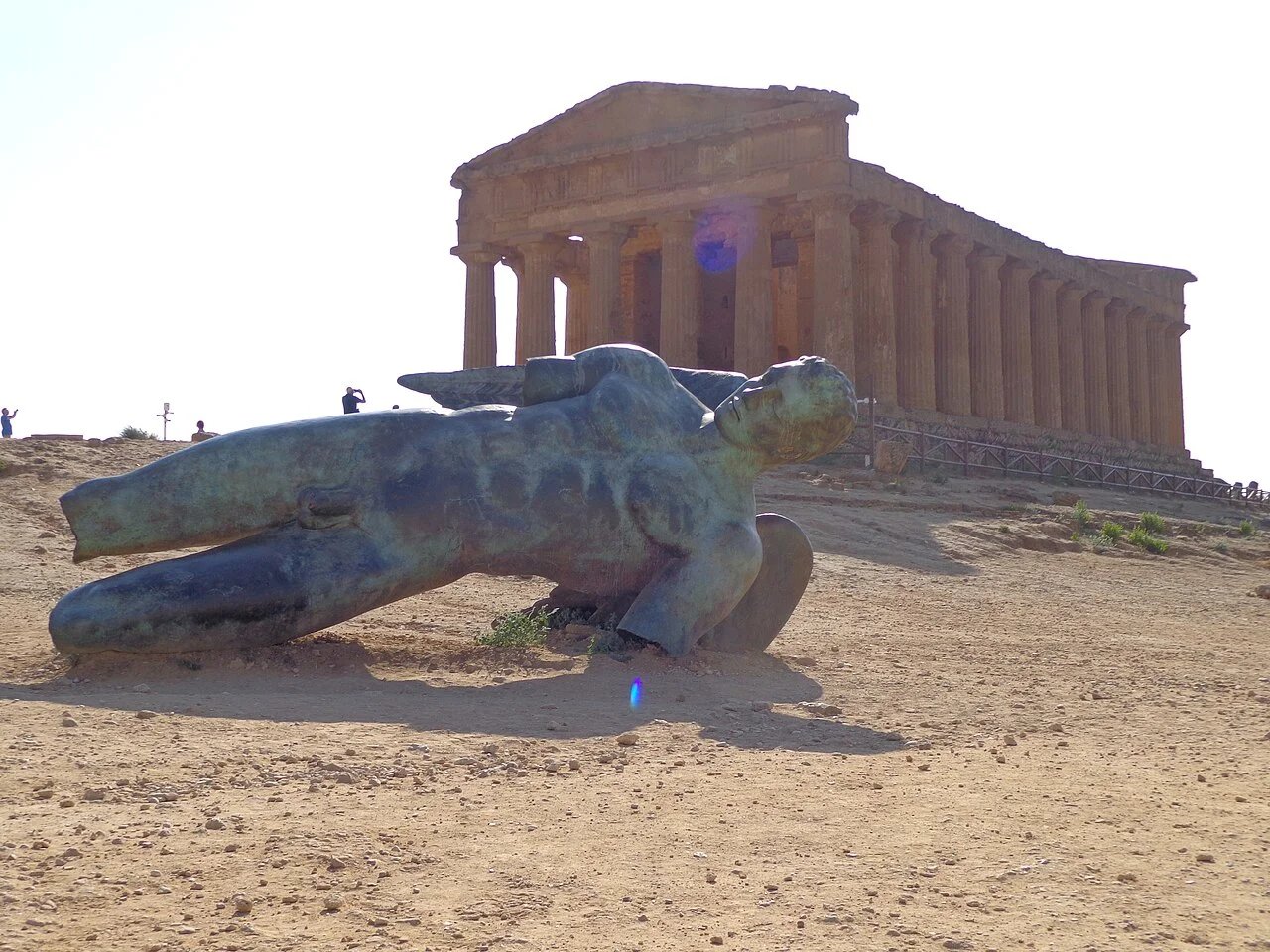
The 2011 Agrigento exhibition, titled Mitoraj ai Templi, was organised in collaboration with the Parco Archeologico e Paesaggistico della Valle dei Templi and brought together approximately twenty large-scale bronzes positioned across the archaeological zone. Beyond Icaro Caduto, works including Tindaro Screpolato and Eros Bendato were placed in dialogue with specific temples, each pairing considered for mythological resonance rather than visual spectacle alone. The exhibition drew significant critical attention across Italy and reinforced Mitoraj's standing as one of the few contemporary sculptors whose vocabulary was genuinely commensurate with classical sites — a judgment that carried weight in the Italian market, where his bronzes had long commanded serious secondary prices. For collectors, the Agrigento exhibition represents a documented provenance moment: works that appeared in the Valle dei Templi installation carry exhibition history tied to one of antiquity's most significant landscapes, a circumstance that distinguishes them within Mitoraj's catalogue. The artist's Pietrasanta foundry, Fonderia Mariani, cast many of the pieces shown at Agrigento, and bronzes bearing this foundry mark alongside the 2011 exhibition documentation are considered among the more traceable examples of his monumental output. Mitoraj died in October 2014 in Paris, meaning the Agrigento installation stands as part of the final decade of his active production — a period now assessed by the market with particular scrutiny given the finite and increasingly well-documented nature of his late work.
The 2011 Agrigento exhibition, titled Mitoraj al Parco dei Templi, comprised approximately thirty bronze works distributed across the archaeological site, curated in collaboration with the Parco Archeologico e Paesaggistico della Valle dei Templi under the direction of Ernesto De Miro. Beyond Icaro Caduto, significant pieces placed during that installation included Tindaro Screpolato and Eros Alato, both characteristic of Mitoraj's mature period: large-scale figures fractured at the neck or torso, their surfaces carrying the deliberate patination he refined over decades in his Pietrasanta foundry. For collectors, the Agrigento placement matters beyond spectacle. Works exhibited in major archaeological contexts — Pompeii, the Louvre, the Valley of the Temples — carry a distinct provenance weight in the secondary market, and bronzes photographed against these backdrops appear repeatedly in auction house catalogue essays as evidence of institutional validation. Mitoraj's estate, managed after his death in 2014 by his longtime collaborators, has maintained careful edition controls on major works, meaning monumental pieces from this period rarely circulate; when they do, they tend to appear through specialist European houses rather than the major international rooms. Smaller-scale bronzes and the artist's terracotta maquettes — working studies for exactly the kind of monumental pieces deployed at Agrigento — represent the more accessible entry point for serious collectors, occasionally surfacing through Italian regional houses and, with increasing frequency, through dedicated sculpture galleries in Paris and London that have built sustained programmes around post-war Mediterranean figuration. The Agrigento exhibition remains the most geographically and historically reson
The 2011 Agrigento exhibition, titled Mitoraj al Valle dei Templi, comprised roughly thirty works distributed across the archaeological park, making it one of the largest temporary exhibitions of his sculpture ever mounted at a single site. Among the pieces displayed alongside Icaro Caduto were Centurione, Tindaro Screpolato, and several of the draped torso works that collectors associate with his mature period — bronzes whose surface patinas Mitoraj developed through a collaboration with the Pierantoni foundry in Pietrasanta, the Tuscan casting town where he maintained his principal studio from the 1980s onward. The exhibition was organized in partnership with the Parco Archeologico e Paesaggistico della Valle dei Templi and drew significant international press attention, reinforcing what the secondary market had already begun to reflect: that Mitoraj's monumental works, when placed in historically charged outdoor settings, generated a documentary record — exhibition catalogues, photographic editions, critical essays — that directly supports provenance and attribution for collectors acquiring smaller bronzes of the same subjects. The 2011 Agrigento catalogue, published with bilingual Italian and French text, remains a reference document for works from this period. Collectors acquiring mid-scale bronzes of Icaro or Tindaro variants should note that the Agrigento showing established these subjects as among the most publicly documented in Mitoraj's entire output, which bears on both authentication and long-term desirability. The permanent retention of Icaro Caduto after the temporary exhibition closed followed a pattern seen at other major sites — Pompeii
The 1992 Agrigento installation predated the widespread institutionalisation of site-specific contemporary art within UNESCO World Heritage zones, making it an unusually early precedent for that curatorial model. Mitoraj worked closely with the then-superintendent of the Valle dei Templi, and the placement of Eros Bendato near the Temple of Juno was documented in the Italian press as a deliberate counterpoint to the site's eroded figuration — broken stone met broken bronze on equivalent terms. For collectors assessing works from this period, the early 1990s represents a transitional moment in Mitoraj's market: his Paris gallery representation through Bartoux was consolidating, edition sizes were still relatively modest, and patina treatments from Fonderia Mariani during this decade differ subtly but measurably from later casts, a distinction that conservators and specialist dealers have used to sequence unsigned or ambiguously dated bronzes. Works traceable to the 1992 Agrigento presentation therefore carry a dual significance — both biographical and material — that later exhibition appearances rarely replicate.
The Valley of the Temples connection also deepened Mitoraj's relationship with the Italian state cultural apparatus in ways that had practical consequences for the market. Following the 2011 installation, several major Italian institutions acquired or extended loans of his bronzes, and the Agrigento exhibition catalogue — published by Skira — became one of the more rigorously documented records of his monumental work, listing dimensions, cast numbers, and foundry provenance with a precision unusual for temporary exhibition publications. Collectors treating Mitoraj as a long-term holding have found the Skira catalogue useful as a reference point when verifying cast sequences, particularly for editions of Tindaro Screpolato and Eros Bendato, where multiple casts exist at varying scales. Mitoraj had been exhibiting in Sicily since the early 1990s, and his connection to the island was not incidental: he maintained that Greek antiquity, filtered through its southern Italian and Sicilian survival, was the legitimate source material for a European sculptural language, a position that distinguished him from contemporaries working in more ironic or post-modern registers. That conviction gave his Sicilian placements a coherence that purely temporary exhibitions rarely achieve.
The 1992 installation at Agrigento preceded Mitoraj's major retrospectives in Pompeii (2016) and Paestum (2019), and it is worth understanding it as the foundational instance of his practice of engaging ancient Mediterranean sites directly — a strategy that distinguished him sharply from contemporaries working in neutral gallery or museum contexts. Curated with the involvement of the Italian cultural authorities overseeing the Valle dei Templi, the 1992 exhibition introduced international audiences to the pairing of Centauro and Perseo against temple stonework worn by two millennia of Sicilian weather, an effect that reproduced poorly in print and was experienced primarily by those present — giving collectors who acquired related works shortly afterward a biographical connection to the show that later buyers could only reconstruct through catalogue documentation. The exhibition catalogues from both 1992 and 2011 remain the primary paper trail for works exhibited at the site; the 1992 volume in particular is now difficult to locate in complete condition and is treated by specialist dealers as a reference document rather than a decorative item. Collectors researching specific bronzes are advised to cross-reference foundry marks against these catalogues, as several edition numbers associated with pieces shown at Agrigento were subsequently exhibited at other European venues, creating overlapping provenance chains that require careful separation when establishing a work's precise exhibition history.
The 1992 installation at Agrigento predated Mitoraj's wider international consolidation and is now understood as a pivot point in his market trajectory. Prior to that exhibition, his bronzes circulated primarily through a circuit of Parisian galleries and select Italian dealers, with auction appearances remaining relatively infrequent. Following Agrigento, and the critical endorsement it carried within Italian cultural institutions, demand broadened across German and Swiss collecting circles, markets that would go on to absorb a significant share of his monumental editions throughout the 1990s. Works from that earlier period — particularly pieces cast at the Fonderia Artistica Battaglia in Milan, which handled a portion of his output before his longer association with Fonderia Mariani in Pietrasanta — are today distinguishable by foundry mark and patination technique, details that matter to specialist buyers assembling documented collections. The Valley of the Temples context also sharpened curatorial language around Mitoraj's practice: the recurring critical framing of his fragmented figures as meditations on time and incompleteness, rather than mere stylistic classicism, gained traction in Italian art writing after 1992 and subsequently shaped catalogue essay conventions that persist in auction house literature to this day. Collectors approaching the secondary market should note that exhibition loans from both the 1992 and 2011 Agrigento presentations were occasionally sourced from private Italian collections rather than the artist's own stock, meaning provenance chains for some exhibited bronzes lead back to early Italian patrons rather than directly to the studio or its authorised representatives — a distinction with implications for edition verification and condition history.
The 1992 exhibition at Agrigento predated the broader European recognition that would come to define Mitoraj's market trajectory, making it a foundational moment rather than a capstone one. At that staging, works including Testa di Medusa and Ala Spezzata were positioned among the Doric columns of the Valle dei Templi at a time when Mitoraj's auction presence outside France and Poland was still limited, and Italian institutional support of this scale was genuinely unusual for a living sculptor working in a classical idiom. The Agrigento platform accelerated his relationship with Italian collectors specifically, a demographic that would come to represent a significant share of private acquisition activity throughout the 1990s and into the 2000s. Galleria Sinopia in Rome and several Milanese dealers subsequently handled editions closely associated with the Agrigento works, and pieces documented to that 1992 showing began appearing in Italian estate sales and inheritance inventories within a decade — a pattern that reflects how quickly the exhibition established his name within serious domestic collecting circles. For researchers attempting to trace individual bronzes, the distinction between the 1992 and 2011 Agrigento showings matters practically: photographic documentation from the earlier exhibition is considerably sparser, and bronzes with credible 1992 provenance are correspondingly harder to verify but carry proportionally greater catalogue significance when that provenance can be established through correspondence, press coverage, or foundry records. The Valle dei Templi itself, designated a UNESCO World Heritage Site in 1997, gave both exhibitions a retrospective authority that purely gallery-based showings could not replicate, and the site's administration has referenced the Mitoraj installations in its own published histories of temporary art interventions at the park — a form of
The 1992 exhibition at Agrigento preceded a period of sustained institutional recognition that would define the final two decades of Mitoraj's career. That earlier installation, organised in part through the efforts of the Ente Provinciale per il Turismo di Agrigento, introduced works including Centauro and Grande Testa Addormentata to an international audience at a moment when the Italian art market was reassessing the place of figurative bronze within contemporary practice. The critical framing of the 1992 show was notably different from what followed in 2011: where the later retrospective was received as a summation, the earlier exhibition carried the charge of an argument still being made — that a sculptor working with fragmented classical forms deserved consideration alongside, rather than merely after, the conceptual movements that had dominated European gallery programmes through the 1980s. For collectors tracking provenance, the 1992 Agrigento show is the less frequently documented of the two, and bronzes with verifiable exhibition history from that earlier installation — supported by period catalogue entries or photographic records placing specific edition numbers at the site — occupy a distinct position in the secondary market. The exhibition catalogue from 1992, published with texts by the archaeologist and art historian Ernesto De Miro, who was closely associated with the Valle dei Templi's scholarly programme, remains a primary reference for authenticating which works were physically present at the site rather than simply associated with the broader Agrigento project in later dealer descriptions. De Miro's involvement lent the exhibition an archaeological seriousness that separated it from the more commercially oriented outdoor sculpture events of the same period, and his catalogue essay is frequently cited in auction house condition reports when establishing the significance of the Agrigento placement. Collectors acquiring Mitor
Own a Mitoraj Work?
The mythological bronzes that stood at Agrigento — Centurione, Persée, Eros Bendato — exist as collector editions at intimate scale. I buy directly, privately, anywhere in Europe.
Contact Me Directly