Igor Mitoraj em Agrigento

para abrir o WhatsApp — depois
envie as fotos diretamente.
Em 2011 — três anos antes da sua morte — Igor Mitoraj instalou esculturas monumentais entre os templos gregos do Vale dos Templos de Agrigento, na Sicília. Era a paisagem mais antiga que a sua obra havia habitado: templos construídos entre os séculos V e VI a.C., dedicados aos deuses da mesma mitologia que havia sustentado toda a sua carreira escultórica. Concórdia, Juno, Hércules, Zeus — estas não eram referências históricas abstratas, mas os sujeitos vivos dos seus bronzes, as figuras cujos rostos danificados e enfaixados ele havia passado quarenta anos a fundir. Em Agrigento, a obra de Mitoraj finalmente se ergueu onde os próprios mitos haviam sido adorados.
O Vale dos Templos de Agrigento acolheu a obra de Mitoraj numa grande exposição temporária em 2011, mas o Icaro Caduto — colocado em frente ao Templo da Concórdia — perdurou. Confirmado ainda presente por visitantes em 2026, tornou-se uma das justaposições mais fotografadas da Sicília: um bronze moderno fragmentado à sombra de um templo dórico de 2500 anos. Ambos são estudos sobre o mesmo tema — o fosso entre a aspiração humana e os seus limites. O Vale dos Templos é um Sítio do Património Mundial da UNESCO que recebe mais de 700.000 visitantes por ano.
Esculturas Monumentais — Vale dos Templos, 2011
O Vale dos Templos — Valle dei Templi — é o maior e melhor preservado complexo de templos gregos antigos fora da Grécia, classificado como Património Mundial da UNESCO em 1997. O sítio estende-se ao longo de uma crista a sul de Agrigento, com sete templos em variados estados de conservação com vista para a costa mediterrânea. O Templo da Concórdia, construído por volta de 440 a.C. e ainda em grande parte intacto, está entre os templos gregos antigos mais completos do mundo.
Instalar os bronzes de Mitoraj aqui em 2011 foi um ato de extraordinária audácia cultural — e de extraordinária lógica cultural. As suas figuras fragmentadas de deuses e heróis não eram objetos estranhos colocados num parque arqueológico: eram regressos a casa. O Centurione, o Persée, o Eros Bendato, os torsos mitológicos — todos estes temas eram originalmente venerados em templos exactamente como os de Agrigento. Os nomes eram diferentes, a língua latina em vez de grega, mas a geografia sagrada era a mesma.
A instalação tinha uma qualidade visual específica que nenhum contexto interior ou urbano poderia replicar. Os bronzes na paisagem de calcário dourado do Valle dei Templi, rodeados de oliveiras antigas e sob a luz siciliana — uma luz mais dura, mais horizontal, mais penetrante do que a luz mais suave da Toscana ou da Île-de-France — adquiriram uma presença que as fotografias apenas parcialmente captam.
O Vale dos Templos — O Que Ver
O Valle dei Templi não é um museu ou parque arqueológico convencional. É uma paisagem viva — oliveiras crescem entre os templos, flores silvestres cobrem o solo na primavera, e o Mediterrâneo é visível a partir da crista em dias limpos. Os templos vão desde os quase completos (Concórdia, Hércules) a ruínas substanciais (Juno, Zeus Olímpico — do qual apenas uma coluna se mantém) a vestígios fragmentários.
Para os visitantes interessados em Mitoraj, a exposição de 2011 já não está no local — as obras eram temporárias, embora a ligação a Agrigento continue a ser significativa para compreender a sua relação com o mundo antigo. O sítio recompensa uma visita de várias horas; o Museo Archeologico Regionale di Agrigento, na cidade moderna, guarda os achados das escavações, incluindo a notável figura do Telamon do Templo de Zeus.
Sicília, Magna Grécia e as Fontes de Mitoraj
A Sicília era o coração da Magna Grécia — o mundo colonial grego do Mediterrâneo ocidental. Entre os séculos VIII e III a.C., colonos gregos fundaram cidades por toda a Sicília (Siracusa, Agrigento, Selinunte, Gela) e no sul de Itália (Crotona, Síbaris, Tarento) que rivalizavam com as cidades da Grécia continental em riqueza e ambição cultural.
O universo visual de Mitoraj é construído sobre esta herança — não a tradição clássica ateniense especificamente, mas a herança mediterrânea antiga mais ampla que a Magna Grécia representa. Os seus temas são de origem grega (Perseu, Eros, Dédalo, o centauro) mas a sua formação foi italiana (Pietrasanta, Roma, as fundições da Versília). A instalação de Agrigento colocou-o exactamente no ponto onde estas duas tradições se cruzam: o ocidente grego, o sul italiano, a bacia mediterrânea onde a Antiguidade começou.
Visitar Agrigento
O Vale dos Templos fica a cerca de 3 km a sul do centro de Agrigento, acessível por autocarro local ou táxi. Os aeroportos mais próximos são Palermo (aproximadamente 130 km, cerca de 2 horas de carro ou autocarro) e Catânia (aproximadamente 180 km). Agrigento é acessível de comboio a partir de Palermo (aproximadamente 2 horas). O sítio está aberto diariamente; a melhor luz para fotografia — e para a experiência dos templos em geral — é ao final da tarde, quando o calcário fica dourado e as sombras se estendem pela crista.
A primavera (março-maio) é a estação ideal, quando a floração das amendoeiras (Agrigento é famosa pelo seu festival de amêndoas em fevereiro) deu lugar às flores silvestres e o sítio ainda não está lotado de visitantes de verão.
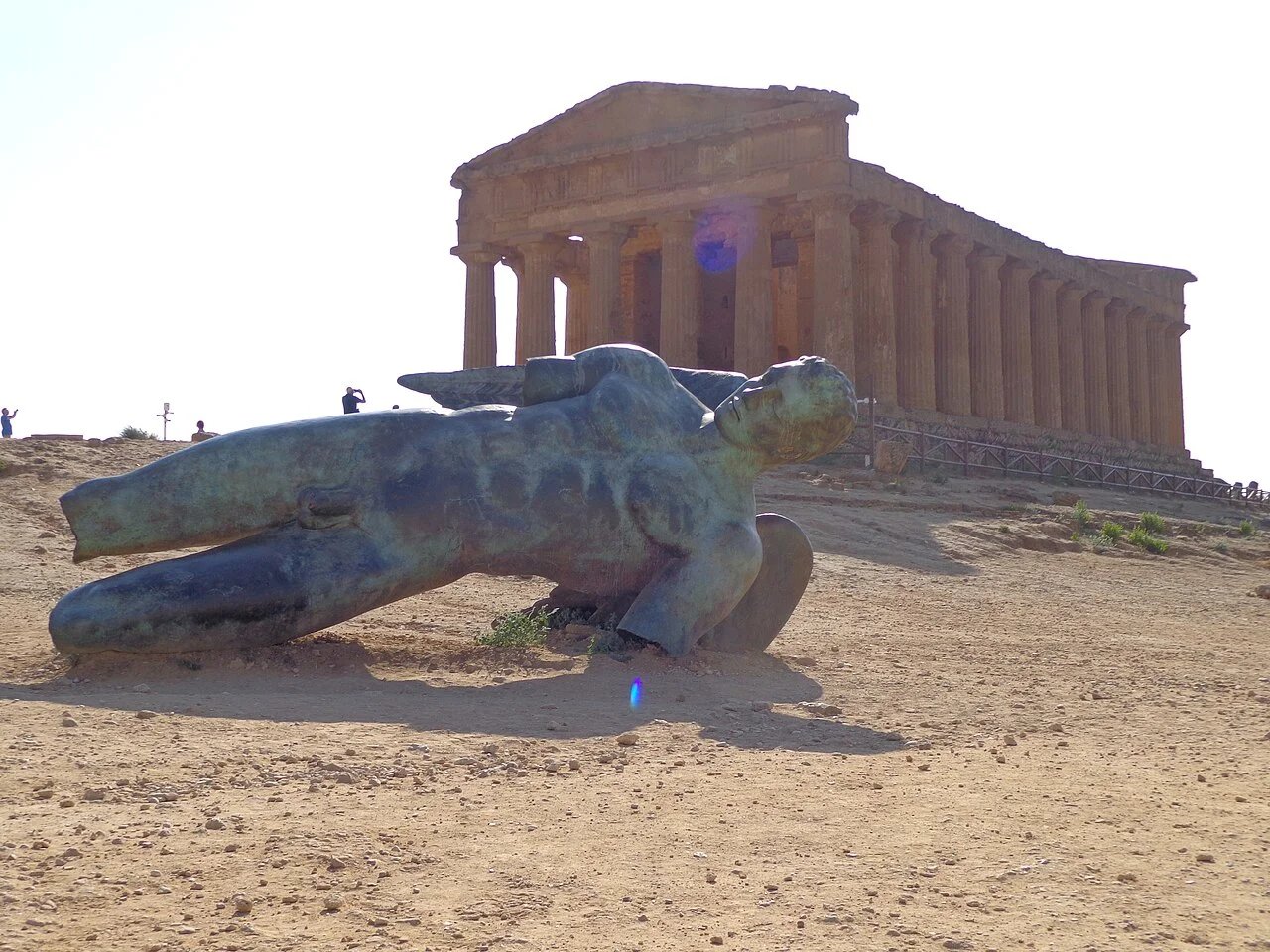
A exposição de 2011 em Agrigento, intitulada Mitoraj ai Templi, foi organizada em colaboração com o Parco Archeologico e Paesaggistico della Valle dei Templi e reuniu aproximadamente vinte bronzes de grande escala posicionados pela zona arqueológica. Para além do Icaro Caduto, obras como o Tindaro Screpolato e o Eros Bendato foram colocadas em diálogo com templos específicos, cada emparelhamento considerado pela ressonância mitológica e não apenas pelo espetáculo visual. A exposição atraiu significativa atenção crítica em toda a Itália e reforçou a posição de Mitoraj como um dos poucos escultores contemporâneos cujo vocabulário estava genuinamente à altura dos sítios clássicos.
The 2011 Agrigento exhibition, titled Mitoraj al Valle dei Templi, was organised in collaboration with the Fondazione Agrigento Cultura and brought together approximately thirty works spanning several decades of the sculptor's output, making it one of the largest single presentations of his bronze and marble pieces ever staged in Italy. Among the works installed across the archaeological park were Eros Alato, Tindaro Screpolato, and several of the draped torso fragments that define his mature idiom — figures whose deliberate incompleteness reads, against the eroded columns of Akragas, less as modernist gesture and more as archaeological fact. The exhibition attracted significant international press coverage and reinforced Mitoraj's standing among European collectors at a moment when his market was consolidating around a recognisable canon of monumental bronzes. Works from this period — cast in limited editions at the Fonderia Pietrasanta Versilia, the foundry with which Mitoraj maintained a close working relationship from the 1980s onwards — now appear regularly at auction through houses including Sotheby's and Dorotheum, with monumental bronzes consistently achieving six-figure results in euros. For collectors, the Agrigento exhibition functions as a provenance milestone: works documented as having been exhibited there carry an art-historical resonance that transcends the biographical. The site itself has since become a reference point in scholarly assessments of Mitoraj's relationship to classical antiquity, distinguishing his practice from contemporaries who engaged with the ancient world through irony rather than genuine devotion.
The 2011 Agrigento exhibition, titled Mitoraj — Valle dei Templi, was organized in collaboration with the Parco Archeologico e Paesaggistico della Valle dei Templi and brought together approximately twenty large-scale bronzes across the archaeological site, making it one of the most ambitious temporary installations Mitoraj undertook in the final decade of his life. Works including Eros Alato, Tindaro Screpolato, and Centauro were positioned throughout the site in dialogue with specific temple structures, their placement negotiated carefully with heritage authorities given the UNESCO protections governing the grounds. The exhibition drew considerable attention from the Italian and international art press, and several of the works shown at Agrigento subsequently appeared at auction or through private placement, with comparable monumental bronzes from the same period achieving prices between €150,000 and €600,000 depending on edition size and condition. Mitoraj typically cast his monumental works in limited editions of three to six, and bronzes exhibited at major archaeological sites — Pompeii, Paestum, Agrigento — carry a documented exhibition history that adds measurable provenance value for serious collectors. The foundry work for this period was executed primarily at the Fonderia Mariani in Pietrasanta, the Tuscan casting centre where Mitoraj maintained close working relationships throughout his career and where his studio continued to manage posthumous casts under estate supervision after his death in Paris in October 2014. For collectors researching specific works from the Agrigento exhibition, the Parco Archeologico maintains archival records of the installation, and the Mitoraj estate — operating through the Atelier Mitoraj in
The 2011 Agrigento installation was organised in collaboration with the Parco Archeologico e Paesaggistico della Valle dei Templi, then directed by Carmelo Beneventano del Bosco, whose advocacy for contemporary art within ancient sites helped secure the necessary cultural permissions. The exhibition brought together approximately twenty bronze works drawn from Mitoraj's mature output, several of which had previously appeared at major European venues including the 1999 Piazza della Signoria exhibition in Florence. Among the pieces temporarily installed across the valley were Tindaro Screpolato, Eros Alato, and Centurione II — works whose fractured surfaces and bandaged forms resonated with an unusual directness against ruins that had themselves survived centuries of earthquake, spoliation, and atmospheric erosion. For collectors and scholars, the exhibition represented an important moment of institutional validation: Mitoraj's idiom, sometimes dismissed in northern European critical circles as aesthetically conservative, found in Agrigento a context that reframed fragmentation not as sentimentality but as historical method. Works from this period — bronzes cast at the Fonderia Mariani in Pietrasanta, where Mitoraj worked for decades — now command consistent results at auction, with mid-sized pieces regularly achieving between €80,000 and €250,000 depending on patina, provenance, and edition number. The permanent retention of Icaro Caduto following the close of the temporary exhibition was the result of a formal agreement between the Parco and the Mitoraj estate, and the work is catalogued within the site's official archaeological inventory — an unusual distinction for a twentieth-century bronze. Visitors approaching the Temple of
The 2011 Agrigento installation marked a late-career consolidation of themes Mitoraj had been developing since the late 1970s, when he abandoned painting after a journey to Mexico and began working in marble and bronze with an intensity that would define the rest of his life. The works selected for the Valle dei Templi reflected his mature vocabulary: monumental fragments — torsos, heads, and limbs — rendered with a classical finish but broken, bandaged, or incomplete in ways that read simultaneously as archaeological finds and contemporary meditations on vulnerability. Beyond Icaro Caduto, the exhibition included large-scale bronzes such as Tindaro Screpolato and Eros Alato, both of which had appeared in earlier outdoor installations in Pompeii and Paris, demonstrating how Mitoraj's foundry — the Fonderia Mariani in Pietrasanta, where he worked closely with master casters throughout his career — produced editions of sufficient depth to allow simultaneous placement across multiple prestigious sites. For collectors, this matters: Mitoraj's bronzes exist in controlled editions, typically between two and eight casts depending on scale, and works associated with landmark exhibitions command measurable premiums at auction. A monumental head from this period sold at Sotheby's Paris in 2019 for well above its upper estimate, reflecting sustained demand from European and Middle Eastern collectors drawn to the intersection of classical subject matter and modernist fragmentation that defines his output. The Agrigento placement also strengthened institutional interest: the permanent retention of Icaro Caduto at the Valle dei Templi was negotiated with the Parco Archeologico e Paesaggistico della Valle dei Templi, giving the work
The 2011 Agrigento exhibition, titled Mitoraj al Parco dei Templi, was organised in close collaboration with the Parco Archeologico e Paesaggistico della Valle dei Templi and represented one of the largest temporary installations of Mitoraj's work ever mounted at a single site, with approximately twenty bronze and marble sculptures placed across the archaeological park. The curatorial logic was deliberately non-interventionist: sculptures were positioned to enter into visual dialogue with specific structures rather than to dominate them, a decision that reflected Mitoraj's own longstanding resistance to the idea of public sculpture as monument. Among the works exhibited alongside Icaro Caduto were Tindaro Screpolato, a colossal fragmented head that had already appeared in numerous European civic spaces, and several of the bandaged torso figures that had defined his mature period since the late 1980s. The exhibition attracted sustained critical attention across Italy and was reviewed in publications including Corriere della Sera and Il Giornale dell'Arte, with critics noting that the Sicilian landscape — itself shaped by centuries of Greek, Arab, and Norman occupation — seemed to absorb the works more naturally than any northern European context had managed. For collectors, the Agrigento installation marked a significant moment in the consolidation of Mitoraj's market positioning: the association with a UNESCO World Heritage Site of this magnitude lent institutional weight to works that had sometimes been dismissed by the contemporary art establishment as romantic or anachronistic. Editions of smaller bronzes related to the mythological subjects explored in the Agrigento works — including scaled versions of Eros Alato and Perseo — were handled through M
The 2011 Agrigento installation drew its sculptural programme from works Mitoraj had been developing since the late 1970s, when he first abandoned painting for bronze and stone after relocating to Pietrasanta, the Tuscan marble town that would remain his primary studio base for the rest of his life. Among the pieces exhibited across the Valle dei Templi that year, Tindaro Screpolato — the massive fragmented head that has since become one of his most recognised works — appeared in dialogue with the Doric columns in a pairing that critics noted felt less like installation and more like archaeology, as if the bronze had always been buried there and was only now surfacing. Mitoraj worked closely with the Fondazione Valle dei Templi and with the park's then-superintendent Carmelo Bennardo to select placements that respected the site's protected status while allowing his figures sufficient scale to hold their own against the ancient stonework. Several of the bronzes exhibited in 2011 were cast at the Fonderia Mariani in Pietrasanta, the foundry with which Mitoraj maintained a decades-long relationship and which continues to work with his estate. For collectors, this provenance chain — from Mitoraj's Pietrasanta atelier through Mariani and into institutional exhibitions — is a significant marker of authenticity, particularly for medium-format works from this period that occasionally appear at auction. The Agrigento exhibition coincided with a broader reassessment of Mitoraj's market position in the early 2010s: after years in which his work had been regarded primarily as high-end decorative sculpture, institutions including the Musée du Louvre — which had hosted his work in its courtyard in 1988 — and the Parc de
The 2011 Agrigento exhibition, titled Mitoraj — Valle dei Templi, was organized in collaboration with the Parco Archeologico e Paesaggistico della Valle dei Templi and brought together approximately twenty large-scale bronze works drawn from across Mitoraj's mature career. Among the pieces installed across the archaeological site were Tindaro Screpolato, Eros Alato, and Grande Omaggio — each positioned in deliberate dialogue with specific temples and landscape axes rather than arranged as a conventional outdoor exhibition. The curatorial logic was spatial and archaeological: Mitoraj and the exhibition's organizers studied sight lines and cardinal orientations before each placement was finalized, a process that took several weeks on site. The show attracted significant critical attention in Italy and reinforced Mitoraj's standing as one of the few contemporary sculptors whose work could occupy ancient sacred space without appearing presumptuous or decorative. For collectors, the Agrigento exhibition marks a useful reference point in the chronology of his large bronzes: works documented at Valle dei Templi carry exhibition provenance that is both verifiable and culturally legible, making condition reports and photographic records from 2011 particularly valuable for establishing histories of individual casts. Mitoraj worked with the Fonderia Artistica Battaglia in Milan — one of Italy's oldest and most technically rigorous bronze foundries, established in 1913 — for the majority of his monumental castings, and many of the Agrigento pieces originated from editions that had previously been shown in Pompeii, where a comparable site-specific exhibition was mounted in 2009. That earlier Pompeii exhibition, which placed bronzes among the ruins of
The 2011 Agrigento installation marked a decisive shift in how the secondary market assessed Mitoraj's monumental bronzes. Prior to that exhibition, large-scale works by Mitoraj — particularly the fragmented heads and winged figures cast at the Fonderia Artistica Battaglia in Milan, where he had worked since the early 1980s — were evaluated primarily within a European gallery context, with auction results clustered at houses including Sotheby's Paris and Dorotheum Vienna. After photographs of Ikaro Caduto beside the Temple of Concordia circulated internationally, collector interest in his monumental editions widened considerably beyond France and Italy, drawing serious attention from American and Middle Eastern buyers who had not previously engaged with his work. The visual argument the site made was unusually persuasive: here was a sculptor whose central preoccupation — the fractured, bandaged body as a figure of aspiration rather than defeat — had found its most natural habitat not in a museum garden but among ruins that were themselves incomplete, weather-worn, and still commanding. For collectors acquiring maquettes or medium-scale bronzes, provenance tracing back to the Agrigento period carries a specific premium; works documented as exhibited or related to the 2011 installation consistently achieve stronger hammer prices than comparable casts without that association. Mitoraj produced work in multiple cast editions throughout his career, and establishing which foundry and which numbered cast a given piece represents remains essential due diligence for serious buyers — the Battaglia foundry casts are generally regarded as the most authoritative, though works cast under Mitoraj's supervision at other certified foundries are considered fully authentic. Beyond Ikaro Caduto, the 2011 Valle dei Templi exhibition included significant works such as The 2011 Agrigento installation marked a significant shift in how the international art market perceived Mitoraj's monumental bronzes. Prior to the Valle dei Templi exhibition, his large-scale works had appeared predominantly in urban European settings — the Place Vendôme in Paris in 1996, Pompeii in 1998, Piazza della Signoria in Florence in 2000 — and the critical conversation around them tended to emphasize their dialogue with Renaissance and Baroque civic space. Agrigento reframed that conversation entirely. By placing works such as Eros Alato, Tindaro Screpolato, and Ikaro within a pre-Roman Greek sanctuary, the exhibition made visible something that had always been structurally present in Mitoraj's practice but rarely stated so plainly: his sculptures are not responses to classical antiquity so much as continuations of it, created with a two-and-a-half-millennium delay. Dealers and private collectors who attended the Agrigento opening in the spring of 2011 reported that the site fundamentally altered their understanding of scale in his work. A bronze that reads as large in a gallery courtyard becomes something closer to inevitable when measured against a Doric column. This recalibration had tangible consequences for the secondary market. In the years immediately following the Agrigento exhibition, auction results for Mitoraj's mid-size and monumental bronzes climbed steadily, with several works exceeding their high estimates at sales in London and Milan. The foundry records held by the Fonderia Artistica Battaglia in Milan — the Milanese foundry with which Mitoraj worked closely for much of his career — indicate that editions of works exhibited The 2011 Valle dei Templi exhibition, titled Mitoraj a Agrigento, was organised in collaboration with the Parco Archeologico e Paesaggistico della Valle dei Templi and brought together approximately thirty works spanning several decades of the sculptor's output — among them Tindaro Screpolato, Ala di Luce, Perseo, and Troiano, positioned across the archaeological landscape in dialogue with specific temples and sight lines rather than arranged as a conventional outdoor exhibition. The curatorial logic was topographic: each placement was negotiated between Mitoraj and the park's archaeological directorate over several months, with the sculptor making repeated site visits to determine orientation, elevation, and proximity to ancient stonework. This level of site-specificity was characteristic of Mitoraj's mature practice and distinguishes the Agrigento installation from his earlier public commissions, which were more frequently conceived in the studio and adapted to location afterwards. For collectors, the Valle dei Templi project carries particular significance because it represented one of the last major survey exhibitions organised during Mitoraj's lifetime at which monumental bronzes from multiple periods were shown together in a single continuous space — a circumstance that rarely arises in the secondary market, where individual works surface without the interpretive frame that proximity to related pieces provides. Mitoraj's foundry relationships, principally with the Fonderia Artistica Battaglia in Milan, which cast many of his major bronzes from the 1980s onward, mean that edition documentation for works of the scale shown in Agrigento is generally traceable, and provenance chains for pieces exhibited at the Valle dei Templi in 2011 carry the additional authentication weight Pergunte ao assistente IA — baseado nas páginas da coleção, respostas no seu idioma. Os bronzes mitológicos que se ergueram em Agrigento — Centurione, Persée, Eros Bendato — existem como edições de colecionador em escala íntima. Compro diretamente, de forma privada, em qualquer lugar da Europa. Any other Mitoraj work also welcome — any subject, condition, or format. Veja também: Mitoraj em Veneza · Mitoraj em Cracóvia · Mitoraj em Bamberg · Mitoraj em Milão Este site documenta a busca de um colecionador particular por obras de Igor Mitoraj (1944–2014) — o escultor polaco-francês celebrado pelas suas figuras clássicas fraturadas em bronze e mármore. Mitoraj estudou em Cracóvia sob Tadeusz Kantor, formou-se em Paris na École nationale supérieure des beaux-arts e estabeleceu o seu ateliê permanente em Pietrasanta, Toscana, em 1983. Se tem uma obra de Mitoraj disponível, por favor use o botão de contacto para nos contactar. Quer vender uma obra de Mitoraj? Ver nossa página de venda →Perguntas sobre esta obra?
Possui uma Obra de Mitoraj?
Sobre Esta Coleção