🇮🇹 ローマのミトライ
イタリア · イーゴル・ミトライの公共彫刻
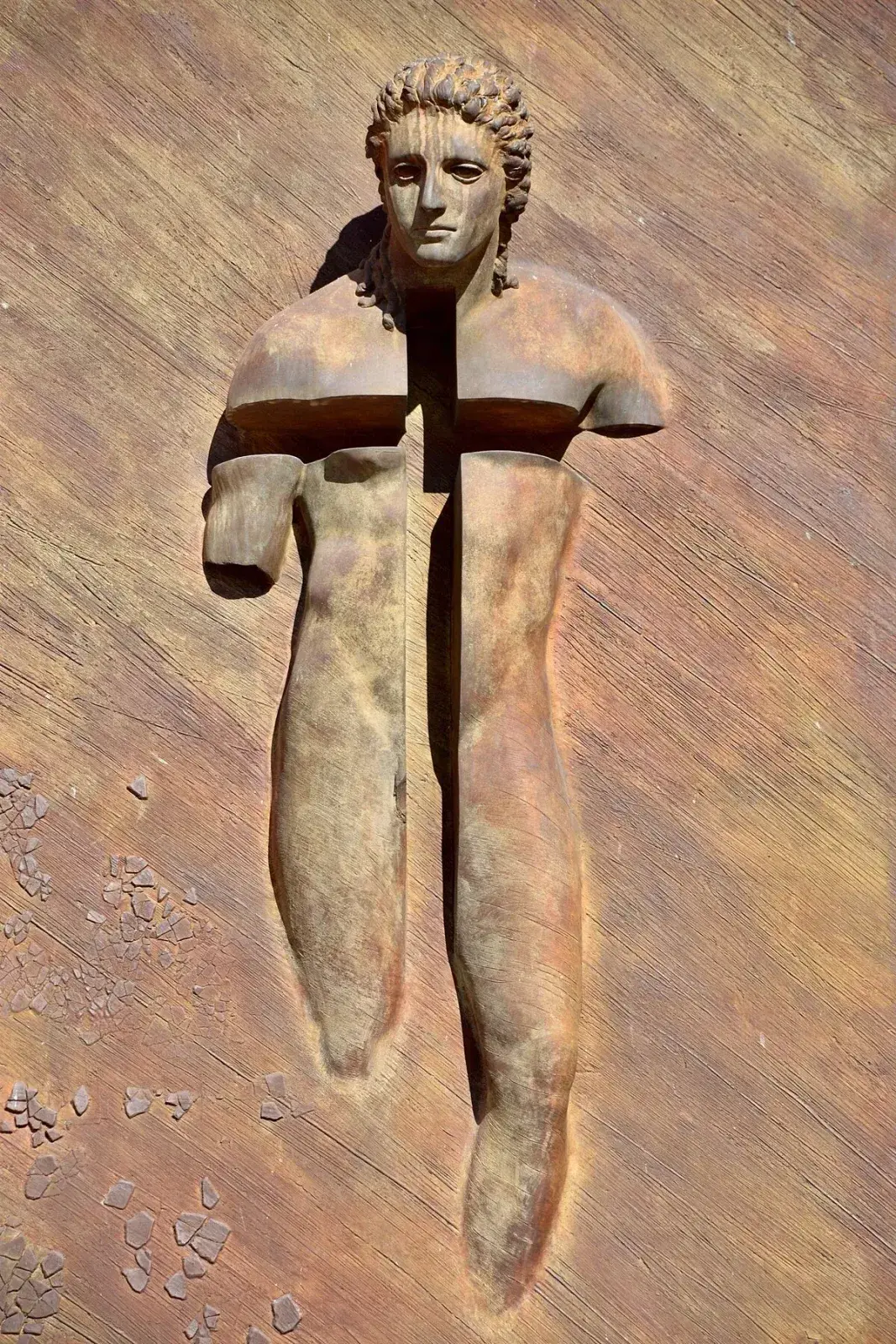
ローマはミトライの最も重要な公共委嘱の地の一つです。サンタ・マリア・デッリ・アンジェリ・エ・デイ・マルティリ教会(ミケランジェロが設計したパンテオン浴場跡)には、2006年に制作した大型ブロンズ扉と洗礼者ヨハネ像が設置されています。
主要作品と設置場所
- ブロンズ扉と洗礼者ヨハネ像 — サンタ・マリア・デッリ・アンジェリ・エ・デイ・マルティリ教会 · 2006年
- その他の設置作品 — ローマ市内各所
Dea Roma — the goddess Rome, the personification of the city — was a subject that occupied Roman coinage and civic iconography for centuries. Mitoraj's version, installed permanently at Piazza Monte Grappa in 2003, reinterprets the classical personification through his own visual syntax: the monumental female form, fragmented, partially wrapped, emerging from the bronze surface as if from excavation.
Piazza Monte Grappa is in the Prati neighbourhood, north of the Tiber and close to the Vatican — a quieter, residential part of Rome that gives the Dea Roma a different civic register than the highly touristic zone around Santa Maria degli Angeli. Where the church doors speak to millions of visitors annually, the Piazza Monte Grappa installation is part of the daily life of the neighbourhood.
Rome & Pietrasanta — The Italian Foundation
Mitoraj's relationship with Italy was defining. He first arrived in the 1970s, discovered the marble carvers and bronze foundries of Pietrasanta, and remained bound to the region for the rest of his life. While his studio was in Pietrasanta, Rome represented the culmination of the classical tradition he had spent his career engaging with. The Santa Maria degli Angeli commission in 2006 — eight years before his death in Pietrasanta in 2014 — was in many ways the fulfilment of that long engagement.
For collectors, the Rome connection is significant: the works produced in proximity to these major public commissions — the bronze editions, the lithographs, the unique works — carry the same visual vocabulary that Mitoraj brought to the most prestigious public spaces in the world.

The bronze doors commission came through a process that connected Mitoraj to a long tradition of artist-church collaboration in Rome. Cardinal Francesco Marchisano, then president of the Fabbrica di San Pietro and a significant figure in the Vatican's engagement with contemporary art, was instrumental in advancing the project. The doors weigh approximately six tonnes in total and were cast at the Fonderia Mariani in Pietrasanta, the foundry Mitoraj used for much of his monumental bronze work throughout the 1990s and 2000s. Collectors seeking to understand the scale of Mitoraj's ambition during this period should note that the Santa Maria degli Angeli commission occupied him for several years and coincided with some of his most sought-after limited edition bronzes — works from the early 2000s that now represent a pricing high-water mark at auction. The freestanding San Giovanni Battista installed inside the basilica is distinct from the door reliefs in its full sculptural presence: a fragmented male torso rendered with the combination of classical composure and deliberate incompleteness that defines his mature style, and which serious collectors recognise as the hallmark of his peak output.
The iconographic programme of the Santa Maria degli Angeli commission extended beyond the doors themselves. Mitoraj's freestanding bronze San Giovanni Battista, positioned inside the basilica, depicts the saint in the sculptor's characteristic mode — a fragmented, partially formed figure that reads simultaneously as archaeological find and contemporary vision. The choice of St John the Baptist carried personal resonance: Mitoraj was baptised Catholic in France and maintained a private spiritual dimension to his work that collectors and curators close to him frequently noted, even as his public statements remained measured on the subject. The basilica's unusual history — a Counter-Reformation church embedded within the shell of a third-century imperial bathing complex — mirrors the layered temporal logic that defines Mitoraj's entire output. Visitors approaching from Piazza della Repubblica encounter the doors at eye level, an unusually intimate scale for monumental bronze work of this kind, allowing close inspection of surface detail that rewards the same attention one would bring to a cabinet bronze. For collectors building serious holdings of Mitoraj's work, understanding these Roman commissions is essential context: the iconography, the material dialogue with ancient stone, and the formal language of the public bronzes all recur — at reduced scale — in the edition bronzes and unique works that appear at auction and through specialist dealers. The 2006 unveiling drew considerable institutional attention and consolidated his standing among post-war European figurative sculptors of the first rank.
The doors of Santa Maria degli Angeli e dei Martiri represent one of the few instances where Mitoraj worked directly within an established Catholic liturgical tradition, placing him in a lineage that includes Ghiberti's celebrated doors for the Florence Baptistery and Giacomo Manzù's work for St Peter's Basilica — commissions that, historically, define the reputations of sculptors across generations. The iconographic programme Mitoraj developed for the basilica extends beyond St John the Baptist to incorporate fragmented angelic figures and faces emerging from the bronze surface, consistent with the vocabulary he had developed over decades but here given a specifically sacred charge. Collectors and scholars have noted that the commission arrived at a late and confident period in his career, when his market recognition in Europe was at its height — his solo exhibition at the Boboli Gardens in Florence in 1999 had drawn significant institutional attention and consolidated serious collector interest in his large-format bronzes. The basilica itself draws over a million visitors annually, making Mitoraj's doors among the most-viewed works he ever produced, far exceeding the audience of any gallery or auction context. For collectors assessing his legacy, the Roman commissions carry particular weight: they establish that his work was considered appropriate for the most historically loaded sites in Western European culture, not merely as contemporary ornament but as a continuation of a sculptural conversation stretching back through Bernini, Michelangelo, and the classical world that Mitoraj had always treated as a living inheritance. Works from this period — bronzes dated to the early 2000s — consistently attract the strongest prices when they appear at auction, particularly at Sotheby's and Christie's European sales.
The Santa Maria degli Angeli commission emerged from a relationship between Mitoraj and the Diocese of Rome that had been developing through the early 2000s, with the artist presenting preparatory drawings and maquettes to church authorities before the final bronze programme was approved. The completed ensemble comprises not only the main doors but a series of relief panels whose iconographic programme — figures emerging from, or being absorbed into, an indeterminate ground — translates Mitoraj's studio vocabulary directly into a liturgical context without compromise on either side. For collectors, this ecclesiastical dimension adds a layer of provenance thinking: works from the same casting campaigns at the Fonderia Mariani in Pietrasanta, which produced elements of the church commission, share a material genealogy with the public pieces. Mitoraj's practice of issuing numbered bronze editions — typically in runs of eight plus artist's proofs — means that cabinet-scale works such as Testa di Ikaro and Eros Bendato from this period circulate through specialist auctions at Sotheby's, Christie's, and Artcurial, regularly achieving prices between €40,000 and €180,000 depending on scale and condition, with documented provenance to the Pietrasanta studio strengthening results at the upper end of that range.
The Santa Maria degli Angeli commission was not Mitoraj's first encounter with Rome's sacred architecture. Throughout the 1990s, he exhibited large-scale bronzes at several Roman venues, building a reputation in the city that preceded the 2006 doors by more than a decade. The commission itself involved eight monumental bronze panels for the central portal, each depicting figures from early Christian iconography rendered in Mitoraj's characteristic idiom — classical bodies incomplete, faces partially occluded, limbs dissolving into abstracted mass. The scale demanded by the basilica's Michelangelo-designed interior pushed Mitoraj toward some of his largest bronze castings, all produced at the Pietrasanta foundries he had worked with since the 1970s. For collectors tracking the relationship between his public and private work, the period 2003–2008 is particularly instructive: the monumental commissions in Rome and elsewhere — including the Paestum installation of 2002, where his bronzes were placed among standing Greek temples — generated a corresponding body of smaller bronze editions and works on paper that share the same resolved formal thinking. Editions produced during this period, particularly those cast at Arte Fonderia Mariani in Pietrasanta, are among the most consistently documented in terms of provenance and foundry records, making them relatively straightforward to authenticate. Auction results at Christie's and Sotheby's from 2015 onward reflect sustained collector interest in bronzes from this mature phase, with Eros Alato and Tindaro Screpolato variants from the early 2000s achieving strong secondary market premiums.
The Santa Maria degli Angeli commission was not Mitoraj's first engagement with Rome's institutional fabric. As early as 1995, his work had been exhibited in the city through the Galleria Nazionale d'Arte Moderna, and the sustained critical attention that followed helped establish him as one of the few living sculptors whose practice was considered genuinely continuous with the Western classical tradition rather than merely referencing it. When the Fabbrica di San Pietro — the Vatican's own building administration — endorsed the Santa Maria degli Angeli project, it represented an ecclesiastical imprimatur that few contemporary sculptors of any nationality had received. The eight bronze door panels, each depicting figures from early Christian and classical antiquity, were cast at the Fonderia Mariani in Pietrasanta, the foundry with which Mitoraj maintained his closest working relationship across several decades. For collectors, this foundry provenance matters: works cast at the Mariani foundry carry consistent metallurgical documentation, and the edition records maintained there have provided a reliable basis for provenance research in the secondary market. Mitoraj typically worked in small numbered editions — often between three and six casts for larger bronzes, with larger editions reserved for smaller-format works and reliefs — which has kept supply constrained relative to the sustained institutional demand his public commissions continue to generate. Since his death in 2014, auction results across Paris, London, and Milan have reflected a steady upward revaluation, particularly for works produced between 1990 and 2006, the period bracketed by his first major European retrospectives and the completion of the Rome doors. Collectors entering the market now are acquiring work whose public context — the piazzas, the basilicas, the permanent installations across three continents — is fully established and unlikely to diminish in cultural legibility.
The bronze doors at Santa Maria degli Angeli represent only one register of Mitoraj's engagement with the ancient fabric of Rome. Throughout the 1990s, the city served as an extended studio of reference: Mitoraj made repeated working visits to study the collections of the Museo Nazionale Romano, in particular the fragmentary Hellenistic and Republican-era bronzes held at the Palazzo Massimo alle Terme, whose condition — limbs severed, surfaces corroded to a mineral patina — directly informed the visual language he was developing in parallel at the Pietrasanta foundry. Scholars and gallerists who worked with Mitoraj during this period, including staff at the Galleria Forni in Bologna, which represented him from the 1980s onward, noted that Rome functioned less as a commission destination than as an archive he returned to repeatedly to test his intuitions about damage, beauty, and survival. For collectors, this context matters when assessing works on paper and small bronzes from the decade before the Santa Maria degli Angeli doors were installed. Editions such as Tindaro Screpolato and Eros Bendato, produced in limited bronze casts through the mid-to-late 1990s, reflect not the finished public monument but the working vocabulary Mitoraj was refining in direct conversation with Roman antiquity. The market for these mid-career bronzes has strengthened steadily since his death in 2014, with auction appearances at Sotheby's Paris and Dorotheum Vienna confirming consistent collector demand for works that predate the peak public visibility of the church commission. Provenance connected to Italian private collections — particularly those assembled in Rome or Tuscany during the 1990s and early 2000s — tends to carry
The Santa Maria degli Angeli commission drew Mitoraj into a sustained dialogue with one of Rome's most technically demanding sacred spaces — a basilica whose interior volume, converted by Michelangelo from the frigidarium of the Baths of Diocletian, imposes extraordinary scale requirements on any artist working within it. The bronze doors Mitoraj designed for the church's main entrance were cast at the Fonderia Mariani in Pietrasanta, the foundry with which he maintained a long working relationship and which produced many of his major monumental editions. Beyond the doors themselves, Mitoraj contributed San Giovanni Battista, a standing figure whose treatment of the body — partially dissolved, the surface interrupted by absences — reads as a meditation on faith and fragmentation rather than a conventional devotional image. The commission was overseen in part through the Vatican's cultural apparatus, giving the project an institutional weight that positioned Mitoraj alongside a small number of contemporary artists trusted with permanent work in Rome's active ecclesiastical spaces. For those researching the market, it is worth noting that Mitoraj's monumental public commissions in Rome coincided with a period of heightened international attention to his bronze editions, roughly 2003 to 2008, during which auction appearances for signed and numbered bronzes increased across London, Paris, and Milan. Works from this period — particularly bust-scale fragments and winged heads in patinated bronze — tend to carry stronger provenance narratives when documentation connects them to the Pietrasanta foundry runs adjacent to the public commission work. The Testa di Ikaro and Eros Bendato editions, for example, were produced in multiple scales during overlapping foundry campaigns, and examples with exhibition history from Italian institutions or gallery presentations in Rome itself
The Santa Maria degli Angeli commission was not Mitoraj's first contact with Rome's sacred architecture. As early as the 1990s, his work had circulated through the city's gallery network, and Italian collectors — particularly those connected to the Prati and Parioli districts — had begun acquiring bronze editions well before the 2006 doors brought him to wider public attention. The doors themselves consist of eight panels cast at the Marinelli foundry in Pietrasanta, each depicting figures drawn from Mitoraj's established formal lexicon: veiled heads, truncated torsos, and faces partially consumed by the bronze surface. The commission was awarded under Pope John Paul II's Jubilee cultural programme, which sought to introduce contemporary sacred art into the fabric of Rome's historic churches — a context that gives the work a precise institutional timestamp. For the secondary market, this matters: bronzes dated or editioned around 2003–2006, the years bracketing the Rome commission, represent a period of heightened critical visibility for Mitoraj in Italy, and auction results from houses including Sotheby's Milan and Dorotheum Vienna reflect a measurable premium on works from this window. Collectors approaching the Rome-period output should also be aware of Ikaro and Perseo, two subjects Mitoraj returned to repeatedly across different scales and patinas, and which appear in both public siting and private editions from this era. The distinction between unique works — cast in single exemplars and frequently tied to specific exhibition moments — and the numbered editions, typically running to eight plus four artist's proofs, is central to valuation. Works exhibited at the Galleria dello Scudo in Verona or at Mitoraj's own shows coordinated through the Contini Gallery in Venice during the early
Own a Mitoraj Work?
I buy Mitoraj bronzes, marbles, lithographs and drawings directly and privately — anywhere in Europe. Discreet, prompt, fair price.
Contact Me DirectlyMitoraj in Other Cities