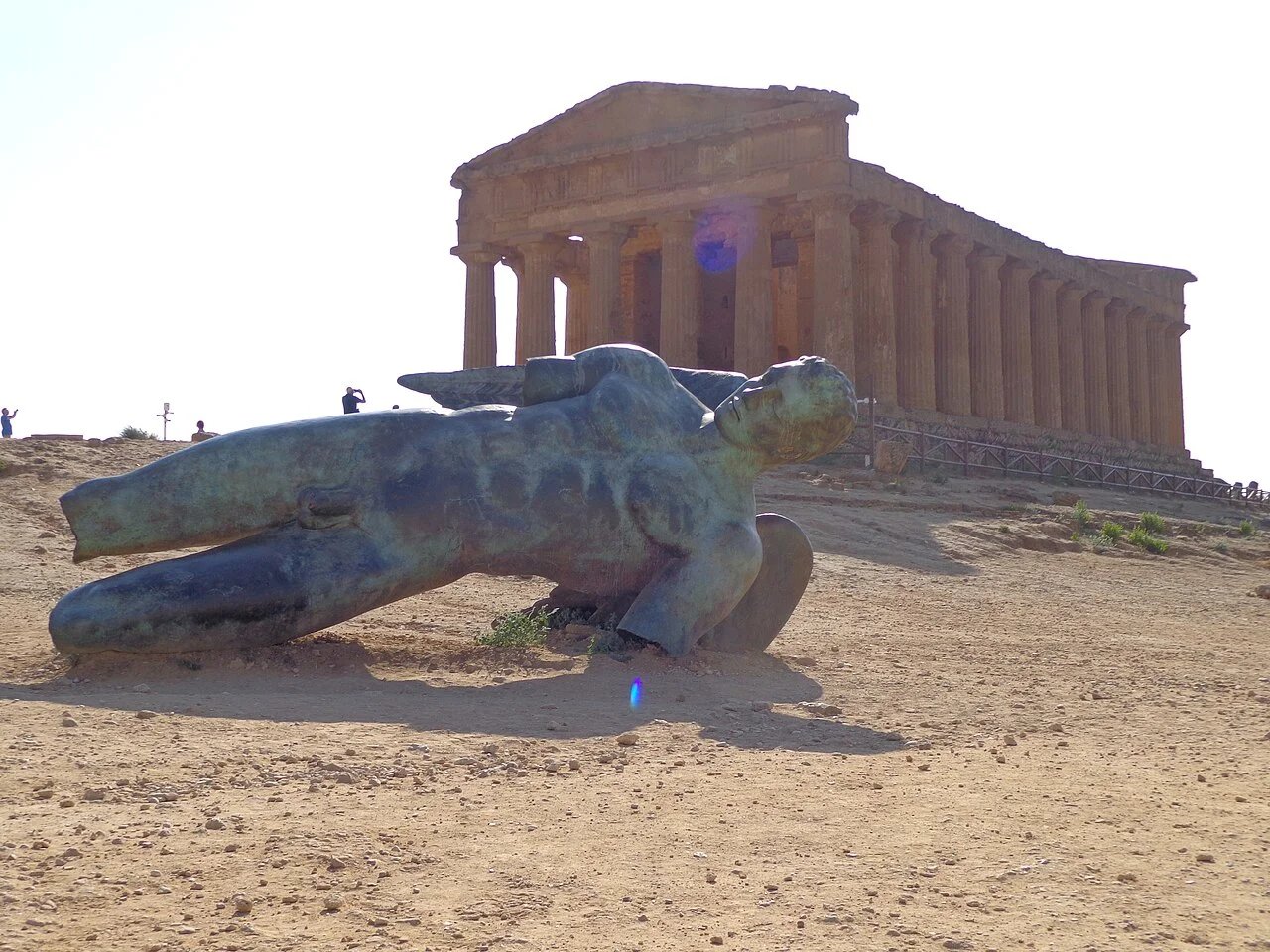
Ίγκορ Μιτοράι στο Αγκριτζέντο
In 2011 — three years before his death — Igor Mitoraj installed monumental sculptures among the Greek temples of the Valley of the Temples at Agrigento, Sicily. It was the most ancient landscape his work had ever inhabited: temples built between the fifth and sixth centuries BC, dedicated to the gods of the same mythology that had sustained his entire sculptural career. Concordia, Juno, Heracles, Zeus — these were not abstract historical references but the living subjects of his bronzes, the figures whose damaged, bandaged faces he had spent forty years casting. At Agrigento, Mitoraj's work finally stood where the myths themselves had been worshipped.
Agrigento's Valley of the Temples hosted Mitoraj's work in a major temporary exhibition in 2011, but Icaro Caduto — placed in front of the Temple of Concordia — endured. Confirmed still standing by visitors in 2026, it has become one of the most photographed juxtapositions in Sicily: a modern fragmented bronze in the shadow of a 2,500-year-old Doric temple. Both are studies in the same subject — the gap between human aspiration and human limitation. The Valley of the Temples is a UNESCO World Heritage Site receiving over 700,000 visitors annually.
Μνημειακά Γλυπτά — Κοιλάδα Ναών, 2011
The Valley of the Temples — Valle dei Templi — is the largest and best-preserved complex of ancient Greek temples outside of Greece itself, designated a UNESCO World Heritage Site in 1997. The site extends across a ridge south of Agrigento, with seven temples in varying states of preservation overlooking the Mediterranean coast. The Temple of Concordia, built around 440 BC and still largely intact, is among the most complete ancient Greek temples in the world.
Installing Mitoraj's bronzes here in 2011 was an act of extraordinary cultural audacity — and extraordinary cultural logic. His fragmented figures of gods and heroes were not foreign objects placed in an archaeological park: they were homecomings. The Centurione, the Persée, the Eros Bendato, the mythological torsos — all of these subjects were originally worshipped in temples exactly like the ones at Agrigento. The names had been different, the language Latin rather than Greek, but the sacred geography was the same.
The installation had a specific visual quality that no interior or urban setting could replicate. The bronzes in the golden limestone landscape of the Valle dei Templi, surrounded by ancient olive trees and under the Sicilian light — a light that is harder, more horizontal, more searching than the softer light of Tuscany or the Île-de-France — acquired a presence that photographs only partially capture. The patinated bronze surfaces, designed to age and weather, were in their natural element against stone that had been doing the same for twenty-five centuries.
Η Κοιλάδα Ναών — Τι Θα Δείτε
The Valle dei Templi is not a conventional museum or archaeological park. It is a living landscape — olive trees grow between the temples, wild flowers cover the ground in spring, and the Mediterranean is visible from the ridge on clear days. The temples themselves range from the nearly complete (Concordia, Heracles) to substantial ruins (Juno, Zeus Olympius — of which only one column stands) to fragmentary remains. The scale is consistently larger than visitors expect: the Temple of Zeus Olympius was, when intact, the largest Doric temple ever built.
For Mitoraj visitors, the 2011 exhibition is no longer in place — the works were temporary, though the Agrigento connection remains significant in understanding his relationship with the ancient world. The site itself rewards a visit of several hours; the Museo Archeologico Regionale di Agrigento, in the modern town, holds the finds from the excavations including the remarkable Telamon figure from the Temple of Zeus.
Σικελία, Μεγάλη Ελλάδα και Πηγές Έμπνευσης Μιτοράι
Sicily was the heartland of Magna Graecia — the Greek colonial world of the western Mediterranean. Between the eighth and third centuries BC, Greek colonists established cities across Sicily (Syracuse, Agrigento, Selinunte, Gela) and southern Italy (Croton, Sybaris, Taranto) that rivalled the cities of mainland Greece in wealth and cultural ambition. The temples they built were sometimes larger and always more elaborately decorated than their equivalents in Athens or Corinth.
Mitoraj's entire visual world is built on this legacy — not the Athenian classical tradition specifically, but the broader ancient Mediterranean inheritance that Magna Graecia represents. His subjects are Greek in origin (Perseus, Eros, Daedalus, the centaur) but his formation was Italian (Pietrasanta, Rome, the Versilia foundries). The Agrigento installation placed him at exactly the point where these two traditions intersect: the Greek west, the Italian south, the Mediterranean basin where antiquity began.
Επίσκεψη στο Αγκριτζέντο
The Valley of the Temples is located about 3 km south of Agrigento town centre, accessible by local bus or taxi. The nearest airports are Palermo (approximately 130 km, roughly 2 hours by car or bus) and Catania (approximately 180 km). Agrigento itself is accessible by train from Palermo (approximately 2 hours). The site is open daily; the best light for photography — and for the experience of the temples generally — is in the late afternoon, when the limestone turns gold and the shadows lengthen across the ridge.
Spring (March–May) is the ideal season, when the almond blossom (Agrigento is famous for its almond festival in February) has given way to wildflowers and the site is not yet crowded with summer visitors.

The 2011 Agrigento exhibition, titled Mitoraj ai Templi, was organised in collaboration with the Parco Archeologico e Paesaggistico della Valle dei Templi and brought together approximately twenty large-scale bronzes positioned across the archaeological zone. Beyond Icaro Caduto, works including Tindaro Screpolato and Eros Bendato were placed in dialogue with specific temples, each pairing considered for mythological resonance rather than visual spectacle alone. The exhibition drew significant critical attention across Italy and reinforced Mitoraj's standing as one of the few contemporary sculptors whose vocabulary was genuinely commensurate with classical sites — a judgment that carried weight in the Italian market, where his bronzes had long commanded serious secondary prices. For collectors, the Agrigento exhibition represents a documented provenance moment: works that appeared in the Valle dei Templi installation carry exhibition history tied to one of antiquity's most significant landscapes, a circumstance that distinguishes them within Mitoraj's catalogue. The artist's Pietrasanta foundry, Fonderia Mariani, cast many of the pieces shown at Agrigento, and bronzes bearing this foundry mark alongside the 2011 exhibition documentation are considered among the more traceable examples of his monumental output. Mitoraj died in October 2014 in Paris, meaning the Agrigento installation stands as part of the final decade of his active production — a period now assessed by the market with particular scrutiny given the finite and increasingly well-documented nature of his late work.
The 2011 Agrigento exhibition, titled Mitoraj al Parco dei Templi, comprised approximately thirty bronze works distributed across the archaeological site, curated in collaboration with the Parco Archeologico e Paesaggistico della Valle dei Templi under the direction of Ernesto De Miro. Beyond Icaro Caduto, significant pieces placed during that installation included Tindaro Screpolato and Eros Alato, both characteristic of Mitoraj's mature period: large-scale figures fractured at the neck or torso, their surfaces carrying the deliberate patination he refined over decades in his Pietrasanta foundry. For collectors, the Agrigento placement matters beyond spectacle. Works exhibited in major archaeological contexts — Pompeii, the Louvre, the Valley of the Temples — carry a distinct provenance weight in the secondary market, and bronzes photographed against these backdrops appear repeatedly in auction house catalogue essays as evidence of institutional validation. Mitoraj's estate, managed after his death in 2014 by his longtime collaborators, has maintained careful edition controls on major works, meaning monumental pieces from this period rarely circulate; when they do, they tend to appear through specialist European houses rather than the major international rooms. Smaller-scale bronzes and the artist's terracotta maquettes — working studies for exactly the kind of monumental pieces deployed at Agrigento — represent the more accessible entry point for serious collectors, occasionally surfacing through Italian regional houses and, with increasing frequency, through dedicated sculpture galleries in Paris and London that have built sustained programmes around post-war Mediterranean figuration. The Agrigento exhibition remains the most geographically and historically reson
The 2011 Agrigento exhibition, titled Mitoraj al Valle dei Templi, comprised roughly thirty works distributed across the archaeological park, making it one of the largest temporary exhibitions of his sculpture ever mounted at a single site. Among the pieces displayed alongside Icaro Caduto were Centurione, Tindaro Screpolato, and several of the draped torso works that collectors associate with his mature period — bronzes whose surface patinas Mitoraj developed through a collaboration with the Pierantoni foundry in Pietrasanta, the Tuscan casting town where he maintained his principal studio from the 1980s onward. The exhibition was organized in partnership with the Parco Archeologico e Paesaggistico della Valle dei Templi and drew significant international press attention, reinforcing what the secondary market had already begun to reflect: that Mitoraj's monumental works, when placed in historically charged outdoor settings, generated a documentary record — exhibition catalogues, photographic editions, critical essays — that directly supports provenance and attribution for collectors acquiring smaller bronzes of the same subjects. The 2011 Agrigento catalogue, published with bilingual Italian and French text, remains a reference document for works from this period. Collectors acquiring mid-scale bronzes of Icaro or Tindaro variants should note that the Agrigento showing established these subjects as among the most publicly documented in Mitoraj's entire output, which bears on both authentication and long-term desirability. The permanent retention of Icaro Caduto after the temporary exhibition closed followed a pattern seen at other major sites — Pompeii
The 2011 Agrigento exhibition, titled Mitoraj al Valle dei Templi, was organised in collaboration with the Regional Archaeological Park and brought together approximately thirty works spanning several decades of the sculptor's output — among them Tindaro Screpolato, Eros Alato, and Perseo, works that Mitoraj had refined across multiple castings and scales throughout the 1980s and 1990s. The placement of each piece was deliberate rather than decorative: Eros Alato, with its severed wings and sealed eyes, was positioned along the Sacred Way, the ancient processional route connecting the temples, so that visitors encountered it as pilgrims once encountered votive objects — as a threshold, not a destination. Mitoraj worked directly with the park's archaeological team to ensure that no anchor points damaged the original stonework, a constraint that shaped the final positioning of several pieces and gave the installation its quality of careful coexistence rather than imposition. For collectors, the Agrigento exhibition holds particular significance as a reference point for condition and scale: bronzes that appeared there can be cross-referenced against photographs from the show when assessing patina consistency and casting generation on works that subsequently entered private hands. The exhibition catalogue, published by Mondadori Electa with critical texts by Salvatore Settis and Giuseppe Barbera, remains one of the more rigorous scholarly treatments of Mitoraj's relationship to antiquity and is a standard reference in the secondary market for authentication purposes. Settis, the classicist and former director of the Getty Research Institute, argued in his catalogue essay that Mitoraj's fragmentation was not a modernist gesture of irony toward the classical tradition but
The 2011 Agrigento exhibition, titled Mitoraj. Valle dei Templi, was organised in collaboration with the Parco Archeologico e Paesaggistico della Valle dei Templi and curated with the direct involvement of Mitoraj himself, who travelled to the site to oversee the placement of each work — a process he described as one of the most emotionally significant of his career. Beyond Icaro Caduto, the exhibition included approximately twenty large-scale bronzes positioned across the archaeological park, among them Tindaro Screpolato, Eros Alato, Perseo, and Grande Testa di Centauro — works that collectors familiar with Mitoraj's output will recognise as among his most resolved formal statements. The decision to site Tindaro Screpolato near the Temple of Heracles was not incidental: the work, depicting a colossal head bisected to reveal a hollow interior, had already been placed permanently in Warsaw's Old Town Market Square in 1999, and its Agrigento appearance marked one of the few occasions when a work of that scale was temporarily relocated to a new archaeological context. For collectors and scholars tracking the exhibition history of individual casts, the Agrigento showing is now considered a significant provenance point, and works that appeared in the 2011 Valle dei Templi catalogue carry a documentation value that auction specialists at Sotheby's and Christie's have noted in subsequent sale descriptions. The exhibition catalogue itself — a bilingual Italian and English volume produced by Electa — has become a sought-after reference document, particularly for its photographic record of the
The 2011 Agrigento exhibition, formally titled Mitoraj al Parco della Valle dei Templi, comprised eleven monumental bronze works positioned across the archaeological park in dialogue with specific temples and pathways — a curatorial arrangement developed in close collaboration between Mitoraj and the park's archaeological authority, the Parco Archeologico e Paesaggistico della Valle dei Templi. Among the works installed that year were Eros Alato, Tindaro Screpolato, and Centauro, each placed at considered distances from the Doric columns to avoid visual competition while still achieving the scale of conversation Mitoraj sought between ancient and modern stone. The exhibition ran from April through November 2011 and drew significant attention from the Italian press and the international archaeological community, many of whom debated — not always approvingly — whether contemporary sculpture belonged within a UNESCO-protected site. That debate itself reflected Mitoraj's broader position in the art world: serious enough to be granted access, controversial enough to generate resistance. For collectors, the Agrigento context matters because it established a permanent visual grammar for how his monumental bronzes relate to ancient space, a grammar that later informed the valuation of his works at auction. When Sotheby's and Christie's have offered large-format Mitoraj bronzes in the years since his death in 2014, catalogue notes have consistently referenced the Valley of the Temples installation as evidence of institutional validation at the highest archaeological level — a distinction that separates his outdoor bronzes from the broader market in decorative figurative sculpture. The foundry relationship underpinning the Agrigento works was with the Fonderia Artistica Battaglia in Milan, one of Italy
The 2011 Agrigento exhibition, titled Mitoraj. Nelle Terre dei Templi, was organized in collaboration with the Parco Archeologico e Paesaggistico della Valle dei Templi and ran from April through November, drawing an estimated 600,000 visitors over its duration — a figure that represented a meaningful increase in site attendance and demonstrated what curators had argued for years: that contemporary sculpture placed in archaeological context drives engagement rather than undermining it. The exhibition comprised approximately thirty works distributed across the valley's full extent, not confined to the area immediately surrounding the Temple of Concordia but extending to the Temple of Juno at the eastern end of the ridge, the Temple of Heracles, and the Garden of Kolymbetra below. This spatial logic was not incidental. Mitoraj and the exhibition's organizers made deliberate decisions about which works stood before which temples, matching the mythological identities of individual bronzes to the dedications of specific structures. Eros Bendato, one of Mitoraj's most recognized figures — the massive winged torso with its head wrapped in cloth — was positioned near the Temple of Juno, a goddess associated with fidelity, protection, and the ambiguities of divine will that the bandaged form quietly evokes. Tindaro Screpolato, the fragmentary face emerging from a cracked ovoid shell that has become perhaps Mitoraj's single most reproduced image, appeared at multiple locations during the exhibition's run, its geological quality — stone becoming flesh becoming stone again — resonating with a landscape where marble and tufa have been slowly consumed by the same Mediterranean light for twenty-five centuries. For collectors researching provenance and exhibition history, the 2011
Κατέχετε Έργο Μιτοράι;
Τα μυθολογικά μπρούτζινα που στέκονταν στο Αγκριτζέντο — Τσεντουριόνε, Περσέ, Έρως Μπεντάτο — υπάρχουν ως εκδόσεις συλλεκτών σε μικρότερη κλίμακα. Αγοράζω άμεσα, ιδιωτικά, οπουδήποτε στην Ευρώπη.
Επικοινωνήστε Μαζί ΜουSee also: Mitoraj in Pompeii · Mitoraj in Rome · Mitoraj in Venice · All bronzes wanted · Interactive Europe map
Η Ανάθεση για την Κοιλάδα Ναών — Κλίμακα και Φιλοδοξία
The 2011 Agrigento installation, titled Mitoraj ai Templi, was not a commercial gallery show transported to an archaeological site. It was a commission of exceptional cultural ambition: approximately thirty monumental bronzes placed across a UNESCO World Heritage landscape in dialogue with Greek temples dating to the fifth and sixth centuries BC. The scale of the logistical undertaking — transporting, positioning, and anchoring major bronzes across a two-kilometre ridge without damage to the archaeological subsoil — required close collaboration between Mitoraj's Pietrasanta studio, the Parco Archeologico e Paesaggistico della Valle dei Templi, and the Italian Ministry of Cultural Heritage.
The works selected for Agrigento were drawn from across Mitoraj's mature output. Icaro Caduto — the fallen Icarus, his wings severed at the shoulder — was placed directly in front of the Temple of Concordia, where its scale and subject created the most resonant pairing in the exhibition: human overreach and divine harmony in permanent, silent dialogue. Tindaro Screpolato, the cracked head with its visible interior space, was positioned to be encountered along the processional route at a moment when the visitor was already physically immersed in the ancient landscape rather than approaching it from outside. Each placement was the result of Mitoraj's direct involvement, working with the park's archaeological director to identify positions that created meaning through relationship rather than mere adjacency.
For collectors, the Agrigento commission provides essential context for understanding what Mitoraj's large-edition bronzes — the Centurione, the Tindaro, the Eros Bendato — were designed to do at full scale. The desktop and half-scale editions that circulate in the secondary market are not scaled-down versions of the monumental works; they are the same compositional idea at a different resolution, and the Agrigento installation makes the monumental ambition of that idea permanently legible.
Η Ελληνική Κληρονομιά του Αγκριτζέντο και η Οπτική Μιτοράι
Agrigento — ancient Akragas — was founded around 582 BC by Greek colonists from Gela and, through them, from Rhodes and Crete. Within a century it had become one of the largest and wealthiest cities in the ancient world, its population estimated at some 200,000 at its height, its temples among the most ambitious building projects in the Greek colonial world. The Carthaginians sacked it in 406 BC, and though the city recovered, it never regained its original scale. What remained were the temples — built to endure, maintained by successive Roman, Byzantine, Arab, and Norman rulers for different purposes, and surviving into the twentieth century as the most complete ensemble of ancient Greek architecture outside Greece itself.
Mitoraj's entire visual world is drawn from precisely this cultural inheritance. Perseus, Eros, Daedalus and Icarus, the centaur Chiron, the various masked and veiled heads that populate his output — these are the gods and heroes who were worshipped in temples like the ones at Agrigento. The Valley of the Temples is not, from this perspective, a dramatic backdrop for his work: it is the original context for the mythology that his bronzes embody. When Icaro Caduto lies before the Temple of Concordia, it is not a contemporary artist commenting on antiquity; it is the myth returning to the place where it was first given material form in stone and votive offering.
This convergence is what distinguishes the Agrigento commission from other significant Mitoraj placements — Pompeii, the Louvre forecourt, Kraków's Main Square. Pompeii is Roman and archaeological; Kraków is contemporary public space that happens to have historical depth. Agrigento is the original landscape of the mythology itself, and Mitoraj's bronzes there are not insertions but, in a precise cultural sense, homecomings.
Τα Έργα του Αγκριτζέντο — Υλικά και Χύτευση
The bronzes deployed at Agrigento were cast at the Pietrasanta foundries — primarily Fonderia Mariani and Versiliarte — using the lost-wax process that Mitoraj had refined over decades of collaboration with the Tuscan casting tradition. The surface patination of the Agrigento bronzes was designed for outdoor exposure in the Mediterranean climate: a warm brown-green finish that weathers gracefully under the particular light of southern Sicily, harder and more horizontal than the softer light of Tuscany, and that continues to develop character across years of outdoor placement.
The scale of the Agrigento bronzes — some of the Centurione and Tindaro works reached two and three metres in height — required the foundries to work in sections that were joined and finished after casting, a process that demands exceptional skill to achieve the seamless surface quality that distinguishes Mitoraj's large editions from lesser-quality casts. The join lines, when present, are typically located at points that the original sculpture's design masks: at the neck of a torso, at the base of a head, at the edge of a drapery fold. Collectors examining large-format bronzes should note that the presence of a join line is not itself an authentication concern; its quality — whether the bronze flows continuously across the join or whether the surface shows a step or colour differential — is the meaningful indicator.
The marble works that appeared alongside the bronzes at Agrigento were cut in Pietrasanta from Carrara marble, the same material Michelangelo used for the Pietà and the David, and the continuity of that stone-working tradition was deliberately evoked. Mitoraj's marble pieces — the Visage Voilé series, the Luce di Nara heads — have a luminous, almost translucent quality in Mediterranean light that their photographs cannot fully capture, and the Agrigento setting was one of the few outdoor contexts where the natural light was powerful enough to reveal this quality in full.
Συλλεκτική Σημασία Έργων Εμπνευσμένων από το Αγκριτζέντο
The Agrigento exhibition directly affects the secondary market value and documentary weight of several Mitoraj series. Works that appeared at the Valle dei Templi — or that are of the same type and period as the Agrigento pieces — carry exhibition provenance from one of the most culturally significant placements in Mitoraj's career, and this is reflected in how specialist dealers and auction specialists describe them. The 2011 Agrigento catalogue, published with scholarly texts including an essay by the classicist Salvatore Settis, is the primary reference document for this exhibition and is consulted by researchers authenticating or valuing works from this period.
The series most directly associated with Agrigento are Icaro Caduto, Tindaro Screpolato, and Eros Alato — all subjects that appeared in the exhibition and that exist in collector editions at multiple scales. Bronzes from these series with documented exhibition history prior to or including the Agrigento period command consistent premiums over comparable works without that exhibition record. For the Icaro series specifically, the Agrigento placement has given the subject a documentary richness — photographs against the Temple of Concordia, critical commentary in the exhibition catalogue, Italian press coverage — that supports valuation in ways that a work placed only in a private collection cannot match.
Beyond the specific exhibition pieces, the Agrigento commission reinforced Mitoraj's standing among Italian institutional and private collectors in ways that continue to affect the market a decade after his death. Southern Italian collectors who engaged with his work through the Valley of the Temples continue to hold significant bronzes, and as the generation of original collectors gives way to heirs who are unfamiliar with the work's context, the documentary record from Agrigento provides the cultural grounding that supports informed retention or informed sale.
Προέλευση και Αγορά Αγκριτζέντο
The Sicilian art market is less developed than the markets of Milan, Rome, or Turin, but collectors based in Palermo, Catania, and Agrigento itself have held significant Mitoraj bronzes since the early 2000s, acquired partly through the exposure generated by the 2011 Valle dei Templi installation and partly through longstanding relationships with Italian mainland dealers who served the southern Italian collector community. Works that entered Sicilian private hands in the context of the Agrigento exhibition tend to be accompanied by exhibition documentation that gives them a provenance specificity unusual in the Italian regional market.
For anyone considering selling a Mitoraj work with Sicilian or southern Italian provenance, the relevant auction routes are somewhat different from the northern Italian market. Cambi Casa d'Aste in Genoa, Christie's and Sotheby's in Milan, and — for works within the established price range — Finarte in Rome are the primary houses for southern Italian property. Private sale to a serious collector remains the most efficient route for significant bronzes, avoiding the commission structures and timing constraints of the public auction circuit while ensuring that the work reaches a buyer with genuine understanding of its significance.
I am a private collector based in Warsaw, actively seeking Mitoraj bronzes from Italian collections — including works from Sicily and southern Italy. If you have a bronze, marble, or work on paper by Mitoraj in your possession and are considering its sale, I respond to every enquiry personally within 24 hours. The Agrigento connection is not a prerequisite; any authenticated Mitoraj work is of interest.
Σχετικά με Αυτή τη Συλλογή
This site documents one private collector's search for works by Igor Mitoraj (1944–2014) — the Polish-French sculptor celebrated for his fractured classical figures in bronze and marble. Mitoraj studied in Kraków under Tadeusz Kantor, trained in Paris at the École nationale supérieure des beaux-arts, and established his permanent studio in Pietrasanta, Tuscany in 1983. His work is held in public collections across Europe and the Americas, and his auction record — €6.89 million for a monumental Tindaro Screpolato at Sotheby's Paris in 2019 — places him among the most sought-after post-war European sculptors. If you have a Mitoraj work available, please use the contact button to get in touch.