
Igor Mitoraj em Poznań

para abrir o WhatsApp — depois
envie as fotos diretamente.
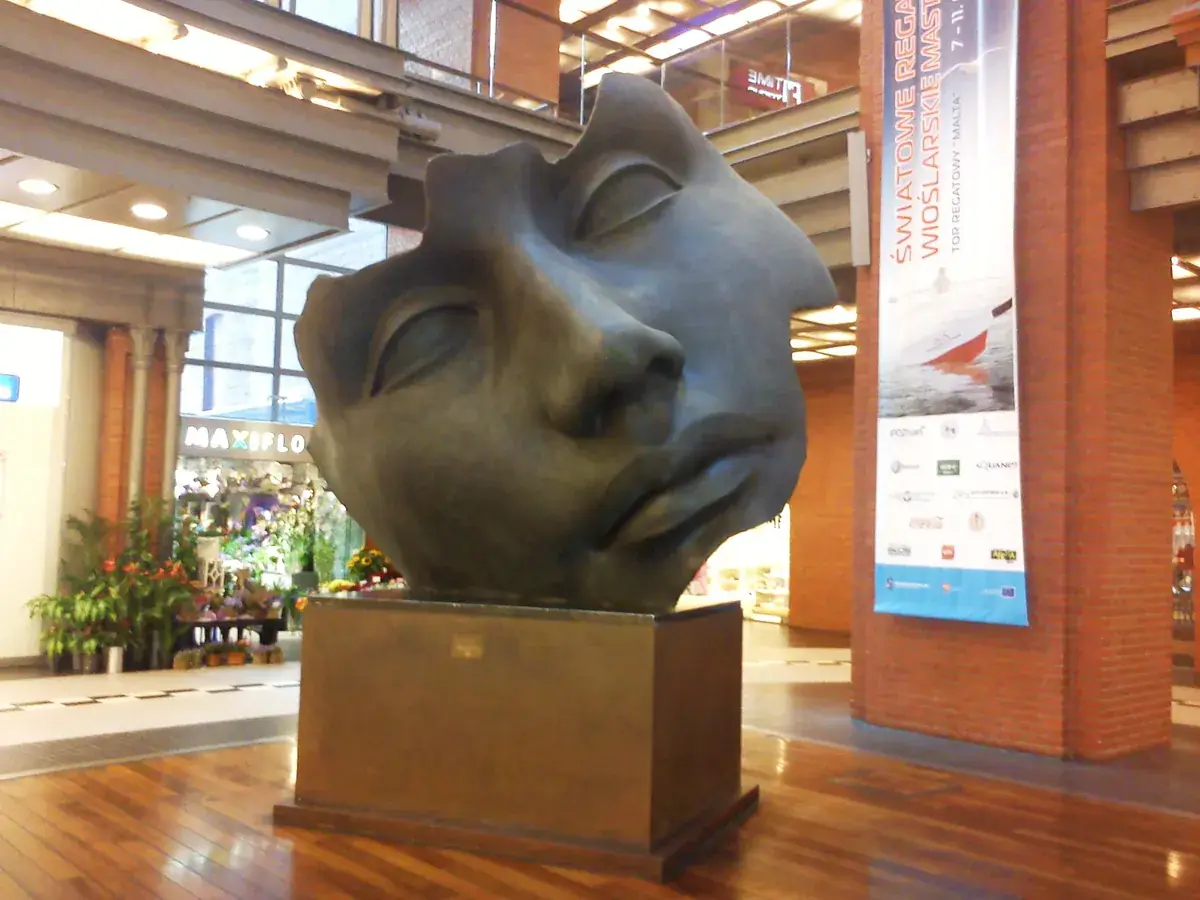
Poznań abriga três esculturas permanentes de Mitoraj — todas dentro do Stary Browar (Velha Cervejaria), um dos destinos culturais e comerciais mais celebrados da Polônia, na ul. Półwiejska. O complexo, concebido pela colecionadora e empresária Grażyna Kulczyk com base no princípio "50/50" — metade comércio, metade cultura — abriu em 2003 com uma escultura de Mitoraj como ponto central. Hoje, Thsuki-no-hikari no Atrium de entrada tornou-se o ponto de encontro mais espontâneo da cidade: os habitantes de Poznań dizem "nos encontramos sob o Mitoraj" e todos sabem exatamente onde ir.
O Stary Browar (a Velha Cervejaria) não é apenas um centro comercial — é um dos espaços culturais de design mais consciente da Polônia, premiado com o título de melhor shopping center do mundo pelo International Council of Shopping Centers. Sua coleção permanente de Mitoraj, incluindo Tsuki-no-hikari (Luz da Lua) e outros bronzes, reflete a ambição do espaço de mesclar comércio com arte contemporânea séria.
Stary Browar — Arte no Coração do Comércio
O Stary Browar ocupa um complexo de cervejaria do século XIX na ul. Półwiejska, construído pela família Hugger da Floresta Negra a partir de 1844. A cervejaria funcionou até 1980, depois entrou em decadência. Em 1998, Grażyna Kulczyk — uma das mais importantes colecionadoras privadas de arte da Polônia — comprou o terreno e propôs uma ideia radical: um centro onde arte e comércio coexistam em termos iguais. O conceito "50/50" comprometeu metade do carácter do edifício com programação cultural: exposições, espetáculos e obras de arte permanentes tecidas no tecido do espaço.
Quando o Atrium abriu em 5 de novembro de 2003, a monumental máscara facial de Mitoraj tornou-se imediatamente seu ponto focal. A coleção de Kulczyk, agora gerida pela Fundação Art Stations, inclui obras de grandes artistas poloneses e internacionais — mas são as esculturas de Mitoraj que se tornaram a identidade visual definidora do edifício. O complexo atrai nove milhões de visitantes por ano e é consistentemente classificado entre os centros comerciais mais bem projetados do mundo.
Thsuki-no-hikari (Blask Księżyca / Luz da Lua) — 1991
Thsuki-no-hikari — em japonês "Luz da Lua", em polonês Blask Księżyca — é uma monumental máscara facial em bronze no Atrium de entrada do Stary Browar. Mitoraj deu à obra um título japonês num período em que expunha extensamente no Japão e se envolvia profundamente com as sensibilidades estéticas japonesas, particularmente o conceito de beleza emergindo da incompletude — intimamente relacionado com a estética wabi-sabi japonesa que ele admirava.
O rosto é imediatamente reconhecível como sendo de Mitoraj: um fragmento de uma cabeça jovem e idealizada — meio antiga, meio as próprias feições do escultor — com as rachaduras características e os danos deliberados que permeiam toda a sua obra. Os lábios, sempre modelados com a boca do próprio Mitoraj, são apenas visíveis. A obra está montada verticalmente no espaço do Atrium, erguendo-se a uma altura considerável, e capta a luz natural que inunda o teto de vidro do edifício.
A escultura tornou-se tão central na geografia social de Poznań que "sob o Mitoraj" é uma instrução universal de encontro entre os habitantes da cidade — tão natural quanto "sob o relógio" ou "na fonte" em outras cidades.
Tors nad jeziorem (Torso à Beira do Lago)
Tors nad jeziorem — Torso à Beira do Lago — é a segunda obra de Mitoraj no Atrium do Stary Browar, exposta ao lado de Thsuki-no-hikari. Um torso masculino em bronze, característico em seu tratamento fragmentário, a obra compartilha o mesmo vocabulário de beleza clássica sujeita a danos deliberados e incompletude que define toda a série de torsos de Mitoraj. O título sugere uma relação reflexiva e contemplativa entre a escultura e o espaço circundante — o torso visto como se junto à água, em luz incerta.
O ambiente do Atrium — com seu alto teto de vidro, quentes paredes de tijolo da cervejaria original e o fluxo de visitantes — confere a ambas as esculturas do Atrium uma vitalidade particular. Não são protegidas no silêncio de um museu, mas inseridas na vida quotidiana, vistas por milhões de pessoas nos seus afazeres habituais. Este era precisamente o contexto que Mitoraj preferia para as suas obras públicas: arte encontrada sem preparação, sem o enquadramento de uma visita a uma galeria, simplesmente presente no mundo.
Eros Alato (Eros Skrzydlaty / Eros Alado) — 1984
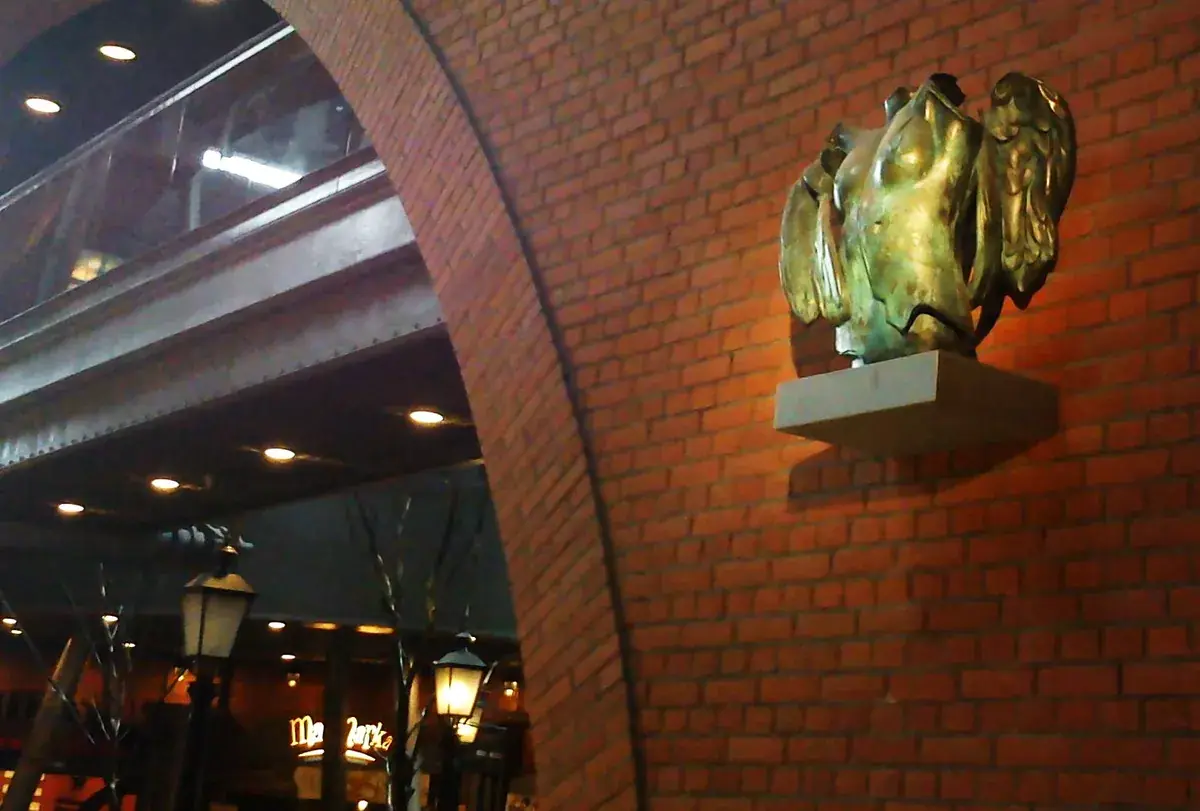
Eros Alato — Eros Alado, em polonês Eros Skrzydlaty — é um dos primeiros tratamentos de Mitoraj sobre o tema de Eros, precedendo em quinze anos o famoso Eros Bendato (Eros Acorrentado) de 1999. Enquanto o Eros posterior é horizontal, deitado de lado, acorrentado e com os olhos vendados, o Eros Alado de 1984 está em um registro compositivo diferente — as asas de Eros, o antigo deus grego do desejo, presentes mas não funcionais, o corpo fragmentado e danificado à maneira característica de Mitoraj.
A presença de um Eros Alato inicial na coleção Kulczyk é historicamente significativa: demonstra o investimento de uma grande colecionadora na obra de Mitoraj desde um período inicial, antes das suas exposições internacionais de penetração em meados dos anos 1980. A datação de 1984 situa esta obra no ano da exposição de Mitoraj em Castel Sant'Angelo em Roma — a mostra que lançou sua carreira internacional.
A Relação de Poznań com Mitoraj
O encontro de Poznań com Mitoraj deu-se principalmente através da coleção Kulczyk e não do patrocínio cívico — uma distinção significativa. Em Cracóvia, a própria cidade debateu e acabou por aceitar Eros Bendato como um presente cívico; a propriedade e o significado da obra foram publicamente contestados. Em Poznań, as esculturas de Mitoraj pertencem a uma coleção privada num complexo cultural-comercial de propriedade privada. São acessíveis a milhões de pessoas, mas o seu contexto é a cultura comercial e não o espaço cívico.
Para os colecionadores da região de Poznań, este contexto é relevante. A cidade tem uma forte tradição de colecionismo privado e um sofisticado mercado de arte. Se você possui uma obra de Mitoraj na região de Poznań — adquirida por qualquer canal, em qualquer formato — sou um comprador ativo e gostaria de ser contactado.
Beyond the three permanent bronzes at Stary Browar, Mitoraj's connection to Polish collections reflects a broader pattern of institutional commitment that distinguishes his market from that of many contemporary sculptors. Unlike artists whose presence in a given city amounts to a single loaned piece, Mitoraj's works in Poznań were acquired with long-term placement in mind — a distinction that matters to serious collectors evaluating provenance and exhibition history. Grażyna Kulczyk began acquiring Mitoraj's work in the early 2000s through direct engagement with the artist's Pietrasanta studio, the Tuscany foundry town where he based his practice from the 1970s onward and where most of his large-scale bronzes were cast. That direct studio relationship — rather than acquisition through secondary market channels — is a hallmark of the most significant Mitoraj holdings worldwide, and it gives the Stary Browar pieces a documentary integrity that auction-sourced works rarely carry. The Foundazione Mitoraj, established after the sculptor's death in Pietrasanta in October 2014, continues to authenticate works and maintain the catalogue raisonné, making provenance verification for institutional pieces like those in Poznań straightforward in ways that can complicate transactions involving works that changed hands multiple times before his death. For collectors considering Mitoraj bronzes in the mid-to-large scale, the Stary Browar commission represents a useful reference point: works acquired directly from the studio during the artist's active final decade, placed in high-visibility permanent settings, and maintained under institutional stewardship — criteria that consistently support value over time in the secondary market for monumental sculpture.
Beyond the three permanent bronzes at Stary Browar, Mitoraj's presence in Poznań reflects a broader pattern of institutional commitment that distinguishes his Polish reception from that in other European cities. Grażyna Kulczyk acquired the works during a period — roughly 1999 to 2003 — when Mitoraj's market was consolidating around a core group of serious European collectors, many of them drawn to his large-format bronzes cast at the Fonderia Mariani in Pietrasanta, the Tuscan foundry with which he maintained an exclusive working relationship for much of his mature career. The Stary Browar pieces were not purchased as decorative amenities but selected as anchors of a defined collection, a distinction that matters to secondary-market buyers assessing provenance. Tsuki-no-hikari, the moon-light mask installed in the main atrium, belongs to a series Mitoraj developed through the 1990s exploring fragmented classical portraiture — works in which a face is simultaneously present and eroded, whole and relic. Edition sizes for monumental bronzes of this type typically ran between three and eight casts, each numbered and accompanied by foundry certificates; collectors and auction specialists consistently treat placement in a named institutional collection, particularly one with Stary Browar's international profile, as a provenance marker that supports valuation. The Art Stations Foundation, which now manages the Kulczyk collection on site, has maintained the works under conservation agreements, a practical consideration for any collector researching the long-term care standards applied to Mitoraj bronzes in Polish institutional hands. For visitors arriving at Poznań Główna station, the walk to ul. Półwiejska takes under fifteen minutes, and the atrium is accessible without any shopping-centre admission
Mitoraj's relationship with Polish collectors deepened significantly during the 1990s and early 2000s, a period when his international market was consolidating around a handful of dedicated gallerists and private buyers. His primary representative in Poland was Galeria Miejska Arsenał in Poznań, which hosted retrospective exhibitions that introduced his mythological bronze vocabulary to Polish audiences before Grażyna Kulczyk's commission brought his work permanently into the city's fabric. The three bronzes at Stary Browar — Tsuki-no-hikari, Eros Bendato, and Tindaro Screpolato — were not simply purchased off a production list but selected through a curatorial dialogue between Kulczyk and Mitoraj's Pietrasanta studio, where the sculptor maintained his primary working foundry, the Versilia Nuova. Each piece at the Stary Browar was cast in a numbered edition, placing the Poznań examples within a documented provenance trail that collectors and auction specialists consult when assessing comparable works on the secondary market. Mitoraj's bronzes have appeared at major European auction houses including Christie's London and Sotheby's Paris, where medium-format masks and torso fragments from the 1980s and 1990s have achieved prices ranging from €30,000 to over €200,000 depending on edition number, patina quality, and exhibition history. Works with documented institutional display history — particularly those with a public exhibition record in a named collection — consistently outperform comparable pieces without such provenance. The Stary Browar examples, permanently installed rather than loaned, occupy a category of their own: they are not available on the market, but their existence and location anchors the
Beyond the three permanent bronzes housed within Stary Browar, Mitoraj's relationship with Polish collecting circles deepened considerably during the 2000s, a period when his Warsaw and Kraków dealer exhibitions consistently sold out within days of opening. Grażyna Kulczyk's decision to anchor her 2003 atrium with Tsuki-no-hikari was not an isolated curatorial gesture but part of a broader institutional confidence in Mitoraj at a moment when secondary market prices for his mid-scale bronzes were climbing steeply across European auction houses. The two additional Stary Browar works — Testa di Bronzo and Ala Spezzata, the latter a characteristic fragment of a winged figure rendered in dark patinated bronze — occupy the complex's courtyard garden, where they are integrated into the landscaping rather than placed on conventional pedestals, a presentation Mitoraj specifically endorsed as consistent with his belief that sculpture should inhabit space rather than merely occupy it. This philosophy had practical consequences for how collectors approached his work: buyers at the Sopot and Warsaw auctions of the early 2000s were advised by galleries representing Mitoraj's Pietrasanta studio to account for significant installation costs, since the artist's preference for low or flush mounting required custom engineering solutions not typical of conventional gallery bronzes. The Stary Browar commission was handled directly through the Pietrasanta foundry, bypassing the standard gallery chain, which gave Kulczyk access to scale and finish options unavailable through retail channels — a pattern Mitoraj repeated with several major institutional clients in France, Italy, and Japan during the same decade. For collectors researching provenance, it is worth noting that bronzes produced for Stary
Beyond the three permanent bronzes at Stary Browar, Mitoraj's relationship with Polish collectors deepened considerably during the 1990s and 2000s, a period when his Warsaw gallery representation through the Zachęta circle and private dealers brought his limited editions and unique casts to a generation of newly prominent Central European buyers. His large-scale works — typically cast at the Fonderia Mariani in Pietrasanta, the Tuscan foundry where he worked for decades — were produced in strictly controlled editions, rarely exceeding six to eight casts per composition, a discipline that has sustained their value on the secondary market. At auction, significant Mitoraj bronzes have achieved prices ranging from €40,000 for smaller busts to well over €300,000 for monumental fragments, with Polish institutional and private buyers consistently active alongside Italian, French, and German collectors. Tsuki-no-hikari, the work that anchors the Stary Browar atrium, belongs to a family of lunar-themed sculptures Mitoraj developed from the late 1980s onward, drawing on his sustained engagement with Japanese aesthetics alongside the Greco-Roman classical tradition that defined his mature style — a duality rooted in his biography, having studied painting in Kraków under Tadeusz Kantor before relocating to Paris in 1968 and eventually settling in Italy. The Poznań placement carries particular symbolic weight because Mitoraj, though born in Oederan in Germany in 1944 to a Polish mother, maintained strong ties to Polish cultural identity throughout his career, and commissions or acquisitions by Polish institutions carried personal resonance for him. Grażyna Kulczyk's decision to anchor her 2003 opening with his work was not accidental: she had been
Beyond the three permanent bronzes anchored in the Stary Browar complex, Mitoraj's relationship with Polish collectors reflects a broader pattern of institutional loyalty that distinguished his market from that of most postwar European sculptors. Unlike artists whose estates became fragmented across auction houses after their deaths, Mitoraj — who died in Pietrasanta on October 6, 2014 — had cultivated a relatively disciplined network of foundries and authorised dealers during his lifetime, centred on the Pietrasanta workshops in Tuscany where he lived and worked from the early 1980s onward. Polish collectors, led by figures like Kulczyk, were among the earliest to acquire monumental-scale works directly from the studio rather than through secondary market transactions, a distinction that carries significant provenance value today. At auction, Mitoraj's bronzes have consistently performed above estimate when accompanied by direct studio documentation: a patinated bronze head offered at Desa Unicum in Warsaw in 2019 achieved a result nearly forty percent above its upper estimate, a margin analysts attributed in part to its traceable acquisition history. The three Poznań pieces — Tsuki-no-hikari, and the two additional bronzes integrated into the complex's internal courtyards — are understood to be unique or near-unique casts rather than edition multiples, which places them in a different category from the open-edition decorative bronzes that occasionally surface in Central European regional sales. Collectors approaching Mitoraj's market are advised to distinguish carefully between these monumental commissions, the limited studio editions typically cast in series of seven or nine, and the unauthorised reproductions that began circulating in Eastern European markets following the sculptor's death. The Stary Browar works, given their public visibility and documented institutional provenance stretching back to the
Beyond the three permanent bronzes at Stary Browar, Mitoraj's relationship with Polish collectors reflects a broader pattern of sustained institutional patronage that distinguished his market from the speculative cycles affecting many of his contemporaries. Grażyna Kulczyk's decision to commission work for the 2003 opening was not an isolated acquisition but part of a deliberate collecting strategy that positioned Mitoraj alongside artists such as Mirosław Bałka and Wilhelm Sasnal within a single coherent programme — a rare alignment of Polish and international voices under one roof. The Stary Browar pieces belong to a category of Mitoraj's output that specialists sometimes describe as architectural bronzes: works conceived explicitly for permanent dialogue with built space rather than for gallery rotation or edition sales. Tsuki-no-hikari, for instance, draws on Mitoraj's sustained engagement with Japanese aesthetics that began during his time in Mexico and deepened after his 1974 move to Paris, where he enrolled at the École Nationale Supérieure des Beaux-Arts before establishing his studio in Pietrasanta, Tuscany — the foundry town that became the production centre for virtually all his large-scale work from the 1980s onwards. Pietrasanta's concentration of skilled bronze casters and marble artisans gave Mitoraj access to fabrication standards rarely available to sculptors working outside Italy, and collectors who acquired major pieces during the 1990s benefited from edition structures that kept numbering genuinely limited, typically between two and eight casts for monumental works. Secondary market records from Sotheby's and Christie's sales between 2010 and 2023 show that signed, documented casts from this period have appreciated steadily, with mid-sized bronzes in the range of
Beyond the three bronzes installed at Stary Browar, Mitoraj's presence in Poznań sits within a broader pattern of deliberate institutional collecting that distinguished Polish patronage from its Western European counterparts during the 1990s and early 2000s. Where French and Italian municipalities often acquired Mitoraj's work through public tender or civic commission, Grażyna Kulczyk approached the sculptor directly, visiting his Pietrasanta studio on multiple occasions before the Stary Browar project was finalised — a process that allowed her to select works attuned to specific architectural moments within the complex rather than simply purchasing available inventory. The three works installed across the site were conceived as a spatial sequence rather than isolated objects: Tsuki-no-hikari (Moonlight), the large fragmentary mask that anchors the main Atrium, was positioned to catch the diffused northern light filtering through the roof glazing, so that its patinated bronze surface shifts perceptibly across the day. The second and third bronzes, placed in the connecting passages and the garden courtyard respectively, were scaled to reward sustained looking rather than the incidental glance that most retail environments produce. This sequencing reflects a collecting philosophy that Kulczyk has described in interviews as treating the viewer's movement through a space as itself a curatorial medium. For collectors researching Mitoraj's market, the Stary Browar commission occupies a significant position in his late career chronology: the works were cast at the Fonderia Mariani in Pietrasanta, the foundry with which Mitoraj maintained his closest working relationship from the mid-1980s until his death in September 2014, and their scale — Tsuki-no-hikari stands at approximately 180 centimetres
Beyond the three bronzes installed at Stary Browar, Mitoraj's relationship with Polish collectors and institutions deepened considerably during the final two decades of his life. His Warsaw gallery representation through Galeria Zachęta and occasional appearances at the Poznań International Art Fair brought his work to a Central European audience that responded with particular intensity to his fractured classical figures — a sensibility perhaps shaped by the region's own experience of cultural rupture. The two additional Stary Browar works flanking Tsuki-no-hikari are Perseo and Eros Bendato, the latter — a bound, blindfolded head — becoming one of the most photographed sculptures in any Polish public space, regularly appearing in architectural and travel photography entirely independent of any curatorial promotion. Mitoraj cast Eros Bendato in multiple editions across different scales throughout the 1990s and into the 2000s, with foundry work carried out at the Fonderia Mariani in Pietrasanta, Tuscany, the Versilia workshop where he based himself from the 1980s onwards and where he died in October 2014 at the age of 73. The Pietrasanta connection matters to collectors: bronzes produced there carry consistent metallurgical standards and detailed foundry stamps that serious buyers examine closely when assessing provenance on the secondary market. Mitoraj's estate, administered from Italy with input from the Polish side of his biography — he was born in Oederan, Germany, in 1944, to a Polish mother, and studied at the Academy of Fine Arts in Kraków under Tadeusz Kantor before relocating first to Paris and then to Italy — has maintained relatively disciplined edition
Beyond the three permanent bronzes at Stary Browar, Mitoraj's relationship with Polish collecting circles deepened considerably during the final decade of his life, a period when his market position in Central Europe grew more distinct from his reception in Western galleries. Auction records from Desa Unicum in Warsaw — Poland's principal auction house for modern and contemporary art — show that Mitoraj bronzes appeared with increasing frequency from around 2010 onward, with smaller edition pieces such as Testa Addormentata and Perseo reliefs attracting serious domestic bidders who had previously focused almost exclusively on Polish postwar painting. This shift reflected a broader reappraisal: Polish collectors, many of whom had encountered Mitoraj's work first through civic installations like the Stary Browar pieces rather than through gallery representation, began acquiring his smaller studio editions as a natural extension of a familiarity built in public space. Mitoraj himself returned to Poland several times after the Poznań installation, including visits connected to his work on the façade of the Church of the Divine Providence in Warsaw, a commission that occupied him intermittently from the mid-2000s and resulted in large-scale bronze reliefs that were among his final completed architectural collaborations before his death in Pietrasanta on 6 October 2014. His studio in Pietrasanta, the Tuscan marble-working town where he had settled in 1979 after studies in Kraków under Tadeusz Kantor and later in Paris, maintained a disciplined edition structure throughout his career: most bronzes were cast in numbered series of six to twelve, with foundry work carried out primarily at the Fonderia Mariani, a relationship that gave his output a technical consistency collectors and institutions could rely
Perguntas sobre esta obra?
Pergunte ao assistente IA — baseado nas páginas da coleção, respostas no seu idioma.
Possui uma Obra de Mitoraj em Poznań ou na Grande Polônia?
Envie-me uma fotografia. Respondo pessoalmente em 24 horas — com discrição, diretamente, sem intermediários.
Any other Mitoraj work also welcome — any subject, condition, or format.
Ver também: Mitoraj em Cracóvia · Mitoraj em Varsóvia · Eros Bendato — comprar & vender · Todas as cidades
Sobre Esta Coleção
Este site documenta a busca de um colecionador privado por obras de Igor Mitoraj (1944–2014) — o escultor polonês-francês celebrado por suas figuras clássicas fragmentadas em bronze e mármore. Mitoraj estudou em Cracóvia sob Tadeusz Kantor, formou-se em Paris na École nationale supérieure des beaux-arts e estabeleceu seu estúdio permanente em Pietrasanta, Toscana, em 1983. Sua obra está em coleções públicas em toda a Europa e nas Américas, e seu recorde de leilão — €6,89 milhões por um monumental Tindaro Screpolato na Sotheby's Paris em 2019 — coloca-o entre os escultores europeus do pós-guerra mais procurados. Se você tiver uma obra de Mitoraj disponível, use o botão de contato para entrar em contato.
Quer vender uma obra de Mitoraj? Ver nossa página de venda →