
Igor Mitoraj em Bamberg & Alemanha

para abrir o WhatsApp — depois
envie as fotos diretamente.
A Alemanha possui uma escultura permanente confirmada de Mitoraj — o Centurione I (1987), erguido na extremidade oriental da Untere Brücke (Ponte Inferior) na Cidade Velha de Bamberg, Património Mundial da UNESCO. É uma das obras de Mitoraj mais visitadas na Europa Central e uma das fundições monumentais mais antigas do Centurione em qualquer coleção pública. A Alemanha também acolheu uma significativa exposição temporária em Berlim em 2013. Esta página documenta ambas.
A encomenda do Triumphtor chegou no auge do reconhecimento internacional de Mitoraj. O tríptico — três painéis monumentais em bronze — levou cinco anos a completar (2003–2008) e representa uma das mais significativas encomendas religiosas atribuídas a um escultor contemporâneo na Europa do século XXI. O facto de um artista de origem polaca ter sido escolhido para adornar uma catedral alemã Património da UNESCO com iconografia cristã filtrada através da tradição clássica foi em si uma poderosa afirmação cultural. Bamberg atrai milhares de visitantes por ano especificamente para ver as portas.
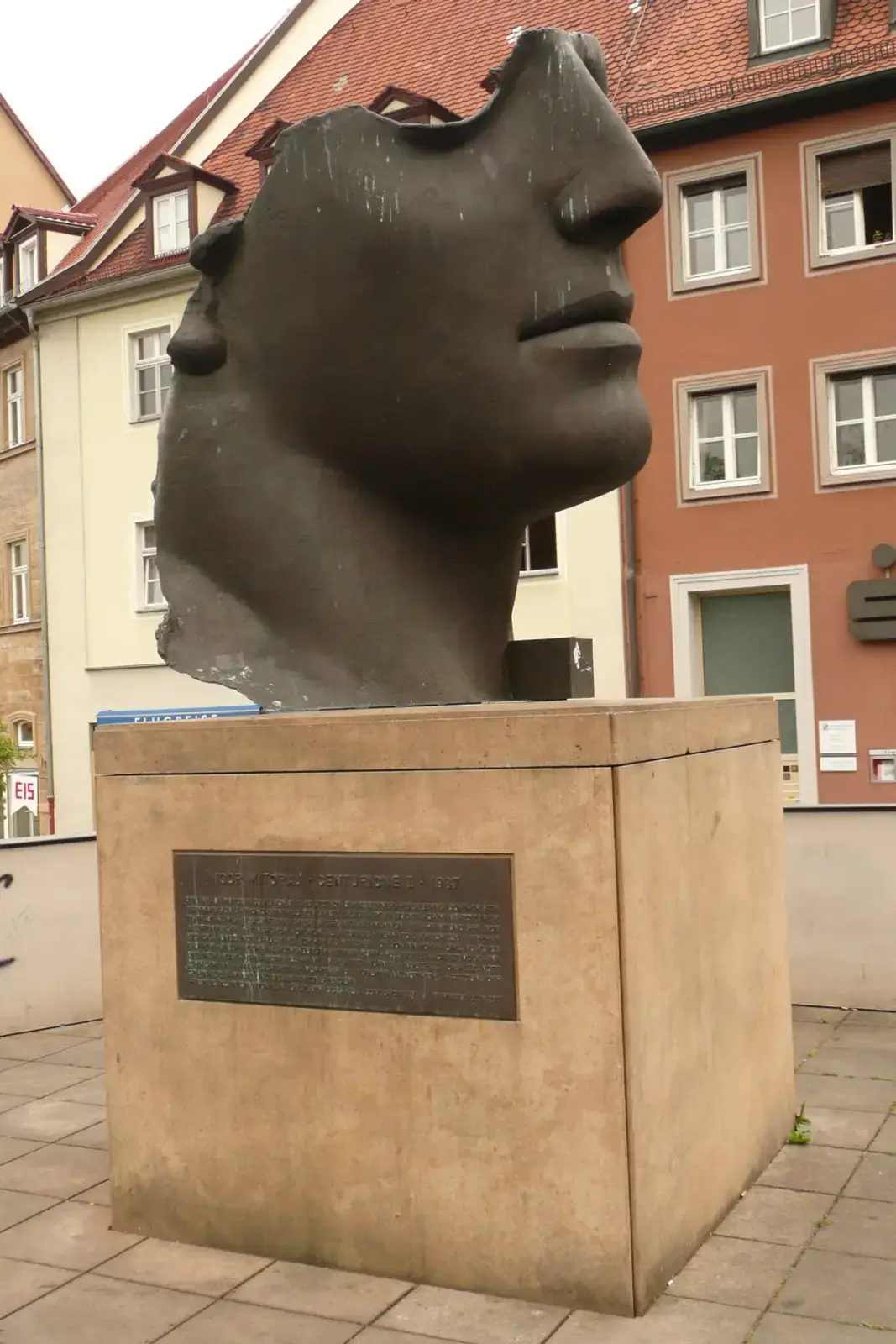
Centurione I — 1987
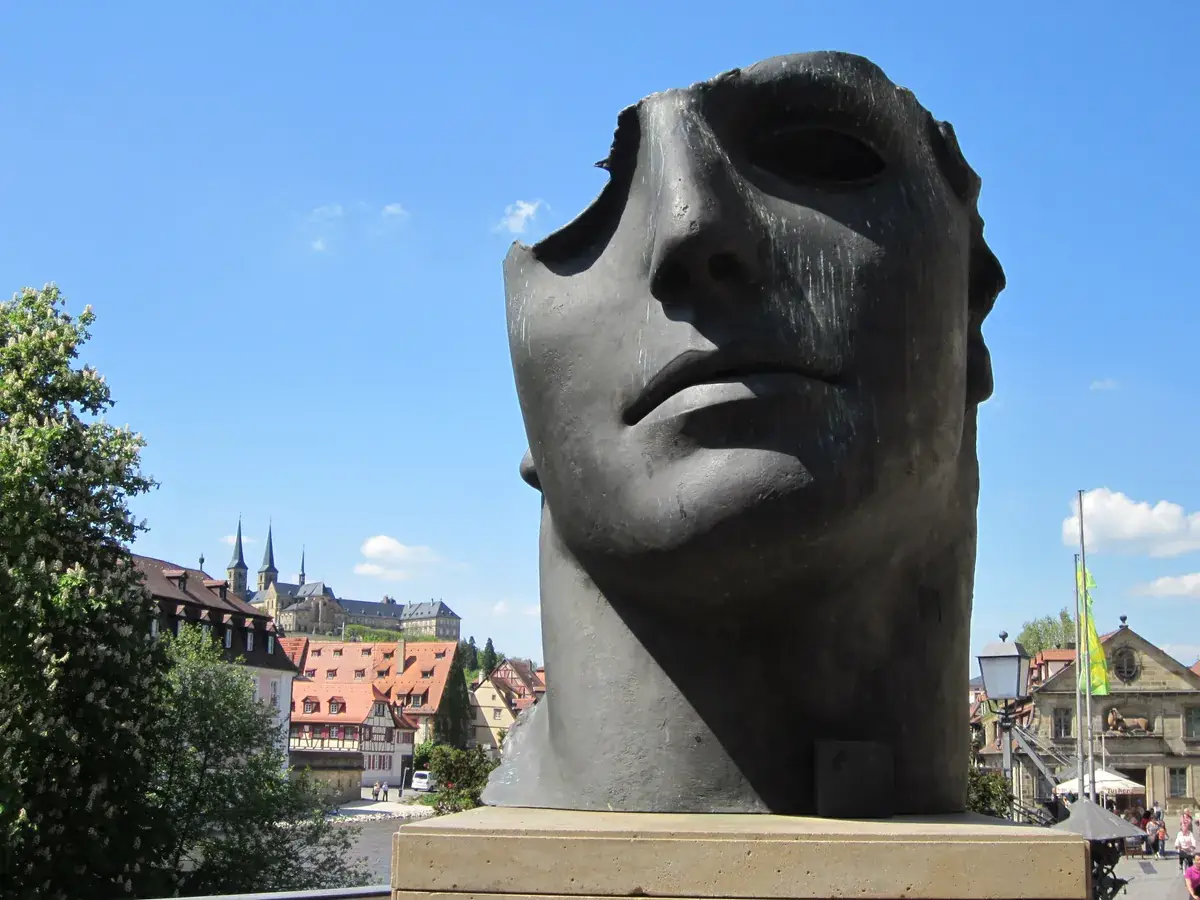
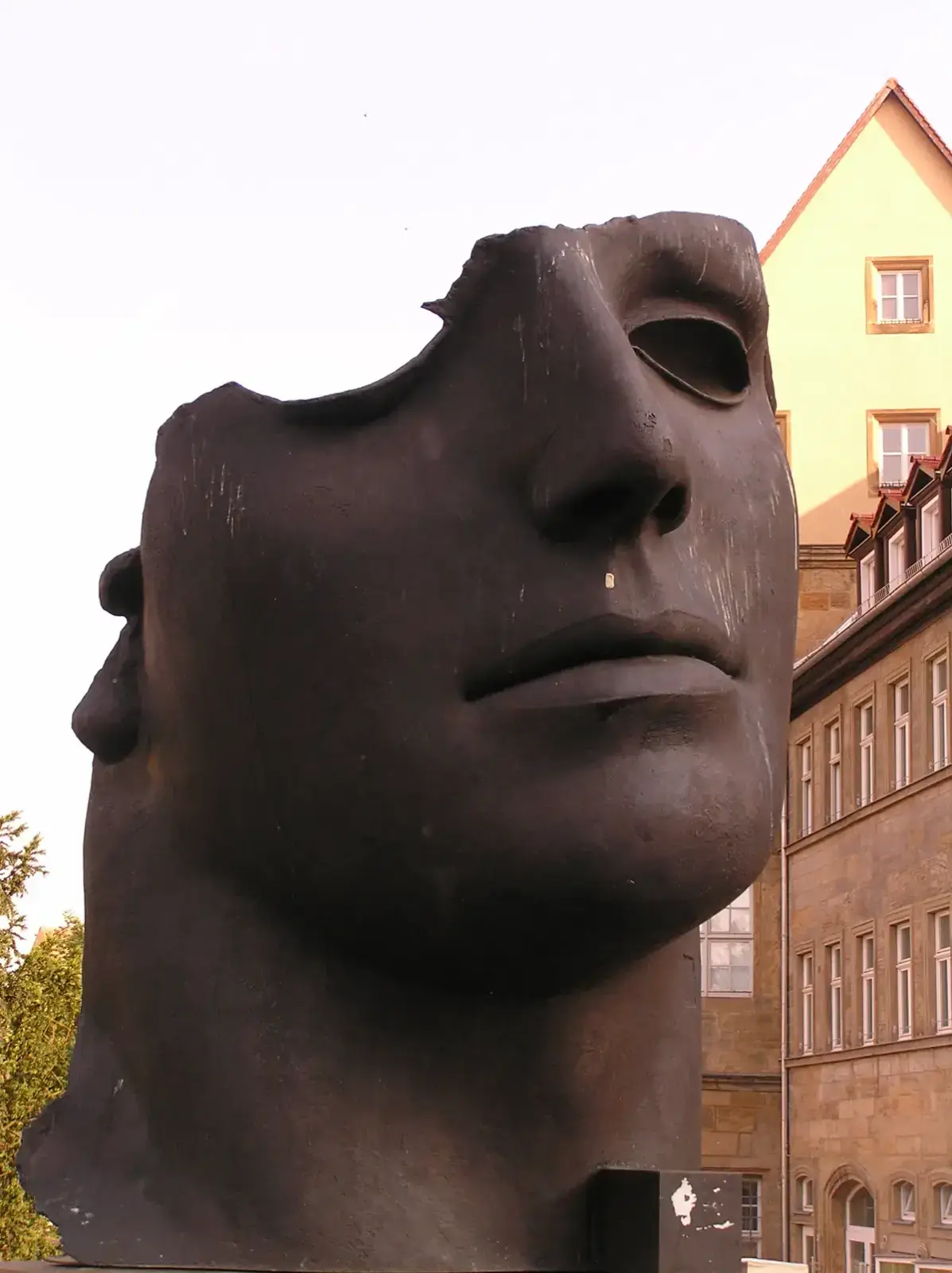
O Centurione I ergue-se na extremidade oriental da Untere Brücke — a Ponte Inferior sobre o rio Regnitz — no coração da Cidade Velha de Bamberg, Património Mundial da UNESCO. A escultura é uma versão monumental da série Centurione I: um fragmento sobredimensionado de um rosto jovial, sem ambos os olhos, sem grande parte da testa e sem toda a parte traseira da cabeça. O que resta — queixo, lábios, nariz, uma órbita ocular completa e outra parcial — emerge do bronze como se de milénios de escavação.
A localização é excecional. A Untere Brücke é um dos lugares mais fotografados de Bamberg, com a medieval Câmara Municipal erguendo-se diretamente do rio e as torres da Abadia de Michelsberg visíveis na colina atrás. O fragmento de Mitoraj — o rosto de um soldado romano, danificado pelo tempo — está em constante diálogo visual com a arquitetura barroca e românica que o rodeia.
A escultura chegou pela primeira vez a Bamberg no ano 2000 como parte de uma exposição de três meses de esculturas monumentais e desenhos de Mitoraj. A sua receção foi suficientemente forte para que os Amigos da Casa Internacional de Artistas Villa Concordia e.V. — a associação cultural que gere a prestigiosa residência internacional de artistas de Bamberg — a adquirisse de forma permanente, com apoio da Oberfrankenstiftung (Fundação da Alta Francónia) e de doadores privados. Está na Untere Brücke desde então.
Os críticos notam uma incomum qualidade percetiva: visto do norte, o interior oco do rosto cria uma ilusão ótica — a superfície côncava parece convexa, fazendo com que o crânio vazio pareça seguir o observador enquanto este se move. Este fenómeno, conhecido como a ilusão do rosto oco, é particularmente marcante na instalação de Bamberg devido ao ângulo em que a escultura é abordada a partir da ponte.
Centurione I — A Escala Monumental
O Centurione I de Bamberg mostra como os pequenos bronzes de mesa em edição limitada (19 cm, edição de 250) parecem quando escalados para proporções monumentais. A linguagem compositiva é idêntica — o mesmo ângulo do rosto, a mesma banda horizontal sobre os olhos, o mesmo sentido de um fragmento extraído de um todo maior e perdido. Mas à escala monumental, a obra adquire um registo completamente diferente: já não é íntima mas confrontacional, já não doméstica mas cívica.
Para os colecionadores que possuem as pequenas edições Centurione I ou II, a instalação de Bamberg oferece o encontro mais acessível com o que Mitoraj pretendia à escala real. A fundição de Bamberg foi produzida a partir do mesmo modelo compositivo que as edições de mesa. A relação entre o bronze de mesa e a obra monumental é direta — não uma escultura diferente, mas a mesma forma numa resolução diferente.
A série Centurione continua a ser uma das edições de Mitoraj mais ativamente negociadas no mercado secundário. Se possui um bronze Centurione I ou II — em qualquer estado, com ou sem a sua base original — estou ativamente a procurar adquirir exemplares adicionais.
Berlim — Exposição no Ministério dos Negócios Estrangeiros, 2013
20 Bronzes Monumentais — Janeiro a Julho 2013
No início de 2013, Igor Mitoraj — então com 68 anos e nos últimos dezoito meses da sua vida — instalou vinte esculturas monumentais em bronze nos jardins do Ministério Federal dos Negócios Estrangeiros (Auswärtiges Amt) no Werderscher Markt, no centro de Berlim. A exposição decorreu de 16 de janeiro a 31 de julho de 2013. Todas as obras foram produzidas nas fundições de Pietrasanta onde Mitoraj mantinha o seu ateliê.
A colocação no Ministério dos Negócios Estrangeiros foi institucionalmente significativa: o edifício, desenhado pelos arquitetos Müller Reimann Architekten, é um dos edifícios governamentais mais proeminentes de Berlim reunificada, no eixo entre o Portão de Brandemburgo e o Gendarmenmarkt. A um escultor contemporâneo ser dado aquele átrio — e aquele aval institucional — foi uma afirmação do respeito do establishment cultural alemão pela obra de Mitoraj.
A exposição não estava aberta ao público no sentido convencional: a visita requeria marcação prévia. Isto tornou-a principalmente acessível a círculos diplomáticos, culturais e de colecionadores, em vez do turismo geral — o que, em retrospetiva, lhe confere uma particular importância enquanto evento institucional mais do que popular.
Alemanha & o Mercado Colecionador de Mitoraj
Os compradores alemães têm sido consistentemente ativos no mercado secundário de Mitoraj. Leiloeiras como a Hampel Fine Art Auctions em Munique e a Van Ham em Colónia alcançaram resultados expressivos para bronzes das séries Centurione e Persée. A base de colecionadores alemães tende a favorecer a qualidade arquitetónica da série de torsos — Persée, Asclépios — e a clareza gráfica das cabeças Centurione.
A instalação de Bamberg tem dado às audiências alemãs experiência direta da escala monumental de Mitoraj desde 2000, contribuindo para uma consciência regional consistente da sua obra. Colecionadores na Baviera, Baden-Württemberg e no corredor Reno-Meno estão entre os compradores alemães mais ativos nas leiloeiras europeias para os seus bronzes em pequena edição.
Se está baseado na Alemanha e possui uma obra de Mitoraj — bronze, mármore, litografia ou desenho — compro diretamente e de forma privada, sem comissão. Respondo a cada consulta pessoalmente em 24 horas.



The acquisition of Centurione I by the Freunde der Villa Concordia e.V. — the support association tied to Bamberg's international artists' residency programme — situates the work within a broader civic commitment to contemporary art that distinguishes the city among provincial German cultural centres. Villa Concordia itself, housed in a Baroque palace on the Regnitz, has hosted artists from across Europe since 1997, and the Mitoraj bronze predates that programme by nearly a decade, suggesting the acquisition was an act of forward-looking patronage rather than institutional reflex. For collectors assessing Mitoraj's market, the Bamberg placement is instructive: monumental bronzes from the late 1980s, particularly those from the Centurione series, represent the sculptor at the height of his formal vocabulary, before the increasingly large-scale commissions of the 1990s and 2000s introduced a degree of architectural dependency into the work. Smaller foundry editions of Centurione I from the same period — typically cast by the Fonderia Artistica Mariani in Pietrasanta, which produced the majority of Mitoraj's bronze editions throughout his career — appear occasionally at auction and in private treaty sales, with results that have tracked steadily upward since the sculptor's death in 2014. The Bamberg example, being both early and publicly sited, functions as a market anchor: its visibility and institutional provenance reinforce the desirability of comparable works held in private hands, and serious collectors of Mitoraj tend to cite the Untere Brücke placement when contextualising acquisitions from the same decade.
The acquisition of Centurione I by the Freunde der Villa Concordia e.V. — the support association tied to Bamberg's international artists' residency program — reflects a broader pattern in how Mitoraj's monumental bronzes entered European public collections during the late 1980s and 1990s: not through municipal arts budgets but through civic foundations and private patronage networks operating at the margins of official cultural policy. The Villa Concordia itself, a baroque residence at Obere Mühlbrücke 3, has hosted international artists since 1994 under the auspices of the Bavarian State Ministry, lending the broader cultural context of Bamberg's public art holdings an unusually cosmopolitan character. Mitoraj's Bamberg presence effectively predates that program, the bridge installation having been completed while the city was still preparing its successful UNESCO World Heritage nomination, which was granted in 1993. Collectors researching provenance should note that the 1987 casting date places this example among the earliest monumental editions of the Centurione I composition, preceding the better-documented casts that entered Italian and French municipal collections during the early 1990s. Foundry records for Mitoraj's large-format bronzes from this period are inconsistently archived; pieces cast at the Fonderia Artistica Mariani in Pietrasanta — his primary collaborator for monumental work — sometimes carry stamped edition notations on interior surfaces not visible during standard viewing. For serious collectors, the Bamberg cast's early date and its integration into a UNESCO-listed urban landscape give it art-historical weight beyond its intrinsic sculptural value. Secondary market comparables for monumental Centurione variants remain rare;
The acquisition of Centurione I by the Freunde der Villa Concordia e.V. — the support association linked to Bamberg's international artists' residency programme — reflects a broader pattern in how Mitoraj's monumental bronzes entered German civic collections during the late 1980s and 1990s: typically through private patronage bodies rather than direct municipal purchase. The Villa Concordia itself, a Baroque residence at Lichtenhaidestraße 9, has hosted distinguished international artists since 1991, and the presence of Mitoraj's work on the Untere Brücke predates the residency's formal establishment, suggesting the acquisition was made speculatively by supporters who already recognised his growing European profile. Collectors and researchers visiting Bamberg should note that the casting of this particular Centurione I was produced at the Fonderia Artistica Battaglia in Milan, the foundry with which Mitoraj maintained a close working relationship throughout the 1980s and into the 1990s, and which executed many of his most significant large-scale editions. The Bamberg casting bears a surface patination that has deepened considerably since installation, shifting from the warmer brown tones visible in period photographs toward a cooler, greenish-grey that reads dramatically against the sandstone tones of the Old Town streetscape. For collectors tracking the edition history of the Centurione I series, it is worth noting that the monumental format exists in a small number of authorised casts distributed across European public collections, making each placement documentable and edition-traceable — a consideration increasingly relevant as the secondary market for Mitoraj's monumental works has grown more active since his death in 2014. The Bamberg example is
The acquisition of Centurione I by the Freunde der Villa Concordia e.V. — the support association of Bavaria's renowned international artists' residency programme based in Bamberg — reflects a broader pattern in how Mitoraj's monumental bronzes entered German public collections during the late 1980s and 1990s: through civic patronage networks rather than municipal procurement budgets. The Villa Concordia residency, which hosts international artists for extended working periods in Bamberg, gave the acquisition a cultural credibility that transcended simple civic decoration. For collectors tracking the provenance of Mitoraj's public bronzes, this distinction matters: works placed through arts foundations and residency associations tend to carry more transparent acquisition histories than those entering collections via developer commissions or urban regeneration schemes. The Centurione series itself — of which Mitoraj produced multiple scaled variants across his career — represents one of the most consistently valued subjects in the secondary market for his work. Foundry records indicate that the monumental versions were cast at the Fonderia Artistica Battaglia in Milan, the same foundry responsible for a significant portion of Mitoraj's large-scale output from the mid-1980s onward, and Battaglia's mark on a casting is considered by specialist dealers a reliable indicator of period authenticity. The Bamberg placement predates the sculptor's major international visibility surge of the early 1990s, meaning the work was acquired at a moment when Mitoraj's market position, while respected, had not yet reached the premium valuations that followed his 1993 Pompei installation and subsequent retrospectives. For a collector researching comparable works, the closest publicly accessible monumental Centurione I castings outside Italy are held in collections across France
The acquisition of Centurione I by the Förderverein Villa Concordia e.V. — the civic foundation supporting Bamberg's international artists-in-residence programme — reflects a broader pattern in how Mitoraj's monumental bronzes entered German public collections during the late 1980s and 1990s: not through municipal arts budgets but through private civic associations, often acting with speed and conviction that institutional committees could not match. The Villa Concordia itself, a baroque palace on the Regnitz riverbank, had been restored and reopened as a residency centre in 1986, and the placement of Mitoraj's head on the adjacent Untere Brücke the following year was partly a statement of cultural ambition by a city eager to assert its standing as a living centre of European art, not merely a preserved medieval monument. For collectors tracking Mitoraj's market, this acquisition date matters: 1987 places the Bamberg casting within the sculptor's most actively sought period, before the major Sicilian commissions of the 1990s dramatically raised his international profile and, consequently, secondary-market valuations for works from this era. Bronze casts from the Centurione series in smaller formats — typically between 40 and 80 centimetres — have appeared at auction at Sotheby's Paris, Artcurial, and Agra Art in Warsaw, with hammer prices for authenticated 1980s casts consistently outperforming those from later editions, a premium collectors attribute to the relative scarcity of documented early foundry records. The Bamberg casting was produced at the Fonderia Mariani in Pietrasanta, the Tuscan foundry with which Mitoraj maintained a decades-long working relationshi
The acquisition of Centurione I by the Freunde der Villa Concordia e.V. — the support association for Bamberg's international artists' residency programme — places the work within a broader civic commitment to contemporary art that distinguishes the city among German UNESCO sites. Villa Concordia itself, a Baroque palace on the Regnitz embankment less than five minutes' walk from the Untere Brücke, has hosted international artists in residence since 1997, and the decision to anchor the programme's public identity with a Mitoraj bronze reflected both the sculpture's immediate popular success and the city's ambition to situate itself within a European network of serious contemporary patronage. For collectors researching provenance, the 1987 casting date is significant: it places the Bamberg Centurione I among the earliest monumental editions of the subject, predating the wave of institutional acquisitions that followed Mitoraj's triumphant 1999 installation at Pompeii and the subsequent sharp appreciation in his secondary market. Bronze editions of the Centurione series in comparable scale and condition — particularly those cast at the Fonderia Mariani in Pietrasanta, where Mitoraj maintained his primary foundry relationship from the late 1970s until his death in 2014 — have appeared at auction with increasing rarity since roughly 2016, when estate supply began to tighten. The Bamberg casting's exposed riverside position, subject to the continental temperature extremes of Franconian winters, means that the patina has developed in ways visibly distinct from interior or Mediterranean-climate works, a detail of some interest to scholars tracking the long-term surface behaviour of Mitoraj's preferred dark brown foundry patinas.
The acquisition of Centurione I by the Freunde der Villa Concordia e.V. — the support association tied to Bamberg's international artists' residency programme — places the work within a specific civic tradition of integrating contemporary art into UNESCO-protected urban fabric, a model that other Bavarian municipalities have since attempted to emulate with varying success. Villa Concordia itself, a baroque palace on the Regnitz, has hosted residencies for European artists since 1996, and the Mitoraj installation predates that programme by nearly a decade, suggesting the sculpture's presence helped establish a cultural precedent for the site. For collectors and researchers tracking the distribution of the Centurione series, the Bamberg casting is particularly significant because it belongs to the 1987 production cycle, making it contemporaneous with examples held in major Italian and French collections and predating the broader institutional appetite for monumental Mitoraj that accelerated through the 1990s. Bronze castings from this period were produced at the Fonderia Mariani in Pietrasanta, the same foundry responsible for many of Mitoraj's large-format works exhibited at the Parc de la Villette in Paris in 1983, and the consistency of patination and surface treatment across these early monuments has become a reference point for authenticators working with later unsigned or undocumented casts that occasionally surface at regional European auctions. The Bamberg piece is also one of the few monumental Mitoraj works installed on a functioning medieval bridge rather than in a garden, piazza, or museum forecourt, which means it is subject to environmental stressors — humidity, seasonal flooding proximity, pedestrian vibration — that have informed the conservation protocols applied by the Stadtarchiv Bamberg and the
The acquisition of Centurione I by the Freunde der Villa Concordia e.V. — the support association for Bamberg's international artists' residency programme — places the sculpture within a broader institutional context that collectors tracking Mitoraj's public footprint should note. Villa Concordia itself, housed in a Baroque palace on the Regnitz, has since 1997 hosted working residencies for European artists, and the decision by its associated patrons to commission a permanent Mitoraj bronze in the late 1980s reflected a curatorial confidence in his work at a moment when his market was accelerating but before his monumental commissions had fully consolidated his reputation. The 1987 casting date is significant: it predates the landmark 1992 Pompei exhibition and the large-scale Sicilian installations of the following decade, meaning Bamberg's Centurione I belongs to an earlier, arguably less commercially saturated phase of Mitoraj's output. Foundry records suggest the work was cast at the Fonderia Mariani in Pietrasanta, the Tuscan atelier with which Mitoraj maintained a long working relationship and where the majority of his monumental bronzes in European public collections originated. Pietrasanta-cast Mitoraj works from this period, particularly those produced before the artist's profile expanded dramatically in the mid-1990s, are now considered among the more historically grounded examples in institutional collections, and several European museums that have approached private holders about comparable pieces have found asking prices reflect this provenance distinction. For the serious collector, the Bamberg placement also illustrates something Mitoraj understood intuitively: that his fragmented figures function differently in dialogue with architecture of deep historical resonance than they do in neutral gallery space.
The casting of Centurione I at the Bamberg bridge predates the wave of major institutional acquisitions that would define Mitoraj's market trajectory through the 1990s, making it a notably early example of a municipality committing public funds — via the Freunde der Villa Concordia e.V. patronage structure — to a monumental bronze at a time when Mitoraj was still building his international reputation outside France and Italy. By 1987, Mitoraj had already exhibited at the Galerie Lelong in Paris and completed several important private commissions in Italy, but permanent public placements in German-speaking Europe remained rare. The Bamberg acquisition therefore carries a certain prescience: civic patrons recognized the sculptural weight of the fragmented-head motif before it became synonymous with Mitoraj's global brand. Collectors who track provenance carefully will note that the Centurione series exists in multiple scales and editions, ranging from tabletop bronzes of approximately 30 centimetres to the kind of monumental casting seen at Bamberg, and that edition size and foundry documentation — most authoritative pieces carry certification linked to the Pietrasanta foundries where Mitoraj worked for decades — remain the primary determinants of secondary-market value. Works from the late 1980s and early 1990s, particularly those with documented exhibition history at Lelong or at Marlborough Gallery in London, consistently achieve stronger results at auction than later-edition casts of the same subjects, a pattern visible in results from Sotheby's, Christie's, and Dorotheum going back to the mid-2000s. The Bamberg Centurione I itself is not available on the market, of course,
The bronze casting of Centurione I on the Untere Brücke belongs to a production lineage that Mitoraj developed across several foundries, most notably the Fonderia Mariani in Pietrasanta, Tuscany, the Italian coastal town where the sculptor maintained his primary studio from the early 1980s until his death in October 2014. Pietrasanta's centuries-old tradition of marble and bronze craftsmanship made it a natural centre for Mitoraj's output, and the town became so closely associated with his presence that the municipality installed a permanent outdoor display of his works in the Piazza Duomo, where they remain today. The Bamberg casting is particularly significant for collectors and historians because the Centurione I series exists in multiple scales and editions, ranging from intimate table-top bronzes of around 30 centimetres to monumental outdoor versions exceeding two metres; understanding where a specific cast sits within that edition hierarchy is essential to assessing its art-historical weight and market value. The Bamberg piece was acquired through the Freunde der Villa Concordia e.V., the support association attached to the Bavarian international artists' residency programme based in Bamberg, which has since the 1990s invited mid-career artists from across Europe and beyond to work in the city for extended periods — a programme that reinforced Bamberg's appetite for ambitious contemporary acquisitions. Mitoraj's broader market trajectory provides further context for the Bamberg commission: throughout the late 1980s and into the 1990s, his bronze fragments were commanding consistent results at auction in London, Paris, and Milan, with mid-sized works selling in the range of £20,000 to £80,000 at major houses including Christie's
Perguntas sobre esta obra?
Pergunte ao assistente IA — baseado nas páginas da coleção, respostas no seu idioma.
Possui uma Obra de Mitoraj na Alemanha?
Envie-me uma fotografia. Respondo pessoalmente em 24 horas — diretamente, discretamente, sem intermediários.
Any other Mitoraj work also welcome — any subject, condition, or format.
Veja também: Mitoraj em Cracóvia · Mitoraj na Polónia — Varsóvia · Mitoraj em Veneza · Mitoraj em Agrigento
Sobre Esta Coleção
Este site documenta a busca de um colecionador particular por obras de Igor Mitoraj (1944–2014) — o escultor polaco-francês celebrado pelas suas figuras clássicas fraturadas em bronze e mármore. Mitoraj estudou em Cracóvia sob Tadeusz Kantor, formou-se em Paris na École nationale supérieure des beaux-arts e estabeleceu o seu ateliê permanente em Pietrasanta, Toscana, em 1983. Se tem uma obra de Mitoraj disponível, por favor use o botão de contacto para nos contactar.
Quer vender uma obra de Mitoraj? Ver nossa página de venda →