~12 min read
Igor Mitoraj — Ikaria Pequeña

to open WhatsApp — then
send photos directly.

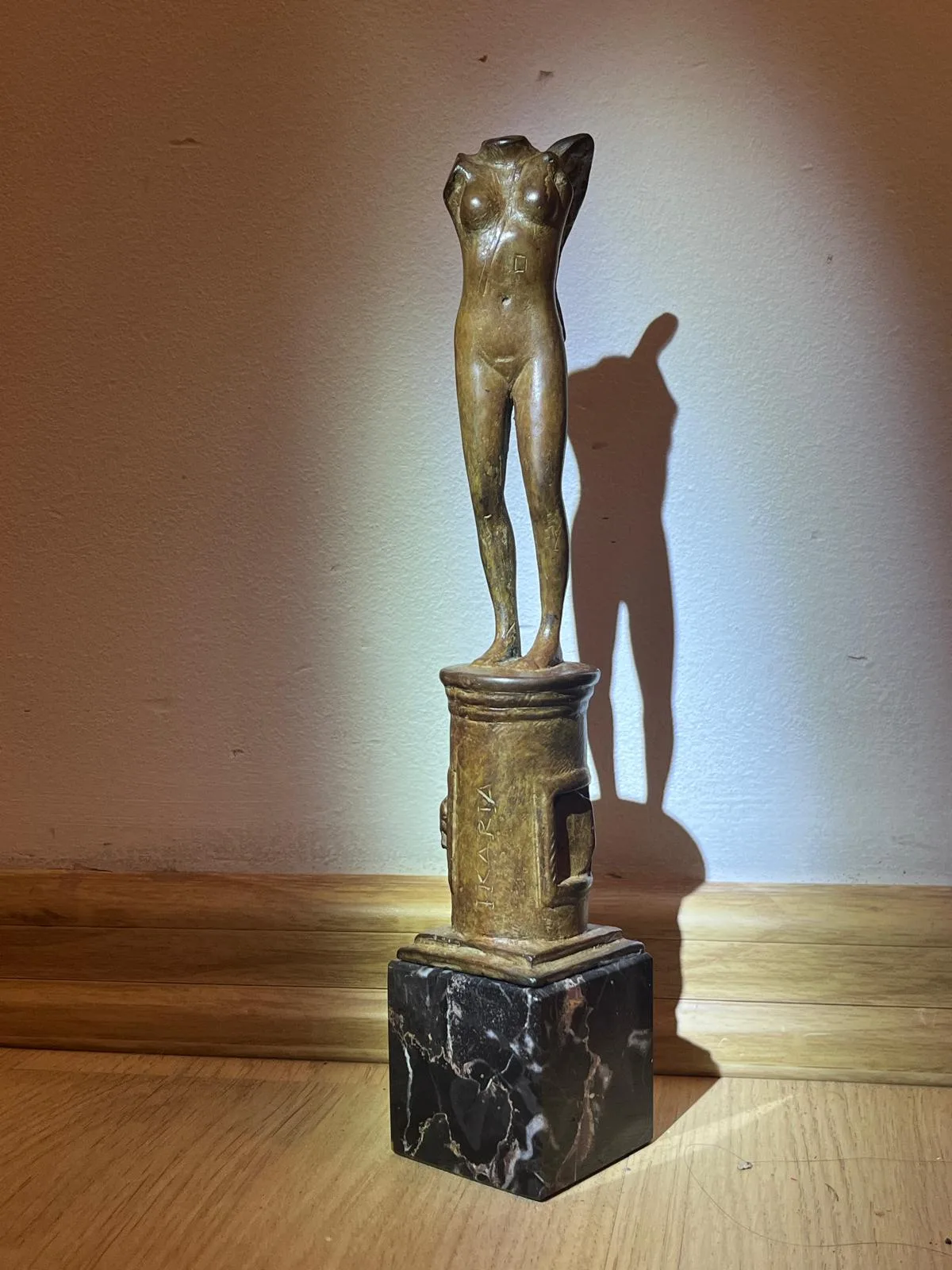
The Ikaria Pequeña — Little Ikaria — is one of Mitoraj's most poignant interpretations of the Icarus myth: a small, fallen figure rendered in dark patinated bronze, its wings broken and body compressed into a foetal descent. Unlike the heroic verticality of Mitoraj's warrior heads and standing torsos, the Ikaria Pequeña is a work about gravity — about the weight of ambition, the silence after the fall. It is a desktop edition, intimate in scale, designed to be held as much as seen.
About the Ikaria Pequeña
Mitoraj returned to the figure of Icarus — which he called Ikaria, after the Greek island where legend says the boy's body fell to the sea — across several decades and scales. The monumental versions stand in public spaces in Paris, Warsaw, and across Italy. The Pequeña (the Spanish diminutive Mitoraj used for the small desktop edition) distils the same tragedy into something you can hold in one hand: a torso curled upon itself, limbs folded, remnants of wings pressed flat against the body.
The surface of the Ikaria Pequeña is among the most worked in Mitoraj's bronze catalogue. The patina ranges from deep charcoal to warm brown in the recessed areas, with the high points burnished to a pale amber — a surface that reads as both ancient and wounded. The figure's face, where present, is typically half-absorbed into the bronze mass, as if the identity of the fallen is already dissolving into myth.
There is also a larger Paris Ikaria — a monumental public installation — the smaller Pequeña edition brings the same meditation on hubris and mortality into the domestic interior. It sits on a shelf or desk as a memento mori that never announces itself as such.

Ikaria Pequeña — Technical Details
A compact, densely modelled figure — the Pequeña edition is typically 15–25 cm in the longest dimension. The bronze surface shows Mitoraj's characteristic deep undercutting and contrast between highly worked planes and raw cast surfaces. The signature appears engraved on the base or on the underside of the figure. Edition stamps vary by foundry — Italian-cast examples typically carry a Pietrasanta foundry mark. Provenance for documented examples includes private collections in France, Spain, and Italy.
Icarus in Mitoraj's Mythology
Mitoraj's mythological programme drew from the same classical sources as ancient Greek and Roman sculptors — Homer, Ovid, Virgil — but processed them through a twentieth-century awareness of bodily fragmentation, of the body as the site of both dignity and disaster. Icarus, the figure who exceeded the limits set for human aspiration, was a natural subject for an artist who consistently depicted the body at its limits: broken, bandaged, partially absent.
Where ancient representations of the Icarus story are relatively rare — the myth is literary more than plastic — Mitoraj's Ikaria series fills a gap in the sculptural tradition. His version is neither the triumphant winged youth ascending nor the comic overreacher falling: it is the aftermath, the stillness after impact, the figure returned to the earth from which it briefly rose. In this sense the Ikaria Pequeña stands close to the Eros Bendato (the bound Eros, another figure of thwarted flight) and to the Persée series — all three are about heroism that has already happened, and the silence that follows it.
The Paris Ikaria and the Pequeña
The large Ikaria installation in Paris — positioned in a public space where the monumental fallen figure reads against the sky — is one of Mitoraj's most publicly visible works. It establishes the subject at civic scale: the city as the space into which the fallen hero descends. The Pequeña edition transposes this public drama into the private register. On a desk or bookshelf, the same figure becomes a personal meditation rather than a civic statement — a reminder, for whoever keeps it, of the specific gravity of aspiration.
Collectors who encounter the large Paris Ikaria and then discover the Pequeña edition sometimes describe it as the more affecting of the two — the intimacy of small scale forcing a closer attention to Mitoraj's modelling, the surface detail that is lost at monument height becoming visible and touchable at desk height.
Condition Notes for the Ikaria Pequeña
Small Mitoraj bronzes of this type are structurally robust — the compact, compressed form of the Ikaria Pequeña offers few vulnerable projections. The main condition considerations are patina stability (some examples show surface oxidation if stored in damp conditions, which is reversible with professional conservation), and the base, which on some editions is a thin stone slab prone to edge chipping. The signature should be clearly legible. I buy Ikaria Pequeña bronzes in all conditions, with or without documentation.
Collection Photographs — Ikaria Pequeña


The Myth and Mitoraj's Interpretation
The myth of Icarus — the boy who flew on wings of wax and feathers fashioned by his father Daedalus, and who fell when he ascended too close to the sun — is one of classical antiquity's most resonant parables. Ancient visual culture treated it sparingly: the story belongs primarily to Ovid's Metamorphoses rather than to the sculptural tradition, and there is no canonical ancient sculptural type for the falling Icarus the way there is for the Laocoön or the Dying Gaul. Mitoraj's decision to take this subject was therefore not a matter of restoring a familiar archetype but of creating a sculptural presence for a myth that had existed almost entirely in words and paint.
His approach is characteristically oblique. The Ikaria series does not depict the fall as a narrative event — there is no trajectory, no outstretched arms, no panic. What Mitoraj gives us instead is the aftermath: a compressed, dense form in which the body has already returned to earth, folded inward, the wings pressed flat and broken. The name itself is significant: Ikaria is the Greek island in the Aegean Sea where, according to legend, the sea received the body of the fallen boy. By naming the work after the island rather than the figure, Mitoraj shifts the emphasis from the person to the place of landing — from the act of flying to the condition of having fallen.
Collectors should be aware that Mitoraj produced works under both the title Ikaria and the related title Ikaro (the Italian form of Icarus). These are not interchangeable: Ikaro typically refers to larger-scale or more upright compositions, while Ikaria, particularly Ikaria Pequeña, denotes the compact, fallen, desktop form. The wings — fragmentary, crushed against the body, barely legible as such — are the defining formal element. They are not decorative additions but structural necessities: without them, the work loses its mythological identity and reads as an abstract compressed figure. Their presence, however damaged or partial, anchors the subject in the Icarian tradition.
Scales, Editions, and Variants
Mitoraj's Ikaria works span an unusually wide range of scales, from the intimate Pequeña editions that fit on a desk to the large outdoor bronzes installed in public spaces across Europe. The Ikaria Pequeña — the small desktop edition — is the most widely circulated form, produced in multiple casting batches with some variation in finishing and base treatment. The typical Pequeña is 15–25 cm in its longest dimension, though occasional larger tabletop examples exist within the same conceptual family.
The Ikaro Alato (Winged Icarus) is a distinct work within the broader series — typically a larger, more vertical composition in which the wing elements are more prominently developed. Collectors encountering the title Ikaro Alato should not assume it describes the same sculpture as the Ikaria Pequeña; the formal differences are substantial. Both titles appear in European auction catalogues, and the distinction matters for valuation and authentication.
Patina variants across the Ikaria editions include deep charcoal-black, warm dark brown, and a mixed surface combining both tones. The deep charcoal patina is the most common for the Pequeña; warm brown or mixed-surface examples are encountered less frequently and tend to attract attention from collectors who prefer surface warmth to dramatic contrast. Foundry marks on authenticated examples typically indicate Pietrasanta casting. The 2011 Pompeii exhibition — one of Mitoraj's most significant late-career installations — included large-scale Ikaro bronzes positioned among the ancient ruins, demonstrating how central this subject remained to his work across four decades.
Market and Collecting
Within Mitoraj's bronze secondary market, the Ikaria/Ikaro series occupies a distinct position. The monumental public works — the Paris Ikaria, the Pompeii installation — establish name recognition internationally, which drives interest in the smaller desktop editions. Collectors who have encountered the large outdoor bronzes and wish to own a work in the same subject frequently seek out the Ikaria Pequeña as the most accessible point of entry. This creates a consistent demand that keeps the Pequeña well-represented at regional auction houses across France, Spain, Italy, and Poland.
Compared to the head series — Centurione, Persée, Eros Bendato — the Ikaria Pequeña is a more specialised acquisition. The head series is recognisable to a broader audience; the Ikaria requires some awareness of Mitoraj's mythological programme. This means that the Pequeña performs somewhat differently at general sale: it finds strong bidders among dedicated Mitoraj collectors but may generate less competitive interest in non-specialist contexts. For a private buyer who understands the work, this dynamic can represent an opportunity.
For edition documentation, collectors should note that the Ikaria Pequeña does not always carry explicit edition numbering in the manner of the Artcurial-published multiples (Tête Secrète, Prométhée, Kea). Foundry marks and the incised MITORAJ signature remain the primary authentication markers. Original stone or cast bases add to completeness and value; works without original bases remain fully collectible provided the signature is intact and the casting quality is consistent with known examples.
Artistic Lineage — The Fallen Hero in Mitoraj's Vocabulary
The Ikaria Pequeña does not stand alone in Mitoraj's sculptural programme: it is part of a sustained meditation on the classical hero at the limits of human capability. The three figures who define this theme most clearly in his work are Icarus, Prometheus, and Perseus — each a mythological protagonist who transgresses the boundary between the human and the divine, and each rendered by Mitoraj in the aftermath of that transgression rather than at its triumphant moment.
Persée in Mitoraj's treatment is a truncated torso — the hero is present only in fragments, his victory already dissolved into the archaeological. Prométhée is the bound figure, punished for bringing fire to humanity. And Ikaria is the fallen, the figure returned to earth after the limit was reached. Together, these three constitute Mitoraj's most sustained engagement with the mythology of ambition and consequence. What unites them formally is silence: none of these works depicts action. They are all, in their different ways, works about what remains after the heroic moment has passed.
Collectors who acquire the Ikaria Pequeña alongside other Mitoraj mythological bronzes find that the works form a coherent intellectual grouping — not merely decoratively but thematically. The Pequeña is the conclusion of a narrative that the Persée and Prométhée begin. In this sense it is not simply a small decorative object but a point in a larger argument about the human condition that Mitoraj spent his entire career making.
Have questions about this work?
Ask the AI assistant — grounded in this collection's pages, replies in your language.
Do You Own a Mitoraj Ikaria?
Send me a photograph — I reply within 24 hours with a genuine offer.
Any other Mitoraj work also welcome — any subject, condition, or format.
See also: Ikaro Alato (2004) — monumental bronze at Centrum Olimpijskie, Warsaw →
See also: Torso Bijou (decorative bronze) · Corazza Media (breastplate torso) · All Mitoraj bronzes wanted · Auction prices guide
About This Collection
This site documents one private collector's search for works by Igor Mitoraj (1944–2014) — the Polish-French sculptor celebrated for his fractured classical figures in bronze and marble. Mitoraj studied in Kraków under Tadeusz Kantor, trained in Paris at the École nationale supérieure des beaux-arts, and established his permanent studio in Pietrasanta, Tuscany in 1983. His work is held in public collections across Europe and the Americas, and his auction record — €6.89 million for a monumental Tindaro Screpolato at Sotheby's Paris in 2019 — places him among the most sought-after post-war European sculptors. If you have a Mitoraj work available, please use the contact button to get in touch.
Interested in this work?
Inquire about this work →You might also have


Thinking of selling a Mitoraj? See our dedicated sell page →