連絡
ブロンズ彫刻 作品一覧 🗺 地図 都市 お問い合わせ
ENFRDE ITESNL SVNOPL 日本語

🇵🇱 ポズナンのミトライ

ポーランド · イーゴル・ミトライの公共彫刻

ポズナンにはミトライの公共彫刻が複数設置されており、ポーランド各地に広がる彼の作品の存在感を示しています。

主要作品と設置場所

Bronze · 1984 · Permanent · Collection of Grażyna Kulczyk / Art Stations Foundation

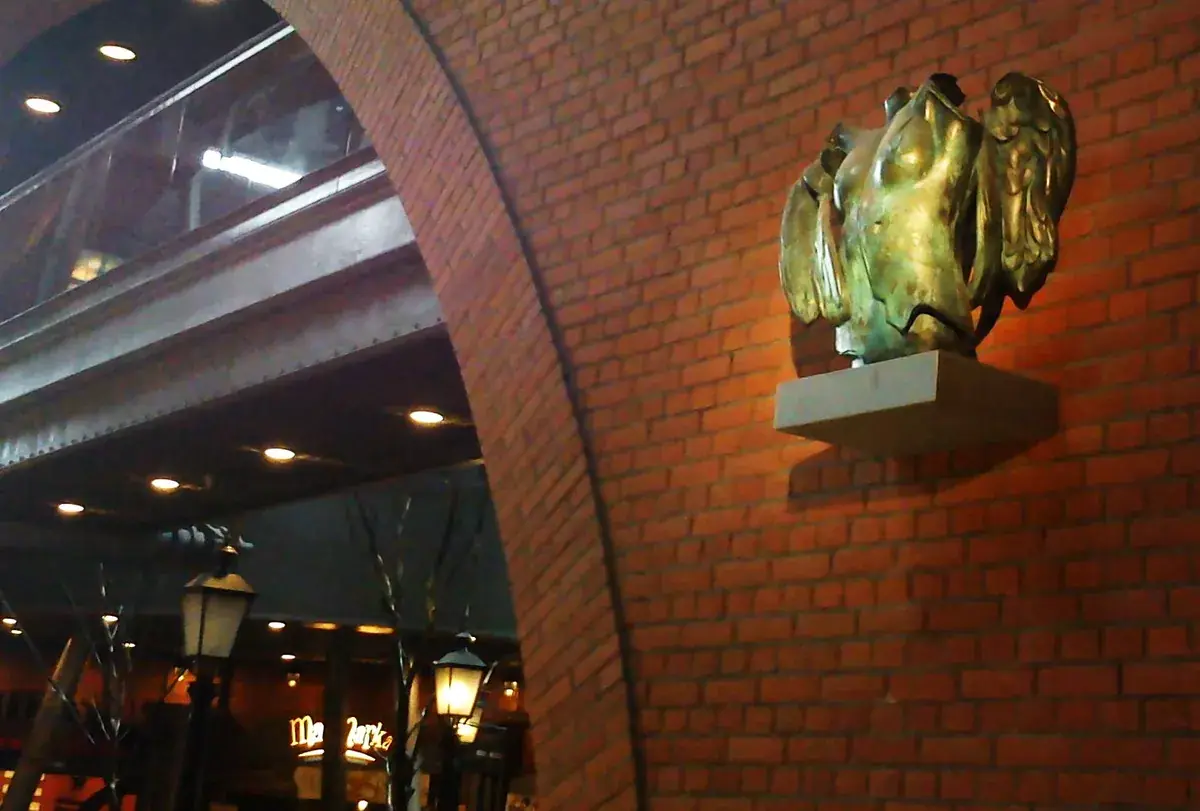
Eros Alato — Winged Eros, in Polish Eros Skrzydlaty — is one of Mitoraj's earliest treatments of the Eros theme, predating the famous Eros Bendato (Bound Eros) of 1999 by fifteen years. Where the later Eros is horizontal, lying on his side, bound and blindfolded, the 1984 Winged Eros is in a different compositional register — the wings of Eros, the ancient Greek god of desire, present but non-functional, the body fragmented and damaged in Mitoraj's characteristic manner.

The presence of an early Eros Alato in the Kulczyk collection is historically significant: it shows a major collector's investment in Mitoraj's work from an early period, before his international breakthrough exhibitions of the mid-1980s. The 1984 dating places this work in the year of Mitoraj's Castel Sant'Angelo exhibition in Rome — the show that launched his international career. A Winged Eros from that period is a document of the moment when his vocabulary was consolidating.

Academic scholarship on Mitoraj's reception in Poland specifically notes the Poznań Eros Alato as a significant early work in a Polish collection, contrasting its private/cultural-commercial setting with the public square placement of the Kraków Eros Bendato. The debate about where Mitoraj's work "belongs" — in civic space or inside cultural institutions — was particularly acute in Poland in the early 2000s, and the Poznań sculptures were central to that conversation.

Poznań's Relationship with Mitoraj

Poznań's encounter with Mitoraj has been primarily through the Kulczyk collection rather than civic patronage — a significant distinction. In Kraków, the city itself debated and ultimately accepted Eros Bendato as a civic gift; the ownership and meaning of the work were publicly contested. In Poznań, the Mitoraj sculptures belong to a private collection in a privately-owned cultural-commercial complex. They are accessible to millions, but their context is commercial culture rather than civic space.

This distinction is not purely academic. It reflects broader patterns in how Polish cities have related to Mitoraj's work: Warsaw through institutional commissions (the Jesuit church doors, the Olympic Centre); Kraków through civic negotiation and controversy; Poznań through the vision of an exceptional private collector. The Kulczyk collection at Stary Browar is one of the most significant private art collections in Poland, and the Mitoraj works are among its most visible and beloved pieces.

For collectors in the Poznań region, this context matters. The city has a strong tradition of private collecting and a sophisticated art market. If you own a Mitoraj work in the Poznań area — acquired through any channel, in any format — I am an active buyer and would welcome contact.

Beyond the three bronzes installed at Stary Browar, Mitoraj's connection to Polish institutional collecting deepened considerably during the final decade of his life. The National Museum in Poznań holds documentary material relating to his work, and Polish auction houses — among them Agra-Art and Desa Unicum in Warsaw — have handled his bronzes with increasing regularity since his death in Pietrasanta on 6 October 2014. Editions cast at the Versiliese foundry in Tuscany, where Mitoraj worked closely with master founders over decades, carry foundry stamps that serious collectors verify before purchase; works cast posthumously from authorised editions remain legitimate, but provenance documentation from the Mitoraj Estate becomes correspondingly more important. Among the sculptures encountered in the Polish secondary market, Torse d'Icare and Eros Bendato appear most frequently, with the latter — a bound, fragmented head that became one of his most reproduced images worldwide — commanding the strongest prices at Polish auction. Mitoraj's appeal to Central European collectors rests partly on biography: born in Oederan, Germany in 1944 to a Polish mother, he studied at the Academy of Fine Arts in Kraków under Tadeusz Kantor before relocating first to Paris and later to Italy, and this trajectory between Slavic and Mediterranean worlds gave his fractured classical forms a particular resonance for Polish audiences. Kulczyk's decision in 2003 to anchor Stary Browar's artistic identity around his work was therefore not simply an international gesture but a recognition of Mitoraj as, in part, a Polish sculptor — one whose reputation had been built abroad but whose emotional roots remained legible to domestic collectors and visitors encountering his bron

Beyond the three bronzes installed within Stary Browar itself, Mitoraj's connection to Poznań is reinforced by the city's position as one of Poland's most active secondary markets for his work. The Poznań auction house Rempex and, more prominently, the Dom Aukcyjny Agra-Art — which holds its major sales in Warsaw but draws significant bidding from Poznań-based collectors — have handled numerous Mitoraj bronzes over the past two decades, with smaller cabinet-scale pieces regularly achieving six-figure sums in Polish złoty. Collectors in the city tend to favour the mid-period works from the 1980s and 1990s, particularly the fragmented head and torso studies that Mitoraj produced in editions from his Pietrasanta foundry, Fonderia Mariani, where he worked closely with master founders to control patination and surface texture across each numbered cast. The edition structures for these works vary considerably: some torso studies were cast in editions as small as three, while the better-known mask reliefs — closer in character to the Stary Browar pieces — sometimes reached editions of seven or nine, a distinction that matters to serious buyers assessing long-term scarcity. Provenance tracing back to Mitoraj's own Paris gallerists, particularly Galerie Enrico Navarra, which represented him from the early 1990s and produced several important catalogues raisonnés of individual series, is considered the strongest indicator of authenticity in the current market. Collectors approaching Mitoraj's work for the first time are frequently advised to cross-reference cast numbers against the foundry records held by the Mitoraj estate, which has been more systematically catalogued since the sculptor's death in Pietrasanta on 6

Eros Alato by Igor Mitoraj at Stary Browar, Poznań
Eros Alato at Stary Browar, Poznań. Photo: MOs810, CC BY-SA 4.0
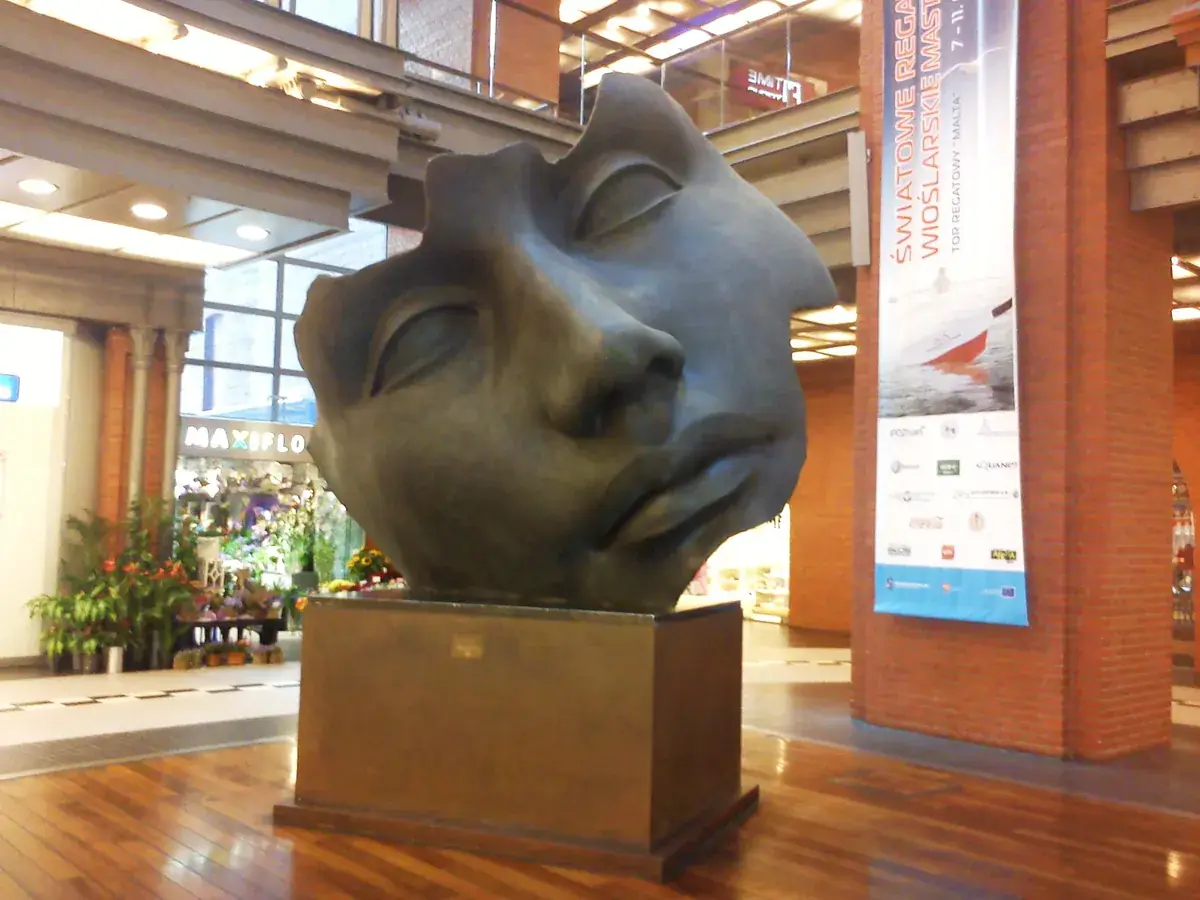
Tsuki-no-hikari by Igor Mitoraj at Stary Browar, Poznań
Tsuki-no-hikari at Stary Browar, Poznań. Photo: MOs810, CC BY-SA 4.0

Beyond the three bronzes installed within Stary Browar itself, Mitoraj's connection to Poznań is reinforced through the city's robust secondary market. Dom Aukcyjny Rempex and Agra-Art — two of Poland's most established auction houses operating out of Warsaw but drawing heavily on Poznań-area consignors — have handled multiple Mitoraj bronzes over the past two decades, with smaller editioned works such as Eros Bendato and Perseo reliably achieving six-figure Polish złoty results at hammer. Poznań collectors, shaped in part by proximity to Stary Browar's permanent installation, have developed a particular appetite for Mitoraj's classical fragment aesthetic: the partial face, the bound or veiled form, the truncated torso. This regional sensibility is not incidental. Grażyna Kulczyk's decision to place a monumental Mitoraj at the physical and symbolic centre of her 2003 project legitimised his work within the Polish collector consciousness in a way that gallery exhibitions alone rarely achieve. Kulczyk herself had encountered Mitoraj's work through European exhibition circuits before commissioning the Atrium piece, and her advocacy helped position him not as a peripheral figure in the Italian bronze tradition but as an artist of genuine international standing whose work rewarded serious acquisition. It is also worth noting that Mitoraj maintained a working foundry relationship with the Fonderia Artistica Battaglia in Milan, one of the oldest bronze foundries in Italy, and that the edition controls enforced through his studio mean that genuinely autographed and numbered casts carry a meaningful premium over unnumbered or posthumously cast examples — a distinction that sophisticated Poznań buyers have increasingly come to understand. Mitoraj

Grażyna Kulczyk's sustained engagement with Mitoraj extended well beyond the 1984 Eros Alato acquisition. Through the Art Stations Foundation, which she established in 2004 within the Stary Browar cultural complex in Poznań, Kulczyk created one of the most significant institutional frameworks for contemporary sculpture in Poland — one in which Mitoraj's work occupied a prominent position. The Stary Browar, a converted nineteenth-century brewery that opened as a mixed-use arts and retail destination in 2003, received the Europa Nostra award in 2006, bringing international attention to its programming model and, incidentally, to the collection housed within it. For collectors tracking the provenance of Mitoraj bronzes that passed through Polish hands in the 1990s and early 2000s, the Art Stations Foundation represents a key institutional node: several works that appeared at auction in subsequent years carried exhibition histories connected to the foundation's programme. Kulczyk's collecting philosophy, well documented in Polish cultural press from the period, emphasised acquiring works at career-defining moments rather than at peak market valuations — the 1984 Mitoraj purchase exemplifies this approach precisely. By the time Mitoraj's prices consolidated at major international auction houses in the late 1990s, the Poznań holdings had already appreciated substantially, lending the collection both cultural authority and market significance. This alignment of aesthetic conviction with financial acuity made the Kulczyk approach a reference point for other Central European collectors who were entering the secondary market for Italian-school bronze sculpture during the same period.

Grażyna Kulczyk's engagement with Mitoraj extends beyond the single Eros Alato acquisition and reflects a sustained collecting strategy that positioned her foundation among the most significant institutional holders of his bronze work in Central Europe. The Art Stations Foundation, which Kulczyk established in 2004 within the Stary Browar cultural complex in Poznań, operated with an explicit remit to bridge contemporary international art and Polish audiences — a mission that made Mitoraj, with his Polish birth and Italian career, a particularly resonant acquisition target. The foundation's collecting model differed from both the civic gifting model of Kraków and the purely speculative market acquisitions that characterized much private Mitoraj ownership in the 1990s and 2000s: works entered the collection as permanent holdings intended for sustained public engagement, not as tradeable assets. This distinction matters for understanding market dynamics, because institutional commitments of this kind effectively withdrew significant pieces from circulation, contributing to the scarcity premium that has shaped auction pricing for Mitoraj bronzes since his death in 2014. The Stary Browar setting itself — a nineteenth-century brewery converted into a hybrid shopping and arts venue — gave Mitoraj's fragmented classical figures an unusual architectural counterpoint, pairing them with industrial Poznań heritage rather than the Mediterranean stone and open piazzas most commonly associated with his outdoor installations. Kulczyk sold the Stary Browar complex in 2012, and the subsequent stewardship of the art holdings within it became a matter of some discussion among Polish collectors and arts administrators, raising practical questions about continuity of access that remain relevant to anyone researching the current location and condition of the Eros Alato and any associated works from the original foundation collection.

Grażyna Kulczyk's acquisition of the 1984 Eros Alato reflects a broader pattern in her collecting strategy during the 1980s and early 1990s, when she was systematically building holdings in contemporary European sculpture at a time when few Polish collectors had the international access or capital to do so. Her Art Stations Foundation, formally established in Poznań in 2004 within the Stary Browar cultural and commercial complex, gave the Mitoraj bronzes an institutional context that shifted their status from private holdings to semi-public cultural assets — accessible to a wider audience without entering municipal ownership. This arrangement is unusual in the context of Mitoraj's European placements, where works typically end up either in fully public civic space or in conventional museum storage. The Stary Browar model, blending retail, arts programming, and permanent collection display, created a distinctive reception environment for the sculptures: visitors encountered them alongside temporary exhibitions of younger artists, which positioned Mitoraj's classical vocabulary in dialogue with contemporary practice rather than isolating it as a monument. Kulczyk's Mitoraj holdings also include works acquired through the Galleria Mitoraj in Pietrasanta, the Tuscan base from which the sculptor managed international sales and commissions from the early 1980s onward. Pietrasanta's marble workshops and foundries made it the practical centre of his production, and collectors who purchased directly through that channel — rather than through secondary market auctions — often acquired works with stronger provenance documentation and closer ties to Mitoraj's own studio records. For researchers tracking the market history of Mitoraj bronzes, the Kulczyk acquisitions represent a relatively well-documented node in what is otherwise a fragmented provenance landscape; many works from the 1980s

Grażyna Kulczyk's engagement with Mitoraj extended well beyond a single acquisition. As founder of the Art Stations Foundation — established in Poznań in 2004 within the Stary Browar cultural and commercial complex — Kulczyk built one of the most institutionally coherent private collections of Mitoraj's work in Central Europe. The Foundation's remit was explicitly to bridge contemporary art and public accessibility, and Mitoraj's bronzes served that dual purpose with particular effectiveness: recognisable enough to draw a general audience, yet demanding enough to reward sustained attention. The Stary Browar setting itself deserves consideration as context for reading these works. Converted from a nineteenth-century brewery and reopened in 2003, the complex was from the outset conceived as a hybrid space where commerce and culture would be deliberately entangled — a philosophy not entirely unlike Mitoraj's own blending of ancient iconography with modern market dynamics. His bronzes, carrying the accumulated authority of Greco-Roman figuration, sat comfortably in an environment that was itself negotiating between heritage and commercial utility. For collectors tracking the secondary market, the Kulczyk holdings are significant as reference points for condition and provenance. Works acquired directly by major institutional collectors in the 1980s — before Mitoraj's prices consolidated significantly following his 1990s retrospectives — tend to carry unusually clean ownership histories, which bears on auction estimates when comparable works appear. Eros Alato casts from the mid-1980s have appeared at Christie's and Sotheby's in various sizes and surface treatments, with prices for authenticated early examples in significant scale regularly exceeding €200,000 at peak market periods in the 2000s and again in the mid-2010s. The Pozn

Grażyna Kulczyk's broader acquisitions strategy offers important context for understanding why a 1984 Eros Alato entered the collection at all. Kulczyk, whose wealth derived from the Kulczyk Holding conglomerate and whose collecting began in earnest during the early 1990s, was among the first Polish private collectors to treat contemporary European sculpture as a distinct category requiring specialist knowledge rather than simply decorative intent. Her foundation, Art Stations, established formally in 2004 within the Stary Browar cultural complex in Poznań — itself a former nineteenth-century brewery converted into a combined shopping and arts venue — operated on a model that blurred institutional and commercial frameworks deliberately. The Stary Browar setting is architecturally relevant: works acquired by the foundation were displayed in dialogue with foot traffic, retail contexts, and programmed cultural events simultaneously, meaning that a visitor encountering a Mitoraj bronze might do so while passing between a boutique and an exhibition hall. This mixed context proved controversial among Polish art critics, some of whom argued it domesticated works that demanded contemplative distance, while others pointed out that Renaissance patrons had always embedded sculpture in commercial and civic life without apology. What distinguishes the Kulczyk holdings from comparable Central European private collections of the period — the Boros Collection in Berlin, for instance, or the Sandretto Re Rebaudengo Foundation in Turin — is their geographic specificity: rather than situating the collection in a capital or an internationally connected hub, Kulczyk anchored it in Poznań, a city with strong trade fair traditions but limited international art market infrastructure in the 1990s. This decision had measurable consequences for how Mitoraj's work was received locally. Polish collectors outside Warsaw who visited the Stary Browar

Grażyna Kulczyk's decision to acquire the 1984 Eros Alato reflected a broader acquisitions philosophy that distinguished her collection from purely decorative patronage. Kulczyk, who built her fortune through the Kulczyk Holding investment group before pivoting to arts philanthropy in the late 1990s, founded Art Stations Foundation in 2004 with an explicit mandate to bring international contemporary and modern sculpture into Polish institutional consciousness. Her interest in Mitoraj predated the foundation by two decades, suggesting a personal rather than institutional logic behind the acquisition — a collector's instinct operating ahead of critical consensus. This pattern, in which a work enters a private Polish collection during or immediately after the artist's early international breakthrough, mirrors the acquisition histories of other Mitoraj holdings in Central Europe, where individual collectors consistently anticipated the institutional recognition that followed. The Art Stations Foundation eventually developed its programme around the Stary Browar complex in Poznań, a former brewery transformed into a mixed arts and commercial space that opened in 2003 and was awarded the ICSC Award for the best shopping centre in the world in 2005 — a context that gave the Mitoraj holdings an unusual dual existence, simultaneously within high retail architecture and serious cultural programming. Scholars of post-communist Polish collecting have noted that foundations of this type, emerging in the first decade after 1989, often used international modernist and late-modernist sculpture as a legitimising strategy, anchoring new money to established aesthetic values. Mitoraj's work, with its references to antiquity and its clear European lineage, was particularly well suited to this function. The Poznań Eros Alato therefore carries an institutional biography as interesting as its formal one: acquired privately, transferred into a foundation context,

Own a Mitoraj Work in Poznań or Greater Poland?

Send me a photograph. I respond personally within 24 hours — discreetly, directly, without intermediaries.

Contact Me Directly

ミトライ作品をお持ちですか?

ワルシャワのプライベートコレクターが直接購入します。オークション手数料なし。迅速・秘密厳守。

✉ ご連絡はこちら

Mitoraj in Other Cities

Kraków Warsaw Paris → All cities