문의
HOME 🗺 MAP BRONZES BIOGRAPHY
CITIES
🇵🇱 Warsaw 🇵🇱 Kraków 🇵🇱 Poznań 🇫🇷 Paris 🇩🇪 Bamberg 🇬🇧 London 🇮🇹 Rome 🇮🇹 Pompeii 🇮🇹 Milan 🇮🇹 Venice 🇮🇹 Agrigento 🇮🇹 Pietrasanta ✉ Contact
Own a Mitoraj? ✉ Contact

Igor Mitoraj in Pompeii

Of all the places where Mitoraj's bronzes stand, Pompeii is the most extraordinary. Two permanent works — Centauro in the Forum and Daedalus, gifted to Italy in 2016 — occupy the ruins of a city that was itself destroyed, buried, and excavated: a city that had already done everything that Mitoraj spent his career depicting. Fragmentation. Burial. Survival. The trauma of time. At Pompeii, his visual language is not metaphor — it is biography, written in the same volcanic stone.

The Pompeii project was described by Mitoraj as "my great dream." Thirty monumental sculptures placed throughout the excavations created an unprecedented dialogue between contemporary art and antiquity — his fragmented figures impossible to distinguish at a glance from ancient remains. When the Italian Culture Minister announced that Daedalus would remain permanently as a gift to Italy, it completed a circle: Mitoraj had spent his life studying antiquity, and now his work would stand among it permanently. The Centaur in the Forum is also confirmed permanent.

📍 Foro di Pompei, Via Villa dei Misteri, 80045 Pompei NA

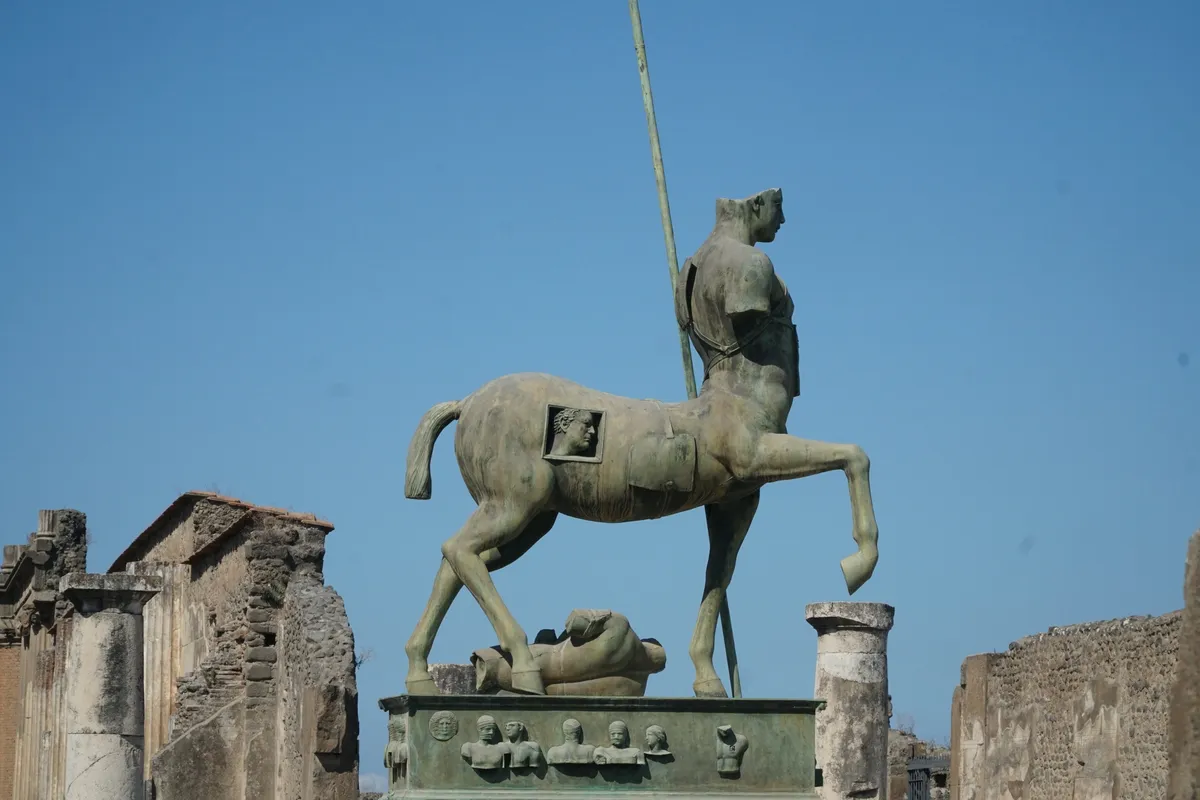
Centauro — Forum of Pompeii · Permanent

Bronze · Monumental · Forum of Pompeii · Permanent installation

The Centauro stands in the Forum of Pompeii — the civic heart of the ancient city, the space where Romans gathered, traded, worshipped, and governed. The Forum is now a long rectangular expanse of volcanic stone, bordered by the remains of temples, basilicas, and administrative buildings, with Vesuvius visible on the northern horizon. It is one of the most visited archaeological sites in the world, receiving over 3 million visitors annually.

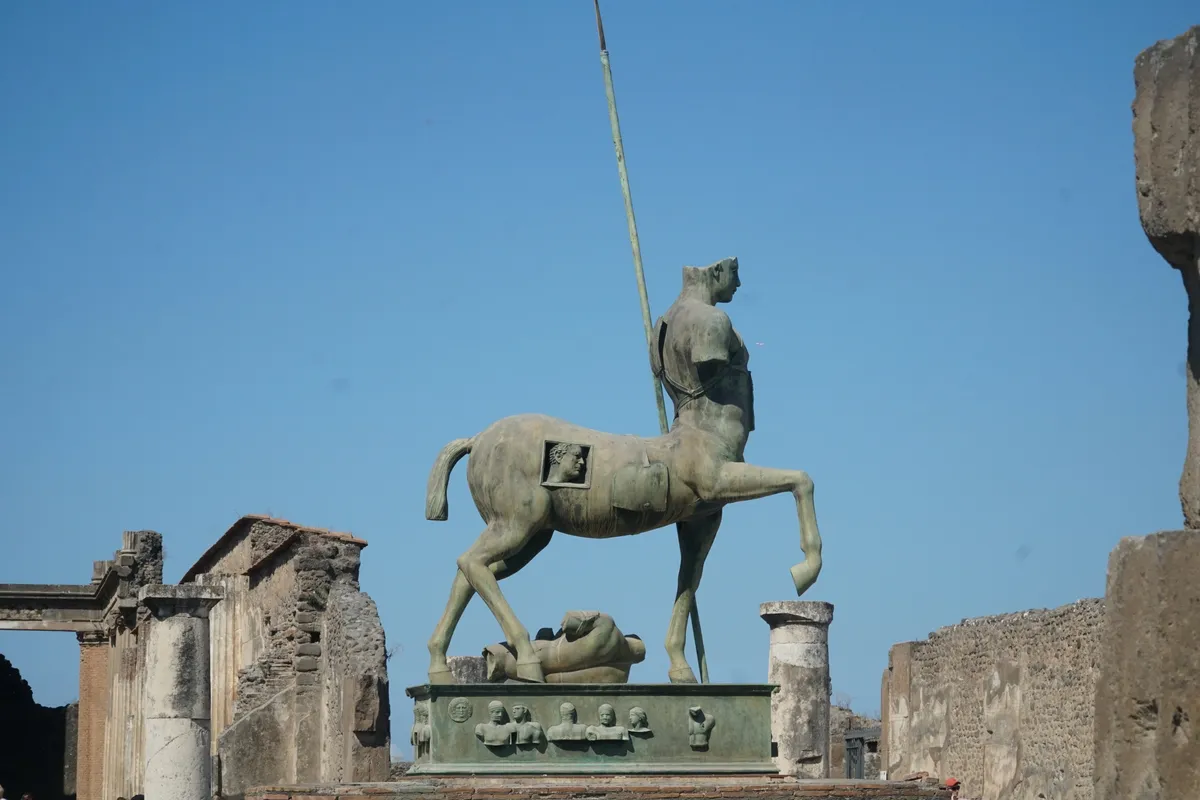
Into this space, Mitoraj placed the Centauro: the half-man, half-horse of Greek mythology, rendered in his characteristic manner — monumental, fragmented, partially bandaged, emerging from the bronze surface as if itself excavated from the ground beneath. The Centaur was a creature of the boundary between the civilised and the wild, between human reason and animal force. In Mitoraj's version, the boundaries are spatial as well as symbolic: the work stands at the threshold between the ancient city and the modern world, between the buried and the surviving.

The effect of the Centauro in the Pompeii Forum is unlike any other Mitoraj installation. Visitors encounter his modern bronze amid Roman stone that is genuinely 2,000 years old — not a reconstructed heritage site but the actual archaeological fabric of a city that existed, functioned, and was destroyed. The Centauro does not compete with this context. It converses with it: both works of human making, separated by two millennia, sharing the same vocabulary of the body under pressure.

→ View on Google Maps

"To place a fragmented modern bronze among the fragmented ancient ruins of Pompeii is not an act of artistic ambition — it is an act of recognition. The city and the sculpture speak the same language: the language of what survives when everything else is gone."
📍 Pompeii Archaeological Park · Gifted 2016 · Permanent

Daedalus — Gift to Italy, 2016 · Permanent

Bronze · Gifted to the Italian state · 2016 exhibition → permanent · Pompeii Archaeological Park

Daedalus — the master craftsman of Greek mythology, maker of the Labyrinth and of the wings that killed his son Icarus — was gifted to Italy as a permanent donation to the Pompeii Archaeological Park in 2016, two years after Mitoraj's death in 2014. The donation was managed by the Mitoraj estate and represents the artist's own wish to leave a permanent presence at Pompeii, where he had exhibited earlier in his career.

Daedalus was one of Mitoraj's recurring mythological subjects. The figure of the craftsman — the maker, the builder, the man whose genius contained its own tragedy — resonated with Mitoraj's understanding of his own role as an artist. Daedalus built the Labyrinth to contain the Minotaur; Mitoraj's sculptures create their own enclosed worlds, interiors revealed by the surface damage that exposes them. The parallel is not incidental.

The gift to Italy, specifically to Pompeii, was also a statement of artistic allegiance. Mitoraj had spent four decades working in Italy, in Pietrasanta, in daily contact with Italian craftspeople, Italian stone, Italian bronze. Leaving a permanent work at the country's most visited archaeological site — and doing so posthumously, through his estate — was the most Italian gesture possible for a Polish-born artist who had made Italy his home.

The 2016 placement followed a significant exhibition of Mitoraj's work at Pompeii in which monumental bronzes were installed among the ruins — a temporary exhibition that generated substantial critical attention before the Daedalus was retained permanently.

Why Pompeii & Mitoraj Belong Together

Pompeii was destroyed on 24 August 79 AD, when the eruption of Vesuvius buried the city under 4–6 metres of volcanic ash and pumice in less than 24 hours. The burial was almost perfectly preserving — the absence of oxygen prevented organic decay, and the pressure of the ash cast perfect moulds of the bodies of those who died where they fell. When excavations began in earnest in the eighteenth century, the casts of the victims — plaster poured into the hollow left by the decomposed body — became the most famous archaeological objects of the modern era.

These casts are, in essence, exactly what Mitoraj spent his career making. A surface that preserves the form of a body that is no longer there. A shell that records the human presence after the human presence has gone. The bandaging, the wrapping, the sealed eyes — all of Mitoraj's visual vocabulary is present in the Pompeii casts, independently and earlier, as if the city had anticipated his entire body of work by nineteen centuries.

This is why the Pompeii installation is not simply a prestigious placement at a famous site. It is a homecoming of a very specific kind — an artist whose entire language was shaped by the question of what survives the catastrophe, returning the answer to the place where the question was first and most urgently posed.

Visiting Pompeii

The Pompeii Archaeological Park is located at Via Villa dei Misteri 2, 80045 Pompei (NA), Italy. It is accessible by the Circumvesuviana railway from Naples (Pompei Scavi–Villa dei Misteri station, approximately 35 minutes) and from Sorrento (approximately 30 minutes). The park is open daily, with seasonal variations in closing time. Advance booking is strongly recommended in peak season (April–October). The Forum is the first major space encountered after the main entrance and cannot be missed.

For serious visitors, allow at least half a day. The park covers approximately 44 hectares and contains over 1,000 structures. The Mitoraj bronzes in the Forum are visible from the entrance path and will be among the first significant artistic encounters of the visit.

The precise current location of the Daedalus within the Pompeii Archaeological Park may change as the site undergoes ongoing conservation work. Confirm with the park authorities or the Mitoraj estate for the most current placement information.
📍 View on Google Maps

Igor Mitoraj Centauro monumental bronze sculpture in the Forum of Pompeii — permanent installation, gifted to Italy
Centauro in the Forum of Pompeii. Photo: Adam Harangozó, CC BY-SA 4.0
Igor Mitoraj Centauro bronze centaur sculpture among the ruins of Pompeii — permanent public collection
Centauro among the ruins. Photo: Adam Harangozó, CC BY-SA 4.0

The 2011 Pompeii exhibition, titled Eros e Psiche after one of its centrepiece works, ran from April through November and drew international attention to Mitoraj's late-career ambitions at a scale he had not previously attempted in a single site. The thirty sculptures were distributed not as a curated gallery installation but as deliberate interventions — placed at the Temple of Apollo, the Triangular Forum, the House of the Faun, and along the Via dell'Abbondanza, among other locations — so that visitors encountered them gradually, as discoveries rather than exhibits. Mitoraj worked closely with the Soprintendenza Speciale per i Beni Archeologici di Napoli e Pompei on the placement, a collaboration that was noted at the time as unusually sustained between a living artist and the Italian heritage authority. For collectors, the exhibition marked a period of heightened market interest: several of the maquette-scale bronzes associated with the Pompeii works — including studies for Ikaro Alato and Tindaro Screpolato — appeared at auction between 2012 and 2016 with strong results, reflecting the documentary and associative premium that major site-specific projects tend to confer on related works. Mitoraj died in October 2014, three years after the exhibition opened and two years before Daedalus was formally gifted to the Italian state, meaning he did not witness the permanent installation of that work in situ. His foundry, Fonderia Artistica Battaglia in Milan — which cast many of his large bronzes — has continued to work with the Mitoraj estate on posthumous authorised casts, a detail of

The 2015 Pompeii exhibition, titled Mitoraj a Pompei, was organised in collaboration with the Pompeii Archaeological Park under the direction of Massimo Osanna, whose scholarly background in ancient art made him an unusually sympathetic partner for the project. The show ran from April through November, drawing on works that Mitoraj had developed over several decades — among them Eros Bendato, Ikaro, and Tindaro Screpolato, works already well known to collectors but transformed by their placement among roofless Roman rooms and broken column bases. What distinguished the exhibition from comparable interventions at ancient sites was the deliberate refusal of pedestals: works were set directly onto tufa and travertine, at ground level, so that the scale relationship between figure and ruin could operate without mediation. For collectors and institutions assessing Mitoraj's market position, the Pompeii project represented a significant inflection point. Secondary market prices for his bronzes, particularly the bandaged head series and the winged figures, strengthened noticeably in the years following 2015, reflecting both the global press coverage and the cultural legitimacy conferred by a permanent presence at one of the world's most scrutinised UNESCO World Heritage Sites. The Galleria Contini, which has represented Mitoraj's estate since his death in October 2014 — he died in Paris just months before the Pompeii installation opened, never seeing his great dream fully realised — has cited the Pompeii works as central to ongoing institutional interest in his sculpture. Edition sizes across his major bronze series were typically small, ranging from two to six casts depending on scale, and provenance connecting a work to the 2015

The 2011 Pompeii exhibition, titled Mitoraj a Pompei, was organised in collaboration with the Soprintendenza Speciale per i Beni Archeologici di Napoli e Pompei and ran from April through November of that year, attracting significant critical attention across the Italian and international press. What distinguished the placement from a conventional outdoor sculpture show was the curatorial precision with which each work was sited: Mitoraj and the exhibition team spent considerable time walking the excavations before deciding where each piece would stand, ensuring that sightlines, scale, and material resonance were all considered in relation to the specific architectural context. A bronze such as Ikaro — a winged figure stripped of its upper body, the torso truncated mid-chest — was positioned so that the absent wings echoed the broken pediments of surrounding structures, creating a visual conversation that required no label to read. Collectors who visited during the exhibition period have since noted that seeing the works in Pompeii materially changed their understanding of pieces they already owned; the site revealed dimensions of Mitoraj's intent that gallery and studio contexts had obscured. For the secondary market, the Pompeii association carries measurable weight. Works documented as having been exhibited in the 2011 installation — or closely related in form and casting period to those works — consistently attract stronger interest at auction than comparable pieces without that provenance thread. Sotheby's, Christie's, and specialist Italian houses have each handled Mitoraj bronzes in the years since, and catalogue entries frequently reference the Pompeii project as a contextual marker, positioning the sculptor within a lineage that includes de Chirico and Paladino in terms of Italian cultural canonisation. Mitoraj died in October 2014,

The 2011 Pompeii exhibition, titled Mitoraj a Pompei, was organised in collaboration with the Soprintendenza Speciale per i Beni Archeologici di Napoli e Pompei under the direction of Superintendent Marcello Fiori, and represented a curatorial undertaking of unusual complexity — each placement required archaeological survey to ensure that the bronzes, some exceeding two tonnes, could be positioned without disturbing subsurface remains. The works were not distributed randomly across the site but arranged along the principal ancient routes: the Via dell'Abbondanza, the triangular forum, and the amphitheatre precinct, so that a visitor moving through the excavations encountered them in a sequence that mirrored the original civic logic of the Roman city. Among the thirty sculptures installed that year, several had been exhibited previously at sites including Agrigento and the Tuileries Garden in Paris, but Pompeii represented the first occasion on which the full scope of Mitoraj's monumental vocabulary — Tindaro Screpolato, Eros Bendato, Ala di Luce, and others — was assembled within a single archaeological context. For collectors and scholars, the Pompeii installation also marked a shift in how Mitoraj's market positioned his editioned bronzes: following the exhibition's critical reception, auction appearances of works from the same series increased notably, with Eros Bendato in particular becoming one of his most commercially recognised subjects at European salesrooms including Sotheby's Paris and Dorotheum Vienna. The exhibition catalogue, published by Skira in 2011 with essays by Pietro Giovanni Guzzo and Gianni Merc

The 2016 Pompeii exhibition, titled Mitoraj a Pompei, was organised in collaboration with the Pompeii Archaeological Park under the direction of Massimo Osanna, who described the pairing of Mitoraj's sculpture with the ruins as "a meeting between two wounded worlds." The show ran from April through November, drawing an audience that significantly overlapped with the site's established archaeological visitor base — an unusual crossover that underscored how effectively Mitoraj's formal vocabulary, built on decades of study at the École des Beaux-Arts in Paris and extended time living in Pietrasanta, communicated across the divide between contemporary art and classical archaeology. Among the thirty works installed across the excavations were Eros Alato, positioned near the Terme del Foro, and Tindaro Screpolato, whose cracked and open cranium read, against the backdrop of Vesuvius, less like surrealist gesture and more like geological fact. For collectors, the exhibition holds particular significance because it represented Mitoraj's last major museum-scale project before his death in October 2014 — meaning the Pompeii installation was realised posthumously, overseen by his studio and longstanding collaborators in Pietrasanta, where his bronzes had been cast for decades by the Fonderia Mariani. The permanent retention of Daedalus — the winged figure whose mythological narrative of ambition, flight, and catastrophic fall is almost brutally legible in Pompeii's context — was formalised through an agreement between the Italian Ministry of Cultural Heritage and the Mitoraj estate, reflecting both the Italian state's recognition of his contribution and the estate's sustained effort to place

The 2016 Pompeii exhibition, titled Eros e Psiche after one of its centerpiece works, ran from April through November and was organized in close collaboration with the Pompeii Archaeological Park under the directorship of Massimo Osanna, who was instrumental in securing both the institutional framework and the permanent placement agreements that followed. The thirty sculptures were distributed across multiple excavated zones — the Forum, the Teatro Grande, the Terme del Foro, and several of the city's residential streets — meaning visitors encountered Mitoraj's work not as a concentrated gallery experience but as a sequence of isolated encounters spread across nearly two kilometers of ruins. This dispersal was deliberate: Mitoraj had long argued that monumental sculpture should be experienced in motion, discovered rather than presented, and Pompeii's layout made that argument with unusual force. Works such as Tindaro Screpolato, Perseo, and Eros Bendato were positioned so that their fragmented bronze surfaces — deliberately weathered and patinated — registered at first glance as indistinguishable from the surrounding Roman stonework, a calculated ambiguity that repeatedly unsettled visitors accustomed to the clear demarcation between ancient artifact and contemporary object. For collectors and scholars tracking Mitoraj's market, the Pompeii context is significant beyond its cultural prestige: the exhibition substantially accelerated international auction interest in his smaller bronze editions, with several works from his Carrara foundry period appearing at Sotheby's Paris and Dorotheum Vienna in 2017 and 2018 at prices that reflected the renewed visibility. The permanent placement of Daedalus — a winged, headless torso

The 2015 Pompeii exhibition, titled Eros e Psiche after one of its centrepiece works, was organized in collaboration with the Soprintendenza Speciale per Pompei, Ercolano e Stabia and ran from May through November, drawing an estimated 600,000 visitors to the excavations during that period alone — a figure that represented a significant increase in foot traffic compared to equivalent months in previous years. The thirty sculptures were distributed across multiple sites within the archaeological park, not only the Forum: works were positioned near the Temple of Venus, along the Via dell'Abbondanza, and within the Garden of the Fugitives, where the famous plaster casts of eruption victims are preserved. This last placement carried particular weight — Mitoraj's bandaged, incomplete forms standing in proximity to the actual frozen bodies of the dead created an unrehearsed visual echo that many critics and curators noted at the time. The exhibition was curated with the involvement of Gioia Mori, who had long been one of the principal scholarly voices on Mitoraj's relationship to classical antiquity, and whose writing on his work consistently emphasised the distinction between nostalgia and what she described as active mourning — a quality she found nowhere more fully expressed than in the Pompeii context. For collectors, the Pompeii exhibition marked a turning point in how Mitoraj's market was understood internationally: the sustained press coverage across Italian, French, and American cultural publications brought serious institutional attention to editions that had previously circulated primarily among European private collectors. Works from series exhibited at Pompeii — including smaller foundry editions of Ikaro and Tindaro Screpolato — saw measurable increases in secondary market interest in

Own a Mitoraj Work?

The Pompeii bronzes show Mitoraj at the height of his ambition. The collector editions — Centurione, Persée, Tête Secrète — carry the same visual language at intimate scale. I buy directly and privately, anywhere in Europe.

Contact Me Directly

See also: Mitoraj in Rome — Santa Maria degli Angeli · Pietrasanta — studio & museum · All bronzes wanted · Interactive Europe map · All cities worldwide

Mitoraj at Pompeii — The 2016 Exhibition

In 2016 Mitoraj's sculptures were installed among the ruins of Pompeii in what became one of the most celebrated temporary exhibitions of that decade. Thirty works were positioned across the ancient city — in the Forum, the theatres, the Temple of Venus — in locations personally chosen by Mitoraj before his death in 2014. The dialogue between his fragmented contemporary figures and the fractured remains of Roman civilisation was considered definitive proof of his artistic vision. One work, Daedalus, was gifted permanently to Italy and remains in Pompeii. The exhibition catalogue is an important reference for collectors and scholars, documenting installation photographs and curatorial essays.

You might also like

Agrigento Rome Pietrasanta

Mitoraj in Other Cities

Rome Venice Pietrasanta Paris → All cities