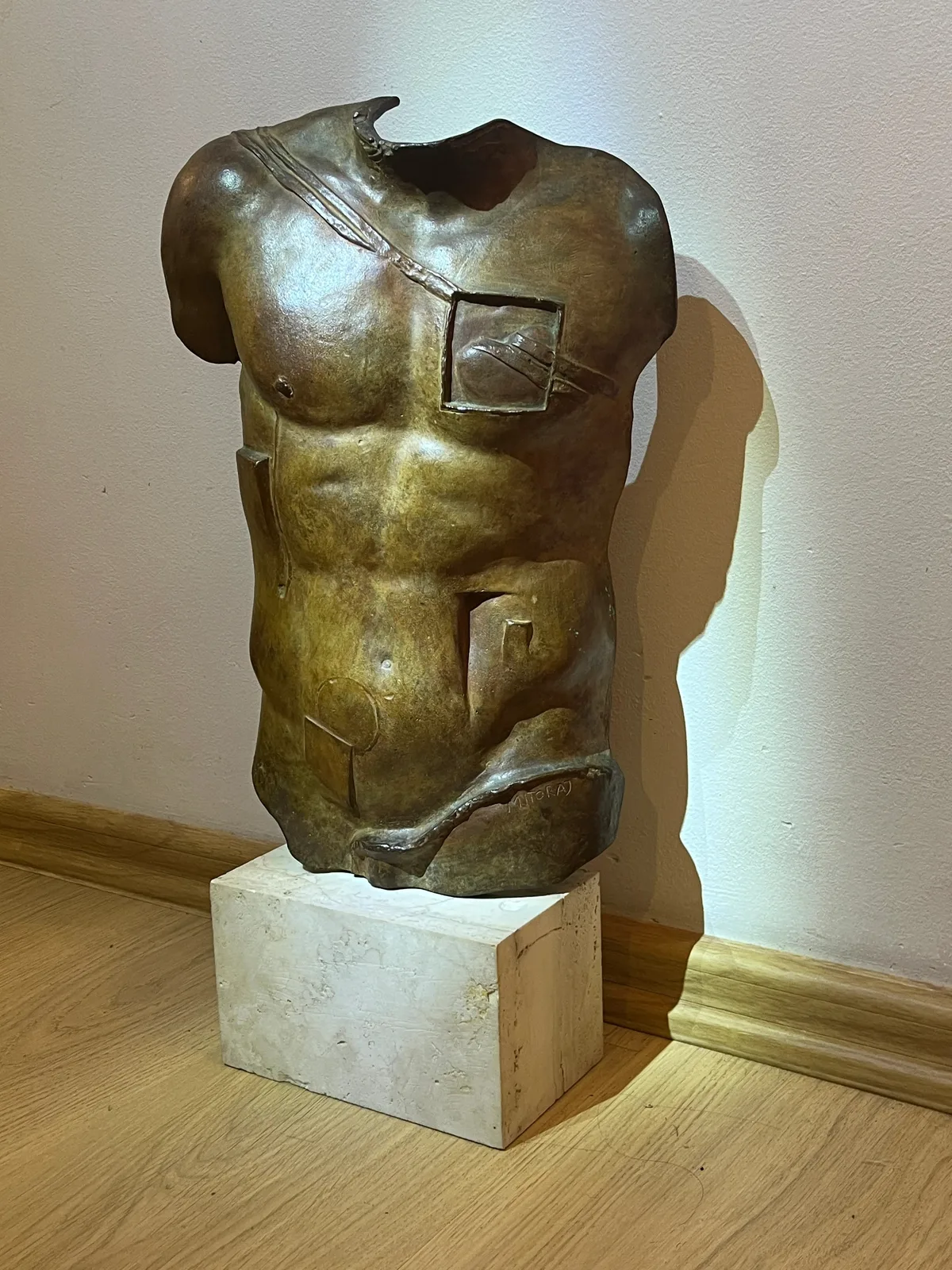
Igor Mitoraj — Persée
The Persée is Mitoraj's most widely collected bronze — an edition of 1000 that remains, three decades after its creation, the work through which most collectors first encounter Mitoraj's language. It is a helmet-wearing head, the face partially absent, the surface marked by the characteristic Mitoraj treatment: the bronze simultaneously ancient and damaged, the figure simultaneously heroic and incomplete. The Persée exists in multiple patina variants — brown, green-black, and silver — and in a version paired with Asclépios that is among the artist's most significant compositional statements.
حول Persée
Perseus — the Greek hero who slew Medusa and rescued Andromeda — is one of the foundational figures of Western mythology. In Mitoraj's hands, he becomes something more specific and more unsettling: not the triumphant hero, but the aftermath of heroism. The helmet survives where the face has been partially erased. The bronze preserves the armour and the wound simultaneously. This is characteristic of Mitoraj's entire mythological programme, but the Persée states it with a clarity and formal economy that no other work in the catalogue quite matches.
The edition of 1000 was published in 1988, placing the Persée in Mitoraj's mature period — after the Artcurial editions of the late 1970s and early 1980s, but before the monumental public commissions that would dominate his later career. By 1988 Mitoraj was established as the leading sculptor of his generation in the Pietrasanta community, and the Persée became the work through which his practice became internationally visible.
Persée — Technical Details
A helmet-wearing male head — the Persée is typically 25–35 cm in height in the standard edition, mounted on a separate stone or bronze base. The signature appears engraved at the base of the neck or on the lower edge, with the edition number on the reverse. The bronze surface shows Mitoraj's characteristic treatment of helmet and facial features: the helmet is resolved and detailed; the face is partially present, partially erased. Three principal patina variants are documented: warm brown (most common), green-black (oxidised, antiqued appearance), and silver (burnished, metallic). Provenance for documented examples spans private collections across France, Italy, Germany, Poland, and the United Kingdom.
ثلاثة متغيرات من البينا
The most important collector distinction within the Persée edition is patina. The three principal variants represent significantly different visual characters, and secondary market values reflect this.
The brown patina — warm copper-brown, similar to the Centurione and Kea editions — is the most common and the most "classic" Mitoraj colour. It reads as directly continuous with ancient bronze, and most collectors who encountered the Persée in gallery contexts in the 1990s and 2000s know the brown patina version.
The green-black patina is the most dramatic and the rarest. The deep oxidised surface recalls the actual condition of ancient bronzes recovered from archaeological contexts — Mitoraj was deeply attentive to Etruscan and Roman bronze, and the green-black patina positions the Persée within that visual tradition most explicitly. Green-black examples consistently achieve higher auction prices than brown patina examples of comparable condition.
The silver patina — polished, with the bare metal surface showing through — is the most contemporary in visual register and the most divisive among collectors. For some, the silver reads as too decorative; for others, the contrast between the burnished surface and the damaged face is the most powerful of the three readings. Silver examples are less common in the secondary market than brown patina.
Persée & Asclépios — The Duo
Among the most significant presentations of the Persée subject is the Persée & Asclépios pairing — two bronze heads displayed together, the warrior-hero and the healer facing one another. Asclépios (Aesculapius in the Roman form) was the god of medicine, identified by the serpent staff that later became the caduceus. In Mitoraj's version, Asclépios is characterised by a softness and interiority that contrasts directly with the military exterior of the Persée. Together, the two heads constitute one of Mitoraj's most explicit statements about the dual nature of classical culture: force and healing, destruction and repair.
The Persée & Asclépios pairing is documented in the collection on this site. A dedicated page covers the duo in detail: Persée & Asclépios →
The Persée in Public Space
Monumental versions of the Persée subject appear in several significant public contexts. In Poland, where Mitoraj is a national cultural figure (born in Oederan, Germany to a Polish mother; studied in Kraków; returned repeatedly to Poland for major commissions), the Persée head has been displayed in civic spaces including Warsaw. In Italy, where Mitoraj spent most of his working life, the subject appears in Pietrasanta, Florence, and in gallery contexts across Tuscany. These public presences reinforce the market position of the desktop and studio editions: a Persée sitting on a collector's desk in Warsaw or Milan is in direct visual conversation with the monumental versions visible in the cities they inhabit.
Condition Notes for the Persée
The Persée is structurally one of the most robust bronzes in Mitoraj's catalogue — the compact, solid form of the helmet-head offers very few vulnerable projections. The main condition considerations are patina stability (all three patina types are durable when not exposed to salt air or abrasive cleaning), the base (stone bases may show edge wear; bronze bases are typically very stable), and the legibility of the signature and edition number. I buy Persée bronzes in all conditions, with or without the original base and documentation.
Identifying Your Persée
The Persée series spans several distinct editions, each with its own scale and context. Persée Piccolo is the small table edition — typically 15–25 cm — made for private interiors and the collector market. Persée Grande and the monumental variants are studio and public-commission works, reaching well above human scale. When identifying an example, the first step is scale: a Piccolo is a desk object; a monumental Persée requires dedicated installation. Edition size and numbering vary accordingly, and the two groups do not overlap in the market.
The most immediately recognisable formal element is the winged helmet of Perseus — the legendary Greek hero who slew Medusa. Mitoraj renders the wings as part of the helmet's structure, cast in one piece with the head. In all Persée editions, the helmet is the resolved element: fully detailed, formally complete. The face, by contrast, is typically incomplete — partially erased, the features interrupted mid-form. This dialectic between the intact armour and the absent face is the formal signature of the Persée across all scales. The severed Medusa head appears in some compositional variants — held at the figure's side, displayed on a nearby plinth, or implied by the pose — but is not present in the standard solo Persée edition.
The dynamic pose is another diagnostic: unlike the more static frontal Centurione, the Persée head turns on its axis, the neck angled, communicating motion arrested rather than stillness assumed.
Patina Variants
- Dark black-brown: the most common variant; deep oxidised surface, approaching black in shadow, revealing warm brown on raised surfaces. Associated with Pietrasanta production from the mid-1980s onwards.
- Warm gold-brown: a lighter patination, the bronze colour more visible, giving a warmer and more immediately "classical" appearance. Common in commercial gallery editions.
- Green verdigris: the most archaeological in register — the surface patinated to recall excavated ancient bronze. Rarest of the three and consistently commands the strongest prices in the secondary market.
Signature and Foundry Marks
The signature MITORAJ is incised or stamped on the lower rear of the neck or at the base edge. Edition numbering follows the format NNN/1000 for the standard Persée edition; hors commerce copies are numbered HC NN/XX. Foundry marks — typically Fonderia Mariani or Del Chiaro, both of Pietrasanta — appear on the reverse lower surface. Pietrasanta foundry marks are a strong authentication indicator: Mitoraj's entire bronze output was produced through this small group of Tuscan foundries, and their marks are well-documented.
Distinguishing Persée from Persée & Asclépios
The solo Persée is a single head, self-contained, on its own base. The Persée & Asclépios is a two-figure group — two separate bronze heads, the warrior and the healer, typically displayed facing one another on paired bases. They are distinct works and not interchangeable. When a single head is described as from the "Persée & Asclépios" series, verify whether the matching Asclépios is present: the pairing has different market dynamics from the solo edition, and incomplete pairs are priced accordingly. A dedicated page covers the duo: Persée & Asclépios →
Perseus in Mitoraj's Mythology
Perseus is the Greek hero who defeats Medusa by the stratagem of the reflective shield — he looks at her reflection rather than directly at her, avoiding the petrifying gaze. This oblique act of vision, this refusal of direct confrontation, is one of the founding moments of Western heroic mythology. Mitoraj's Persée is never the moment of combat. It is always after: the hero who has already acted, the helmet still worn, the face turned away or incomplete as though the act of violence has cost something irretrievable.
This is characteristic of Mitoraj's entire mythological programme. He is not interested in action; he is interested in aftermath and stillness. The Centurione has been buried; the Eros Bendato is bound; the Persée has killed and is now simply present with what has been done. Where classical and Renaissance art celebrates the decisive moment — the spear raised, the sword falling — Mitoraj consistently places his subjects in the moment after the decisive act, when the body must absorb what it has done. This gives the Persée its peculiar combination of formal power and psychological ambiguity.
The Medusa connection also links the Persée to Mitoraj's broader interest in the limits of the gaze: the work that cannot be looked at directly, the beauty that destroys. Several of his works — the veiled faces, the partially absent features — explore the same territory from different angles. Perseus solved the problem of Medusa by refusing to look. Mitoraj's sculptural practice often involves a similar indirection: the face that is present is never fully present; what you see is always partly the absence of what you cannot see.
The Persée subject connects directly to two other works in the collection. Persée & Asclépios pairs the hero with the healer — destruction and repair as a single compositional statement. Eros Bendato (the Bound Eros) is thematically adjacent: another figure from classical mythology rendered in the moment of constraint or aftermath, the mythological energy arrested and turned inward.
See also: Persée & Asclépios (duo) · Centurione II · All Mitoraj bronzes wanted · Auction prices guide
About This Collection
This site documents one private collector's search for works by Igor Mitoraj (1944–2014) — the Polish-French sculptor celebrated for his fractured classical figures in bronze and marble. Mitoraj studied in Kraków under Tadeusz Kantor, trained in Paris at the École nationale supérieure des beaux-arts, and established his permanent studio in Pietrasanta, Tuscany in 1983. His work is held in public collections across Europe and the Americas, and his auction record — €6.89 million for a monumental Tindaro Screpolato at Sotheby's Paris in 2019 — places him among the most sought-after post-war European sculptors. If you have a Mitoraj work available, please use the contact button to get in touch.