Igor Mitoraj em Milão
Milão abriga duas presenças permanentes importantes de Mitoraj — um torso monumental na Piazza del Carmine, no bairro Brera (uma das apenas três fundições no mundo), e obras ligadas ao Teatro alla Scala.
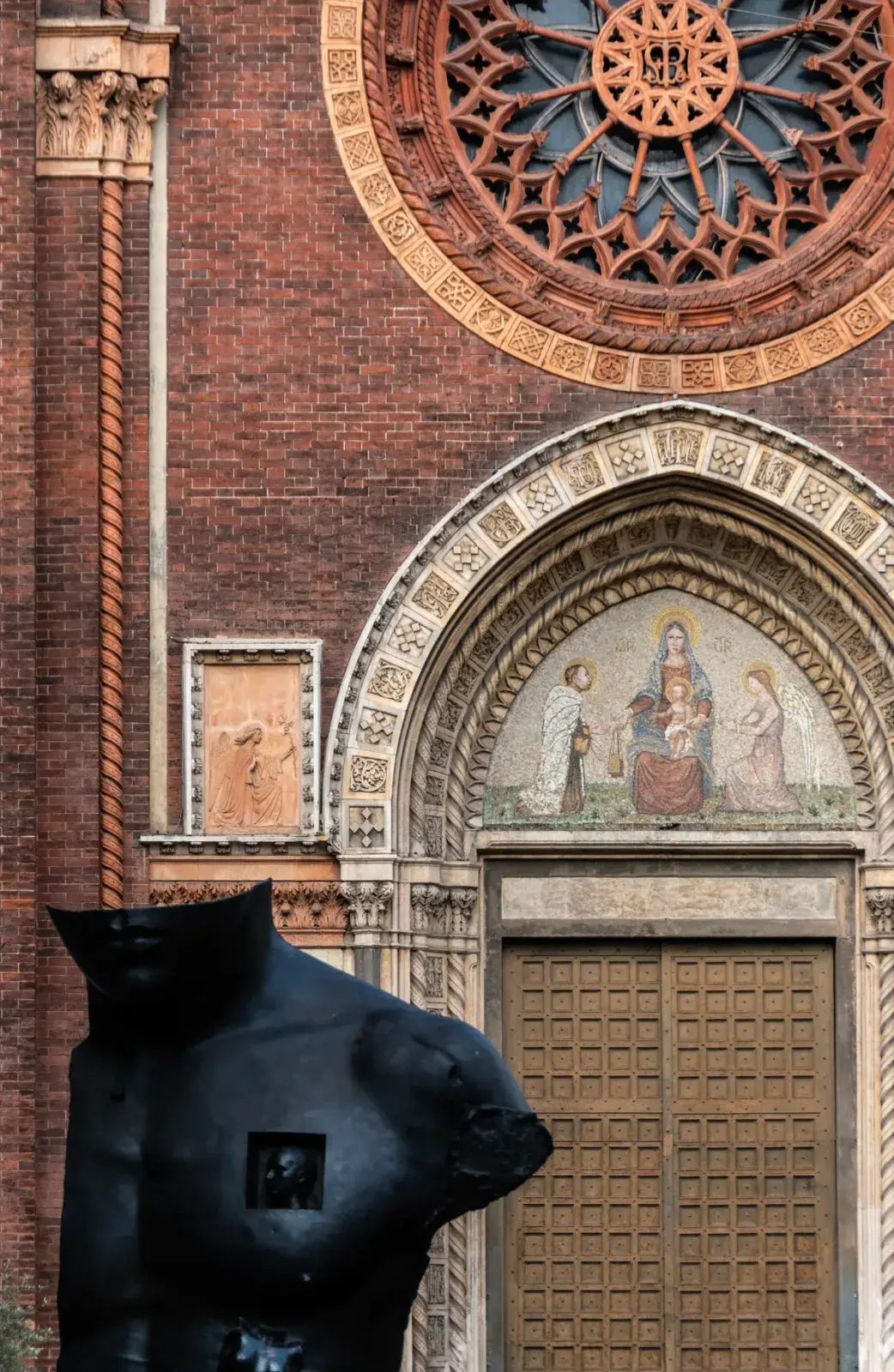
Grande Toscano — Piazza del Carmine, Brera
O Grande Toscano (1986) é um dos torsos monumentais mais significativos de Mitoraj acessíveis ao público — uma figura masculina colossal, truncada à altura dos ombros e das coxas, que domina o pátio da Piazza del Carmine com presença avassaladora. Esta é uma das apenas três fundições desta obra no mundo: as outras encontram-se em Paris (La Défense) e em Varsóvia (ul. Bobrowiecka 6, Mokotów), onde foi inaugurada pessoalmente por Mitoraj em 2009.
O bairro Brera — o quarteirão histórico dos artistas e galerias de Milão, centrado na famosa Pinacoteca di Brera — oferece ao Grande Toscano uma vizinhança adequada à sua ambição intelectual. A obra não fica em frente a um museu ou num espaço público oficial; está no contexto vivo da cidade, acessível a qualquer transeúnte.
Teatro alla Scala
O Teatro alla Scala — a mais famosa sala de ópera do mundo, inaugurada em 1778 — mantém uma ligação com a obra de Mitoraj que vai além do simples contexto geográfico. As figuras fragmentadas de Mitoraj — torsos sem cabeça, rostos velados, corpos interrompidos — partilham com a tradição operática uma preocupação com o corpo humano como veículo de emoção intensa e de narrativa mítica. A Scala representa o encontro entre a herança clássica e a sensibilidade moderna que está no centro da obra de Mitoraj.
Milão foi também palco de diversas exposições de Mitoraj ao longo da sua carreira, refletindo a importância da cidade como centro do mercado de arte italiano e a sua ligação pessoal com os artesãos e fundidores da Toscana, que colaboraram regularmente com o escultor na execução das suas obras.
Milan's role in Mitoraj's market extends well beyond public sculpture. The city's major auction houses and private dealers, particularly those concentrated around Via della Spiga and the Brera district, have handled significant secondary-market transactions for Mitoraj bronzes since the 1990s. Smaller cabinet-scale works — including editions of Tindaro and Perseo Alato — have passed through Milanese sales at prices ranging from €15,000 to well over €200,000 depending on patina, foundry provenance, and edition number. Collectors in Lombardy have historically favoured the darker, heavily patinated finishes Mitoraj developed in collaboration with the Pietrasanta foundries, considering them closer to the artist's stated intentions.
Milan's role in Mitoraj's market extends beyond gallery exhibitions. The city's auction houses, particularly Sotheby's Milan and Finarte, have handled a significant portion of secondary-market transactions for his bronze editions since the 1990s, making it one of the most active trading centres for his work outside Paris. Collectors acquiring smaller bronzes — tabletop versions of works such as Ikaro or Perseo — frequently cite Milan dealers as their point of entry. The Fonderia Artistica Battaglia, a historic Milan foundry operating since 1913, cast several of Mitoraj's smaller editions during the 1980s and early 1990s, providing a direct technical link between the city's craft tradition and the sculptor's output before he consolidated his casting relationships in Pietrasanta, Tuscany.
Milan's role in Mitoraj's career extended well beyond permanent installations. The city's commercial galleries, particularly in the Brera district, hosted several significant solo exhibitions during the 1990s and 2000s, introducing his bronze and marble works to Italian private collectors at a time when demand from European institutions was accelerating. Mitoraj maintained close working relationships with Tuscan foundries — notably the Fonderia Mariani in Pietrasanta — whose craftsmen cast many of the editions now held in Milanese private collections. Works from this period, including smaller bronzes such as Eros Bendato and Ikaro, appear periodically at Italian auction houses and remain among his most actively traded pieces on the secondary market. For collectors, provenance linking a work to a Milan gallery or a documented Pietrasanta casting adds measurable value, reflecting the city's enduring position at the intersection of Italian craft tradition and international contemporary art commerce.
Milan's role in Mitoraj's market extended well beyond exhibition space. Galleria Blu, one of the city's most established galleries with a history stretching back to 1957, represented Mitoraj during key periods of his career and helped introduce his bronze editions to serious Italian collectors at a time when his international reputation was still consolidating. The Milanese collector base proved particularly receptive to works at the smaller end of his scale — table bronzes and half-metre busts such as Tindaro and Perseo — which circulate today through Italian auction houses including Cambi in Genoa and Wannenes, often achieving hammer prices between €15,000 and €60,000 depending on patina, edition number, and provenance documentation. Collectors acquiring works with direct Galleria Blu provenance or accompanied by foundry certificates from the Cereria Bruschi in Pietrasanta — Mitoraj's preferred casting workshop — command consistent premiums on the secondary market, a pattern that reflects the broader Italian preference for verifiable craft lineage over purely institutional exhibition history.
Milan's role in Mitoraj's market extends well beyond exhibition spaces. Galleria dello Scudo, which represented Mitoraj alongside other significant postwar figurative sculptors, helped establish the secondary market infrastructure through which bronzes like Perseo Alato and Eros Bendato reached Italian private collections during the 1990s. The city's major auction houses — including Sotheby's Milan and Cambi — have handled Mitoraj bronzes with some regularity since the early 2000s, with smaller edition works such as Tindaro Screpolato tabletop variants achieving consistent results in the €8,000–€40,000 range depending on size and patina condition. Collectors acquiring works through the Milan market should note that Mitoraj bronzes were produced in carefully controlled editions, typically between three and eight casts, with each piece accompanied by documentation from the Pietrasanta foundries — principally Fonderia Mariani — where Mitoraj maintained close working relationships for decades. Provenance tracing back to the Pietrasanta studios or to established Italian galleries remains the strongest indicator of authenticity. The Milanese collector base, historically oriented toward design and architecture, has proved receptive to Mitoraj's synthesis of classical vocabulary and modernist fragmentation — a sensibility that translates naturally into domestic and corporate interiors of the kind Milan produces in abundance.
Milan's role in Mitoraj's career extended well beyond the permanent installation in Brera. The city's commercial galleries were among the first in Italy to represent his work seriously, with Galleria Blu — one of Milan's most established postwar art dealers — exhibiting Mitoraj during the 1980s as international demand for his bronzes was accelerating. The Milanese collector base proved particularly receptive to works of mid-scale: busts, masked heads, and winged fragments that could be accommodated in private residences and corporate lobbies rather than requiring the open piazzas demanded by monumental pieces. Works such as Tindaro and Eros Alato, produced in limited editions across multiple patinas — dark bronze, golden bronze, and the characteristic weathered green — circulated through the Italian secondary market in part through Milanese auction houses, including Finarte, which handled several Mitoraj lots during the 1990s. For collectors active today, Milan remains a useful point of reference: the city's proximity to the Pietrasanta foundries in Tuscany, where Mitoraj worked closely with the Versilia Marmi ed Arti atelier, meant that finished casts were often first seen — and sometimes first sold — within the Lombard collector network before reaching Paris or New York. Establishing provenance through early Italian sales records can therefore be a meaningful indicator of a work's casting sequence and authenticity, details that bear directly on valuation in the current market.
Possui uma Obra de Mitoraj na Itália?
Compro diretamente de particulares — sem intermediários, sem comissões de leilão, com total discrição.
Contactar DiretamenteMilão como Ponto de Referência para Colecionadores
Igor Mitoraj (1944–2014) trabalhou durante décadas em Pietrasanta, na Toscana, em colaboração com os melhores fundidores de bronze italianos. As suas figuras clássicas fragmentadas — cabeças, torsos, asas — unem a linguagem da Antiguidade a uma sensibilidade contemporânea. Os colecionadores europeus manifestam uma procura constante pelas suas obras, com preços em leilão que atingem regularmente cinco a seis dígitos.
Milão, como cidade global e centro do design e da cultura italiana, é um mercado natural para a obra de Mitoraj. Qualquer pessoa que possua uma obra de Mitoraj e deseje vender encontrará neste colecionador particular um interlocutor discreto e competente.
Veja também: Mitoraj em Agrigento · Mitoraj em Veneza · Mitoraj em Varsóvia · Mapa da Europa · Todas as cidades