ΕΠΙΚΟΙΝΩΝΙΑ
HOME 🗺 MAP BRONZES BIOGRAPHY
CITIES
🇵🇱 Warsaw 🇵🇱 Kraków 🇵🇱 Poznań 🇫🇷 Paris 🇩🇪 Bamberg 🇬🇧 London 🇮🇹 Rome 🇮🇹 Pompeii 🇮🇹 Milan 🇮🇹 Venice 🇮🇹 Agrigento 🇮🇹 Pietrasanta ✉ Contact
Own a Mitoraj? ✉ Contact

Igor Mitoraj — Torso Bijou

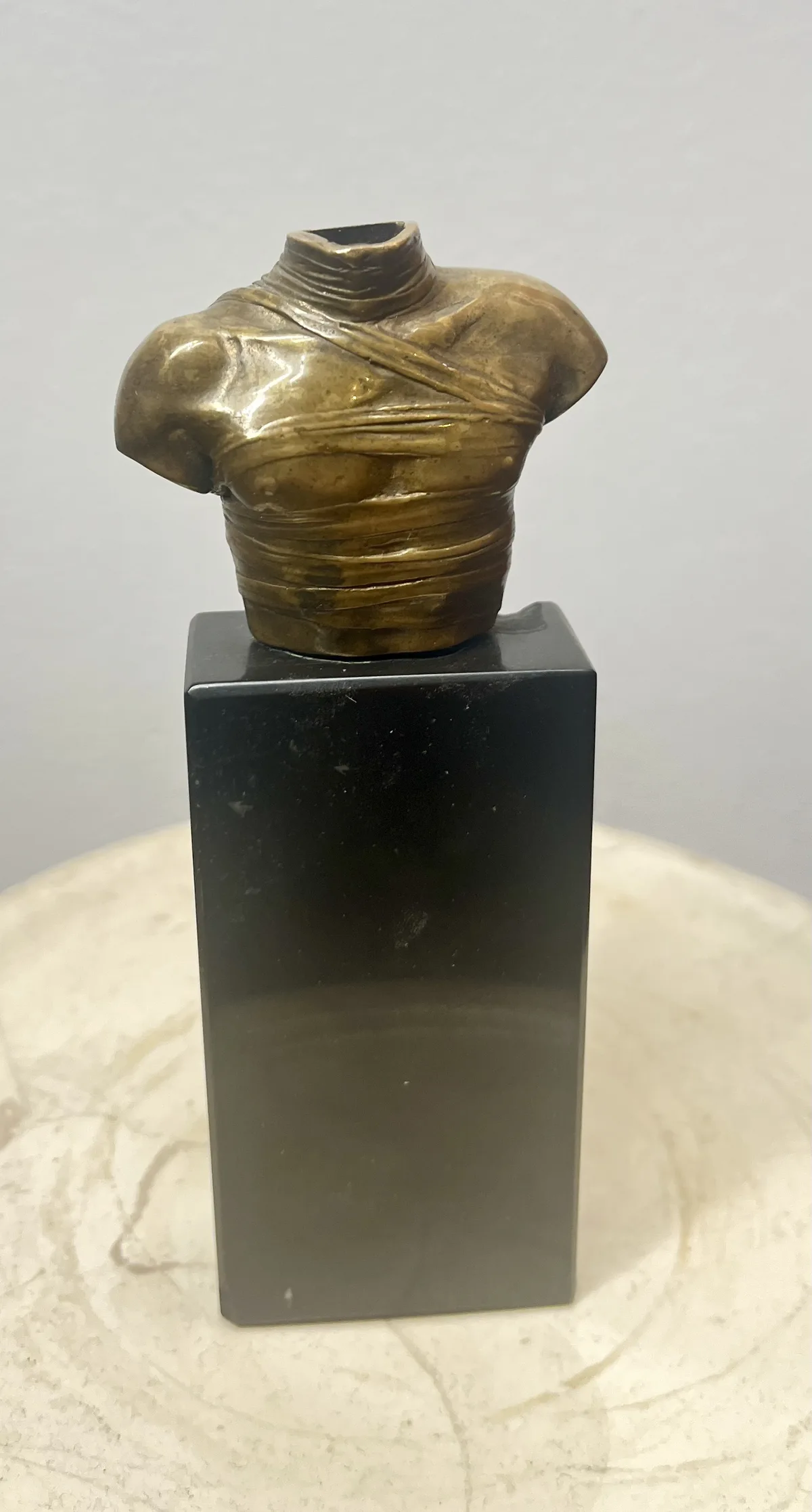
Torso Bijou — Igor Mitoraj bronze, decorative torso with applied metalwork detail

The Torso Bijou is one of Mitoraj's most intimate and decorative small bronzes — a fragment of the classical body treated as an object of adornment. The word bijou (French: jewel) describes both the scale and the spirit of these works: small enough to hold in both hands, their surfaces enriched with applied metalwork, enamel, or gilded detail that transforms the sculptural body into something between sculpture and jewellery. They are among the most approachable pieces in Mitoraj's output, and among the most frequently encountered at auction across French, Italian, and Polish houses.

About the Torso Bijou

Mitoraj's fascination with the fragment — the torso without head, the head without body, the limb without figure — runs through his entire career. The Torso Bijou series takes this preoccupation in a different direction from the monumental bronzes: rather than imposing scale to convey the authority of the classical fragment, Mitoraj reduces the body to something intimate and precious. The bijou designation is both title and description — these are works made to be held, placed on a desk, positioned in a domestic interior alongside antiques and books.

The applied decorative elements — which vary across different variants of the series — include diagonal straps, raised borders, and in some versions a gilded or patinated finish to specific sections of the surface. This combination of sculptural form and decorative elaboration has precedents in ancient bronze work: Greek and Roman craftsmen routinely combined the idealised human figure with ornamental metalwork, and Mitoraj's Torso Bijou series consciously echoes this tradition.

The works are not signed in the same engraved manner as the larger Artcurial editions — many Torso Bijou examples carry a stamped signature or a small foundry mark — and documentation varies considerably. This does not affect the desirability of fine examples in good condition.

Torso Bijou — Technical Details

Medium: Bronze · Patina: Warm brown / dark brown · Scale: Desktop (approx. 15–30 cm height)

Multiple variants exist, differing in the specific applied ornamental detail, patina choice, and base type. The most commonly encountered examples measure approximately 15–25 cm in height and are mounted on a simple travertine or black marble base. Signed examples carry the signature engraved or stamped at the lower torso or on the reverse.

Torso Bijou variant 1 — Igor Mitoraj bronze Torso Bijou variant 2 — Igor Mitoraj, detail of applied strap decoration Torso Bijou variant 3 — Igor Mitoraj, close view of surface modelling

The Decorative Tradition in Mitoraj's Work

The Torso Bijou occupies an interesting position in Mitoraj's output — it bridges the gap between his large-edition collectible bronzes (Kea, Tête Secrète, Centurione II, Persée series) and the purely ornamental objects (lamps, pendants, small decorative pieces) that his Pietrasanta studio produced in collaboration with design houses. The bijou bronzes are genuinely sculptural — each is a considered composition, not a simple mould reproduction — but they are conceived for domestic placement and decorative context.

This dual identity — serious sculpture in a decorative format — is one of the things that makes Mitoraj's small bronzes enduringly popular. They enter private homes through the same door as objets d'art, but they carry the artistic weight of a sculptor whose monumental works stand in Pompeii, London, Paris, and Rome. Collectors who begin with a Torso Bijou on a desk often end with a Tête Secrète or a Kea — the series functions, effectively, as an entry point into the Mitoraj market.

Condition Notes

The most common condition issues with Torso Bijou bronzes are: surface oxidation in recessed areas (usually reversible with professional cleaning); loss of gilded or enamel detail on heavily decorated variants; and chipping or loss to the base. I buy examples in any condition, with or without original bases or documentation. A clear photograph of the signature, base, and overall sculpture is all I need to make an assessment.

Identifying Your Torso Bijou

The Torso Bijou is among the more varied of Mitoraj's collectible series — the term covers a family of related small bronzes rather than a single rigorously defined edition. If you have a small Mitoraj bronze torso and are trying to confirm identification, the following characteristics will help.

Physical Form

A genuine Torso Bijou presents as a truncated classical torso — typically from mid-thigh to mid-chest, or from hips to neck — without head or arms. The surface modelling is smooth and idealised, consistent with Mitoraj's neo-classical approach: musculature is present but not anatomical-realist; the body reads as archetype rather than individual. The defining feature of the bijou variants is the applied decorative element: a raised strap, band, or border running diagonally or horizontally across the surface, sometimes with gilded or enamel-filled sections. Not all small Mitoraj torsos carry these decorative elements — torsos without them may be from a different series (Torso Media, Piccolo Torso, etc.) and will have different valuation.

Signature and Edition

The signature on Torso Bijou works is typically stamped or engraved on the reverse of the torso body, near the lower break. It reads Mitoraj in cursive, sometimes with an edition number immediately following. The stamp is shallower than the engraved signatures on the larger editions — under raking light you should see a clear impression in the metal. Some examples also carry a small foundry mark: B (Bonvicini) or M (Mariani) inside a circle, typically on the base or underside.

Torso Bijou bronzes are not always clearly numbered — this is a known characteristic of the series, not necessarily a red flag. What matters most is the quality of the casting (clean, even surface; no porosity; consistent patina) and the clarity of the signature impression. Works in polished presentation cases or with original gallery receipts command a premium.

Base Types

The most commonly encountered base types for Torso Bijou bronzes are:

The Decorative Bronze in Mitoraj's Work

The Torso Bijou occupies a specific and underappreciated position in the history of post-war decorative art. Mitoraj was not alone among sculptors of his generation in working at the intersection of fine art sculpture and the decorative object — César, Arman, and Niki de Saint Phalle all produced editions that straddled the same boundary — but he was one of the few to do so with a consistent formal vocabulary drawn from classical antiquity rather than the language of found objects or Pop art.

The classical torso as a decorative object has a long history: ancient bronzes, Renaissance statuettes, Neoclassical reductions. Mitoraj's bijou bronzes insert themselves into this history deliberately. They are made to the same standard as his larger works — cast at the same foundries, finished with the same attention to patina — but scaled to inhabit the same domestic space as antique bronzes, silver candlesticks, and ceramic urns. A Torso Bijou on a mantlepiece or a library shelf is not a diminished Mitoraj: it is a Mitoraj conceived for exactly that context.

This also means the series tends to surface in different market channels from the larger editions. While Centurione II and Tindaro Screpolato appear at international specialist auctions, Torso Bijou bronzes more often appear at regional French and Italian houses, at design fairs, and through dealers in antiques and decorative art who carry a selection of twentieth-century bronzes alongside older material. They also appear frequently in estate sales and private collections that were assembled in the 1990s and early 2000s, when Mitoraj was at his most commercially active in the European decorative arts market.

Condition Notes

The most common condition issues are: uneven patina or refinishing (check that the colour is consistent across all surfaces and that there are no obvious brush marks); loss of gilded or enamel detail on the applied decorative element (visible as bare bronze showing through where gold should be); chips to the base; and the separation of the bronze from its mounting pin, causing the torso to rock on the base. All of these are assessable from photographs and none is disqualifying — I buy examples in any condition and will adjust my offer accordingly.

Do You Own a Mitoraj Torso Bijou?

Send me a photograph — I reply within 24 hours with a genuine offer.

Contact Me Directly

See also: Kea (1979) · Tête Secrète · Centurione II · All Mitoraj bronzes wanted · Auction prices guide

About This Collection

This site documents one private collector's search for works by Igor Mitoraj (1944–2014) — the Polish-French sculptor celebrated for his fractured classical figures in bronze and marble. Mitoraj studied in Kraków under Tadeusz Kantor, trained in Paris at the École nationale supérieure des beaux-arts, and established his permanent studio in Pietrasanta, Tuscany in 1983. His work is held in public collections across Europe and the Americas. If you have a Mitoraj work available, please use the contact button to get in touch.

Related Works

Cuirasse II Persée & Asclépios Corazza Eros Bendato