
Igor Mitoraj i Kraków

for at åbne WhatsApp — derefter
send billeder direkte.
Kraków is where Mitoraj became an artist. He studied here, exhibited here, and eventually gave the city its most visited contemporary sculpture. Today Kraków holds four permanent Mitoraj works — more than any Polish city except Warsaw — and the National Museum holds pieces from his early career. This is a complete guide to where to find them.
Kraków shaped Mitoraj profoundly. He studied at the Academy of Fine Arts here under Tadeusz Kantor — one of the most influential Polish artists of the 20th century — before leaving for Paris in 1968. His return to Kraków in 2003–2004 with a fourteen-work exhibition on the Rynek Główny was both a homecoming and a triumph. Luci di Nara in the courtyard of Collegium Luridicum (ul. Grodzka 53) and the bronze at the Kraków Opera (ul. Lubicz 48) complement the famous Eros Bendato on the main square, making Kraków the Polish city with the highest concentration of permanent outdoor Mitoraj works.
Kraków og Mitoraj — Et Biografisk Bånd
Igor Mitoraj arrived in Kraków in 1963 at the age of nineteen, enrolling at the Academy of Fine Arts under the legendary Tadeusz Kantor — painter, theatre director, and the most important Polish artist of his generation. Kantor's influence was decisive: his emphasis on the object, the body as both real and theatrical presence, and the power of fragmentation runs through every Mitoraj sculpture ever made.
Mitoraj left Kraków in 1968, moving to Paris, then eventually establishing his studio in Pietrasanta, Italy. He did not return to Poland in any significant artistic sense until 2003 — thirty-five years later — when the city invited him to install fourteen monumental sculptures on the Rynek Główny (Main Market Square). The exhibition ran from 17 October 2003 to 25 January 2004 and was one of the largest single-artist shows ever mounted in a public European square. At its close, Mitoraj gifted Eros Bendato to the city — a gesture that turned into years of controversy and ultimately created Kraków's most photographed contemporary artwork.
Mitorajs Tidslinje i Kraków
Mitoraj enrolls at the Academy of Fine Arts, Kraków, under Tadeusz Kantor. Studies painting; early sculptural experiments begin.
First solo exhibition at the Krzysztofory Gallery, Kraków — primarily paintings and early works on paper.
Leaves Kraków for Paris to continue studies at the École Nationale Supérieure des Beaux-Arts. Does not return to Poland professionally for 35 years.
Fourteen monumental sculptures installed on Rynek Główny (17 Oct 2003 – 25 Jan 2004). The exhibition is one of the largest single-artist outdoor shows in European history. Mitoraj gifts Eros Bendato to the city of Kraków.
Eros Bendato permanently installed near the Town Hall Tower in the Main Square, following lengthy debate about its placement. Immediate public sensation.
Kraków Academy of Fine Arts awards Mitoraj an honorary doctorate — its highest recognition, acknowledging the city's formative role in his career.
Eros Bendato (Bundet Eros) — 1999
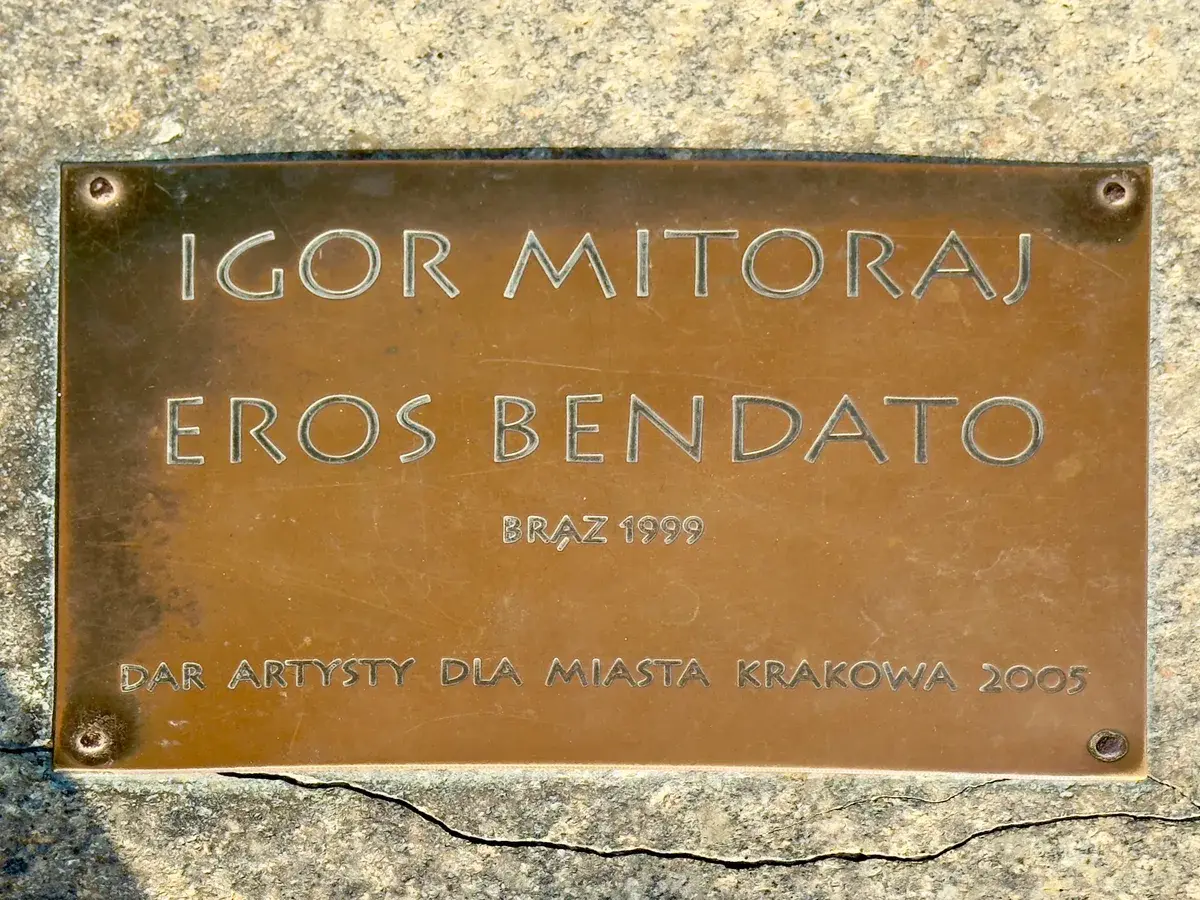
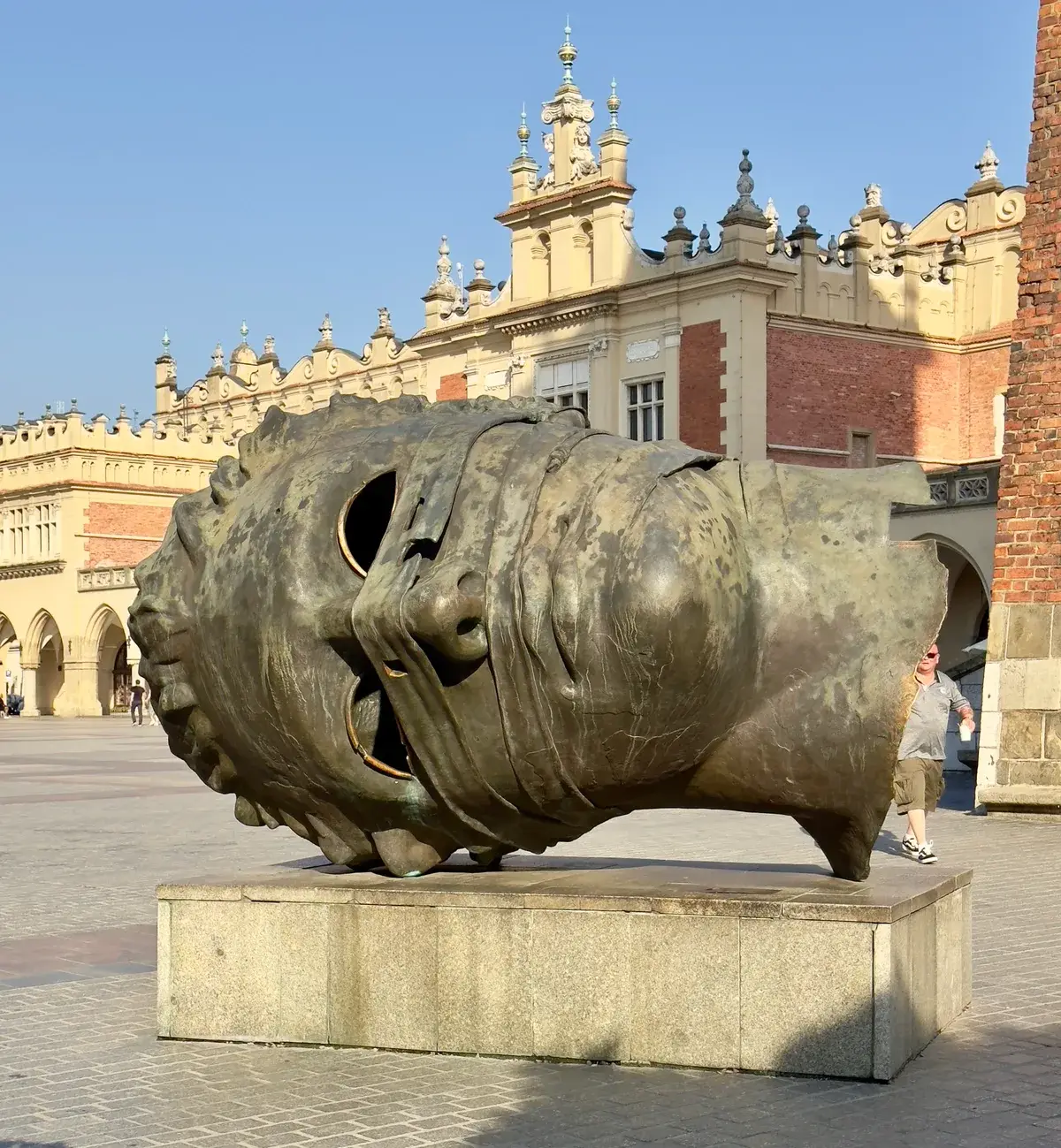
Eros Bendato — "Eros Bound" — is the most visited contemporary sculpture in Poland. A colossal bronze head of Eros, the Greek god of love and desire, lies on its side on the pavement of the Main Market Square near the Town Hall Tower. The face is bound with two horizontal strips of bronze, covering the eyes and suggesting imprisoned desires. The head is hollow — visitors have been photographed sticking their limbs through the eyeholes since the day it was installed.
The work was cast in 1999 in an edition of three: one went to Lugano, one to Kraków, and one was kept by the artist until his death in 2014. The Kraków copy was gifted during the 2003–2004 Main Square exhibition. Its placement caused immediate controversy — city historians and residents objected to a modern sculpture in the historic UNESCO-protected square; Mitoraj objected equally strongly to the initial plan to place it outside the Galeria Krakowska shopping centre, stating that his work did not belong in front of a commercial building. The dispute was eventually resolved in the work's favour, and it has stood near the Town Hall Tower since 2005.
Today it is affectionately known as Głowa (The Head). It serves as a meeting point, a landmark, a climbing frame for children, and — despite everything — one of the most genuinely beloved pieces of public art in any Polish city. Visitors come from across Europe specifically to see it.
Luci di Nara
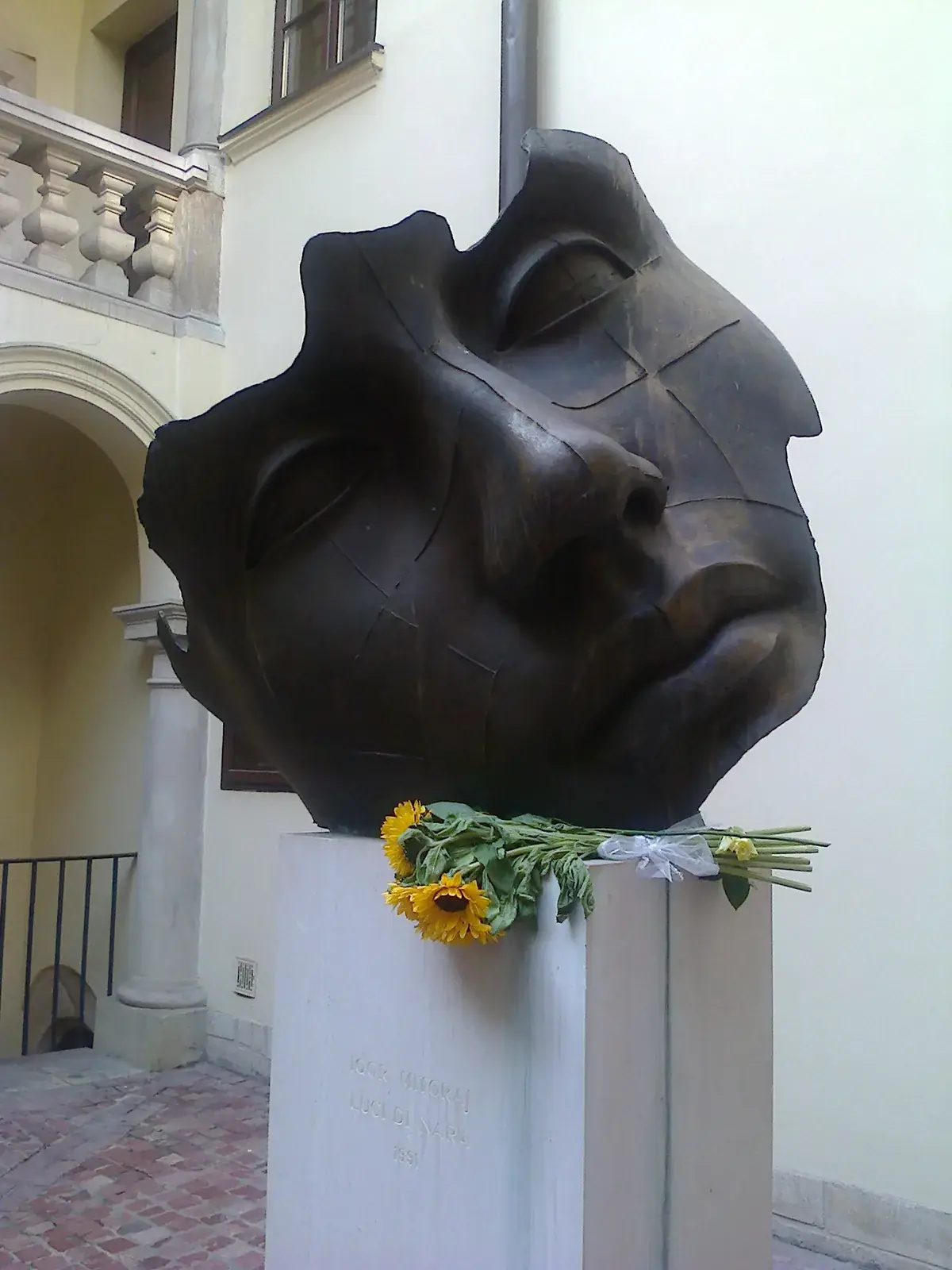
Luci di Nara (Lights of Nara) stands in the charming courtyard of Collegium Luridicum, the historic Jagiellonian University building on ul. Grodzka — just a few minutes' walk from the Main Square. This is a quieter, more contemplative encounter with Mitoraj's work than the public spectacle of Eros Bendato: the courtyard setting gives the sculpture an intimate, almost archaeological quality, as if it has always been there among the old stones.
The work is accessible during university opening hours. Unlike Eros Bendato, which is surrounded by thousands of tourists daily, Luci di Nara rewards visitors who seek it out — it is one of the less-documented Mitoraj works in Poland and rarely appears in tourism literature.
Skulptur ved Kraków Opera
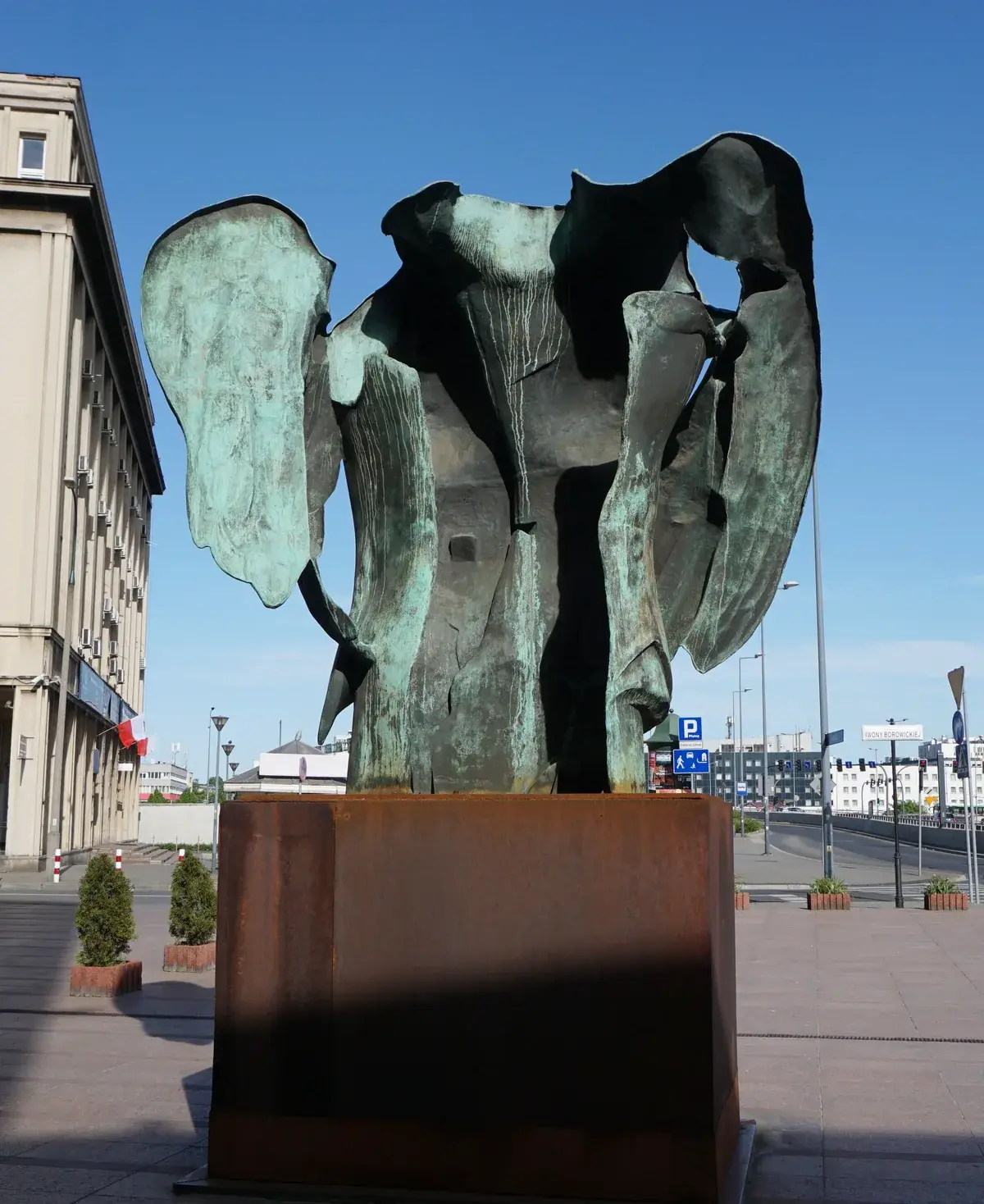
A third permanent Mitoraj work stands in front of the Opera Krakowska on ul. Lubicz 48, on the edge of the Planty park belt that rings the Old Town. The placement — outside a major cultural institution — is more in keeping with Mitoraj's own preference for his work's context. Opera, with its traditions of classical myth, theatrical spectacle, and the staged human body, is a natural home for his fragmentary figures.
Mitoraj himself designed opera sets and costumes throughout his career, including the celebrated 2009 staging of Verdi's Aida in the Boboli Gardens in Florence. The Kraków Opera sculpture connects his visual art to his lifelong engagement with the operatic tradition.
Muzeum Narodowe w Krakowie (Nationalmuseet)
The Muzeum Narodowe w Krakowie (Kraków National Museum) holds works by Igor Mitoraj in its permanent collection — the most significant institutional holding of his work in Poland after the Atelier Mitoraj in Pietrasanta. The museum's collection spans Polish art from the mediaeval period to the present day, and Mitoraj's position within it reflects his status as the most internationally recognised Polish sculptor of the twentieth century.
For collectors, the National Museum provides the authoritative institutional context for Mitoraj's work in Poland: his relationship with the Kraków Academy, his position in post-war Polish art history, and the critical reception of his monumental sculptures are all documented in the museum's scholarly resources.
Kraków og Mitoraj-Markedet
Kraków occupies a particular place in the Mitoraj collector market. The city's educated, culturally engaged population has produced some of Poland's most serious private collectors of his work — people who grew up with Głowa in the Main Square, who studied at the Academy where Mitoraj trained, and who understand his work from the inside rather than as an international import.
Polish buyers — particularly those based in Kraków and Warsaw — have been among the most competitive bidders at European auction houses over the past five years. The 2025 Warsaw record of PLN 6.89 million for Tindaro was driven significantly by Polish institutional and private demand. For anyone in Kraków who owns a Mitoraj work and is considering selling, the private sale route — directly to a serious collector — remains the most efficient and discreet option.
I am a private collector based in Warsaw, actively acquiring Mitoraj works of all kinds. If you own a bronze, marble, lithograph, or drawing by Igor Mitoraj — whatever format, whatever condition — I would like to hear from you.
The National Museum in Kraków (Muzeum Narodowe w Krakowie) holds several early Mitoraj works that rarely appear in collector literature, making it an essential stop for serious researchers of his development. These pieces — drawings and small-format sculptures from the late 1960s and early 1970s — predate his formal turn toward antiquity and reveal an artist still negotiating between figurative tradition and the abstraction circulating through Kraków's post-war avant-garde. Collectors tracking provenance should note that works from this transitional period surface infrequently at auction; when they do, they tend to appear through Central European houses rather than the major London or New York rooms. Desa Unicum in Warsaw has handled several Mitoraj works at auction over the past decade, and their sale records provide one of the more reliable benchmarks for pricing Polish-market pieces. Beyond the museum holdings, Kraków's connection to Mitoraj carries weight in the secondary market because documented regional exhibition history — particularly any link to the landmark 2003–2004 Rynek Główny show — adds a layer of provenance that buyers in both Europe and Asia have demonstrably valued. Certificates or correspondence connecting a bronze to the Pietrasanta foundry Versiliarte, which cast the majority of Mitoraj's large editions, are considered the baseline for authentication by specialist dealers. For works acquired directly from Mitoraj's Kraków connections — gallerists, academy colleagues, or cultural institutions that received gifts during his 2003 visit — written documentation of the transfer is critical, since Mitoraj himself signed relatively few certificates for pieces given informally. The Galeria Starmach in Kraków, which has represented Polish post-war and contemporary art since 1988, is one of the few Polish
The National Museum in Kraków (Muzeum Narodowe w Krakowie) holds the most significant institutional collection of Mitoraj's early work in Poland, including drawings and smaller sculptural studies from the late 1960s that predate his departure for Paris and his subsequent pivot toward monumental bronze. These pieces are rarely displayed in the permanent galleries but have appeared in temporary exhibitions, most notably during the retrospective programming that accompanied the 2003 square installation. For collectors researching Mitoraj's formation as an artist, the museum's print and drawing cabinet represents an underexplored resource: written requests to the curatorial department can arrange study-room access to works not on public view. Beyond the museum, Kraków's secondary market for Mitoraj has grown quietly but steadily since his death in 2014. The auction house Desa Unicum, which operates Poland's most active fine-art sales programme, has handled small-format bronzes and signed lithographs by Mitoraj at several Kraków-linked sales, with hammer prices for authenticated lithographs typically ranging between 3,000 and 12,000 PLN depending on edition size and condition. His signed lithographic series — including prints related to Tindaro and Eros Bendato — were produced in limited editions through Italian workshops in Pietrasanta and occasionally through Parisian publishers during the 1980s and 1990s, and these reach the Polish market with some regularity. Provenance tracing for works with Kraków origins is complicated by the fact that several pieces gifted or loaned during the 2003–2004 exhibition subsequently entered private hands through routes that were not always publicly documented. Collectors acquiring works claimed to originate from that exhibition period are advised to
The National Museum in Kraków (Muzeum Narodowe w Krakowie) holds the most significant institutional collection of early Mitoraj works in Poland, including paintings and drawings from his student years that predate his turn to sculpture entirely. These pieces — largely unknown even to serious collectors — document the transition from a figurative painter trained under Kantor to the bronze classicist the international market came to prize. For those researching provenance or building a collection with biographical depth, the museum's prints and drawings department is the practical starting point; works acquired directly from Mitoraj or from the 2003–2004 Kraków exhibition period carry particular weight with Polish institutional buyers. The Kraków market for Mitoraj differs meaningfully from Warsaw or the international auction circuit: smaller bronzes and maquettes that passed through Polish hands in the 1990s occasionally surface through Kraków's established auction houses, notably Agra-Art and Desa Unicum's regional sales, often with cleaner provenance chains than works that circulated through Italian or French dealers. Collectors should note that the edition numbering on works sold in Poland during the late 1990s and early 2000s was not always rigorously documented by the foundries, making direct comparison with the Pietrasanta studio records — now maintained by the Fondazione Mitoraj — an important step before any significant purchase. The 2003 Kraków exhibition itself generated a secondary market in documentation: the official catalogue, published by the city and now scarce, is the primary reference for the fourteen works installed on the Rynek Główny, including pieces that were never editioned and returned to the estate after the show closed. Copies in good condition have sold privately for several hundred euros. Beyond Eros Bendato, the lesser-
The National Museum in Kraków (Muzeum Narodowe w Krakowie) holds several works from Mitoraj's formative period, giving collectors and researchers rare access to the sculptor before his international breakthrough. These earlier pieces — drawings, studies, and small-format sculptures — document the transition from his Academy training under Kantor toward the fragmented classical figures that would define his mature output. For anyone tracking the development of his market, this is significant context: Mitoraj's prices at auction accelerated sharply after 2000, with bronze editions from the 1980s and 1990s now regularly achieving six figures at major European houses, while works on paper from the Kraków years remain comparatively undervalued and represent one of the more credible entry points for serious collectors. Beyond the museum, the 2003–2004 Rynek Główny exhibition left a documentary trace worth pursuing: the official catalogue, published in Polish and Italian, includes installation photographs, Mitoraj's own commentary on individual works, and essays by curators who had followed his career since the 1970s. Copies surface occasionally at Kraków antiquarian booksellers, particularly along ul. Św. Tomasza, and fetch modest but rising prices — a reflection of growing institutional interest in the exhibition as a landmark event in post-communist Polish cultural history. The Luci di Nara installation in the courtyard of Collegium Iuridicum, placed there following a separate gift arrangement with the Jagiellonian University, is less photographed than Eros Bendato but arguably more rewarding for study: the courtyard setting allows the work to be viewed in close proximity and from multiple angles, and the interplay between the Renaissance arcade and Mitoraj's damaged classical form
The National Museum in Kraków (Muzeum Narodowe w Krakowie) holds the most significant institutional collection of Mitoraj's early work in Poland, including drawings and small-format bronzes produced during his student years in the late 1960s — pieces that document the formative period before his style consolidated around the fragmented classical figure. These works rarely appear in auction records, held as they are within the permanent collection, but they carry considerable importance for scholars and serious collectors seeking to understand the full arc of his development. For those focused on the market rather than the archive, it is worth noting that Mitoraj's bronzes have appreciated steadily since his death in Pietrasanta in October 2014, with mid-sized cast works — typically heads or torso fragments in editions of seven to nine — passing through Sotheby's, Christie's, and Desa Unicum in Warsaw with increasing frequency between 2015 and 2023. Desa Unicum in particular has positioned itself as the primary Polish secondary market for Mitoraj, handling several signed and numbered bronzes from his mature Pietrasanta period, and their auction catalogues from 2018 onward offer one of the more reliable price series for Polish buyers. Collectors visiting Kraków who wish to see the full range of permanent works should note that the bronze at the Kraków Opera — sometimes identified in informal sources as Toscano, though the Opera's own documentation uses the general designation "figure" — sits in a publicly accessible forecourt and can be viewed without a ticket at any hour. Luci di Nara at the Collegium Luridicum courtyard on ul. Grodzka 53 is accessible during university opening hours and benefits from the enclosing Renaissance stonework that
The National Museum in Kraków (Muzeum Narodowe w Krakowie) holds the most significant institutional collection of early Mitoraj work in Poland, including paintings and drawings from his student years that rarely appear on the secondary market and that serious collectors regard as essential context for understanding how his sculptural language developed. These works on paper — many executed in the mid-1960s during his time under Kantor — show the figurative tension and fragmented anatomy that would define his mature bronze output, but in a raw, exploratory register that the polished Pietrasanta castings deliberately suppress. The museum acquired several pieces following the 2003–2004 Rynek Główny exhibition, a moment when Kraków's cultural institutions moved to anchor his legacy formally within the city. For collectors researching provenance, the museum's print and drawing archive is a valuable reference point: works that passed through Kraków's gallery circuit in the 1960s before Mitoraj's departure for Paris sometimes surface at Central European auction houses with incomplete documentation, and cross-referencing against the museum's holdings can help establish authenticity. On the commercial side, Kraków's Rempex and Desa Unicum branches have both handled Mitoraj bronzes at auction, with smaller-edition pieces — particularly the tabletop-scale versions of Testa di Caprone and Ikaro — appearing at regional Polish sales at significantly lower hammer prices than equivalent lots in Paris or London, a differential that informed buyers have quietly exploited since the late 2000s. The city's connection to Mitoraj also sustains a steady trade in authorised printed editions: the catalogue produced for the 2003 Rynek Główny exhibition, published by the City of Kraków with essays in
The National Museum in Kraków (Muzeum Narodowe w Krakowie) holds a small but significant group of Mitoraj works that most visitors to the Rynek Główny never seek out, making it essential territory for serious collectors trying to understand his development. The collection includes drawings and early sculptural studies from the late 1960s and early 1970s — the period immediately after he left Kraków for Paris — which document the transition from his figurative student work under Kantor toward the fragmented classical language he would make his signature. These works on paper are rarely reproduced and have never been the subject of a dedicated catalogue, which means auction houses and private buyers still occasionally undervalue Mitoraj works from this transitional decade when they surface. For context, a bronze from the mature Pietrasanta period — say, a mid-sized Testa di Sera or Centurione — now typically achieves between €80,000 and €350,000 at auction depending on edition number and patination, while documented works from the pre-1975 period remain comparatively undertraded and underresearched. The museum's holdings also include a cast of Luci di Nara, the delicate winged head that exists in several scaled versions and has become one of his most commercially reproduced forms — appearing in editions ranging from small bronzes of roughly 30 cm to the monumental outdoor scale seen in the Collegium Luridicum courtyard. Collectors should note that the edition documentation for Luci di Nara across its various scales is not always cleanly separated in secondary market listings, and verifying the foundry stamp (typically Fonderia d'Arte Massimo Del Chiaro,
Har du spørgsmål til dette værk?
Spørg AI-assistenten — baseret på samlingens sider, svar på dit sprog.
Ejer Du Et Mitoraj-Værk?
Uanset om det er erhvervet i Kraków, Warszawa eller andetsteds — send mig et fotografi. Jeg svarer personligt inden for 24 timer.
Any other Mitoraj work also welcome — any subject, condition, or format.
See also: Mitoraj in Warsaw · Mitoraj cities worldwide · Eros Bendato — buy & sell · All bronzes wanted
Mitoraj & Kraków — Roots and Return
Kraków is where Mitoraj's artistic life began. He enrolled at the Academy of Fine Arts in 1963, studying under the avant-garde director Tadeusz Kantor, and held his first solo exhibition at the legendary Krzysztofory Gallery in 1967 before leaving for Paris. In 2003 he returned to Poland for the first time in decades, reconnecting with Polish cultural institutions and donating the monumental Eros Bendato to Kraków's Main Market Square (installed October 2005). The work has become the city's most photographed contemporary sculpture. Mitoraj received the Gloria Artis Gold Medal in 2005 and the Commander's Cross of the Order of Polonia Restituta in 2012, and was awarded a Doctor Honoris Causa by the Jan Matejko Academy of Fine Arts.
Vil du sælge et Mitoraj-kunstværk? Se vores salgsside →