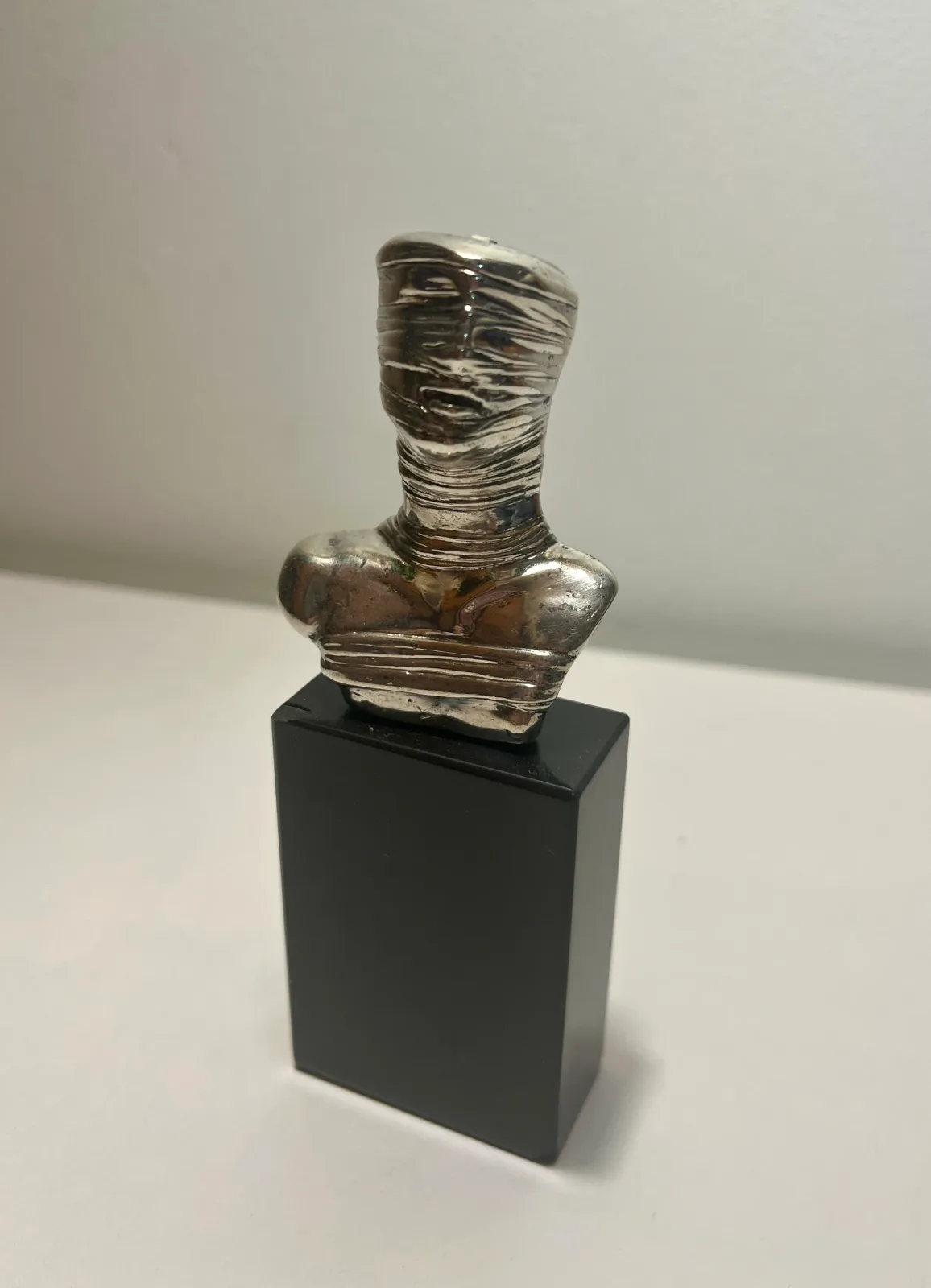
Igor Mitoraj — Prométhée

WhatsApp'ı açmak için — ardından
fotoğrafları doğrudan gönderin.

The Prométhée is one of the rarest bronzes in Igor Mitoraj's entire catalogue. Published by Artcurial, Paris — the prestigious French gallery that worked with Mitoraj from his earliest years — this small bronze was cast in an edition of only 8. That is not a typo: eight examples were made. If you own one, you hold something genuinely exceptional.
Prométhée Hakkında
Prometheus — the titan who stole fire from the gods and gave it to humanity, and was eternally punished for it — was a subject that resonated deeply with Mitoraj's preoccupations. The themes of boundedness, suffering, concealment, and the relationship between the divine and the human body all run through the Prométhée bronze in concentrated form.
The Artcurial edition was produced in the late 1970s to early 1980s, during the period when Mitoraj was transitioning from painter to sculptor and his studio in Pietrasanta was becoming the centre of his creative world. Artcurial — founded in 1975 as a joint venture between major French cultural institutions — was among the first galleries to champion Mitoraj's small bronzes, and the Prométhée is among the most significant of the multiples they published together.
The bronze carries a warm brown patina and is signed igor mitoraj on the lower middle section — note the lowercase signature, characteristic of this early period. Each example is numbered from the edition of 8, and the Artcurial documentation confirms the title, edition number, and artist's signature.
Dimensions & Condition
Height approximately 23.5 cm. Brown patina. Signed and numbered. Accompanied by Artcurial documentation. This is a desktop-scale work — intimate, powerful, and rare in a way that the larger Mitoraj editions simply cannot be.
Mitoraj'ın Görsel Dünyasında Prometheus
Prometheus — the Titan who stole fire from the gods and gave it to humanity, condemned by Zeus to eternal punishment — was a subject that resonated deeply with the artists of the twentieth century. Bound to a rock, with an eagle devouring his regenerating liver each day, Prometheus embodies the cost of creation, the price of knowledge, and the suffering that accompanies the act of giving. For Mitoraj, born to a Polish mother who was a forced labourer in Germany during the Second World War, the image of suffering and constraint was not abstract mythology but biographical truth.
The Prométhée bronze — one of only 8 cast, published by Artcurial in the late 1970s to early 1980s — belongs to the earliest period of Mitoraj's sculptural maturity. The warm brown patina and the lowercase signature style (igor mitoraj, not the capitalised MITORAJ of his later work) are consistent with this early dating. The work was created at almost exactly the moment when Mitoraj was transitioning from painter to sculptor, discovering bronze at the Pietrasanta foundries during his first Italian sojourn.
Neden 8 Baskı Önemlidir
To place the Prométhée's rarity in context: the Tête Secrète, itself considered a rare Artcurial edition, was produced in 250 examples. The Kea, another early Artcurial bronze, was produced in 250 examples. The Prométhée — at 8 — is thirty times rarer than either. Most collectors with a lifetime interest in Mitoraj will never encounter one. The major auction databases (Artnet, Artprice, Invaluable) list fewer than five documented auction appearances of the Prométhée since the artist's death in 2014. This extreme scarcity means that standard auction comparables are essentially unavailable, and private sale is almost always the appropriate mechanism for a transaction involving this work.
Bir Prométhée'niz Varsa
Please contact me directly. I respond the same day, every day. There is no pressure and no obligation. I will give you my honest assessment of the work's value, explain the market context, and — if you wish to sell — make a genuine and competitive offer. For a work of this rarity, discretion is essential: I will not share any information about your ownership or the work with any third party under any circumstances.
Identifying the Prométhée
The Prométhée is a torso fragment — the body truncated at the neck and at the upper thighs, with arms present but tightly constrained to the sides or bent inward. The binding is central to the work's identity: horizontal or diagonal bands visible at the torso indicate the Promethean restraint, differentiating this work from the more open-bodied torso fragments in Mitoraj's catalogue. The overall silhouette is compact and tense, communicating constriction rather than the open grandeur of works like the Centurione or Asclépios.
The signature appears on the lower midsection or base in the lowercase style igor mitoraj consistent with early Artcurial editions — note this distinction from the capitalised MITORAJ used from the mid-1980s onwards. The base is typically marble or travertine. Edition number (from the total of 8) is stamped or engraved on the reverse. The Artcurial foundry stamp and documentation should accompany fully provenanced examples.
The Artcurial Prométhée at edition 8 falls into an extreme scarcity category that makes standard market comparables essentially inapplicable. The most recent documented sale appeared at Vendu Rotterdam (May 2025) as lot 3/8. For reference, comparable works from larger editions in the Mitoraj torso series have achieved the ranges above — the Prométhée's edition of 8 places any genuine example into the large-format pricing tier regardless of physical scale.
Prométhée — Technical Characteristics
Patina: warm brown (standard Artcurial finish) · some examples show deeper oxidation
Base: marble or travertine slab (standard) · black stone documented on some later casts
Signature: lowercase igor mitoraj incised — characteristic of the early Artcurial period
Edition: total of 8 · each example individually numbered on reverse
Binding detail: horizontal or diagonal band element visible at torso, defining the Promethean constraint motif
Petit Prométhée Argent — Collection Photographs, Ed. 5/8
The following photographs document a Petit Prométhée Argent (silver-finish variant), edition 5/8, with the original Artcurial certificate dated 10 April 1981 and bearing the artist's hand signature. The lowercase igor mitoraj inscription and Artcurial foundry mark confirm the earliest period of his sculptural output.


Prométhée and the Binding Motif
The Prométhée belongs to a group of works in which Mitoraj makes restraint and concealment the subject of the sculpture rather than an incidental feature. The most prominent of these are the Eros Bendato (bound Eros) — where horizontal bands cross the eyes of the most tender of gods — and the Tête Secrète, where the entire head is wrapped in bandages that suggest both wound and ritual. The Cuirasse II addresses the same theme through armour: the diagonal crossing straps that protect the torso also bind and constrain it. These works collectively constitute Mitoraj's most sustained meditation on the relationship between the body and the forces that contain it.
What distinguishes the Prométhée within this group is its mythological specificity. Prometheus was punished precisely for an act of generosity — giving fire to humanity — and the binding in the Prométhée carries the full weight of that narrative: the restraint of a figure whose transgression was an act of creation. This connects the Prométhée to a broader strand of twentieth-century interest in the Prometheus myth as a figure for the artist, the innovator, and the suffering that accompanies the gift of knowledge. For Mitoraj — working in the shadow of a century of European catastrophe — the bound body was never merely mythological decoration.
Scale, Editions, and the Argent Variant
The Artcurial Prométhée was published in a single edition of 8. The standard height is approximately 23.5 cm — a desktop-scale work, intimate and concentrated, designed to be experienced at close range. Unlike the large-format mythological bronzes Mitoraj produced in later decades (the monumental Tindaro, the architectural-scale Ikaria and Persée installations at Pompeii and Agrigento), the Prométhée is a private object: the bound torso turned inward, the patina warm and close, the edition so small that no institutional collection can claim to hold a representative sample.
Two finish variants are documented. The standard finish is a warm brown patina consistent with Artcurial's other early multiples of the period — the same family as the copper-brown of the Tête Secrète and the Kea. The photographs in the section above document a second, rarer variant: the Petit Prométhée Argent, which carries a silver-toned finish applied over the bronze. The Artcurial certificate for the silver variant (reproduced in those images) is dated 10 April 1981 and bears the artist's hand signature, placing its creation squarely within the early Pietrasanta period. Whether the silver finish represents a distinct sub-edition or a finish option within the same edition of 8 is not definitively documented; collectors should examine any available Artcurial paperwork carefully.
No large-format versions of the Prométhée composition are documented. Mitoraj did produce large-scale Prometheus-related works later in his career — bound torsos and constrained figures that draw on the same myth — but these are distinct compositions, not enlargements of the Artcurial multiple. The small bronze stands alone as the canonical early statement of this subject. The base is typically marble or travertine; black stone is documented on some examples. The lowercase signature igor mitoraj incised on the lower midsection is the definitive marker of this early period and should be present and clearly legible on any authenticated example.
Collector Positioning: How Prométhée Compares
Within the secondary market for Mitoraj bronzes, the major benchmarks are the large mythological works: the Persée series, the Eros Bendato, the Centurione sequence, and above all the Tindaro Screpolato, whose auction record of €6.89 million at Sotheby's Paris in 2019 set the ceiling for his entire output. The Prométhée operates in a structurally different market segment — not because of any lesser artistic importance, but because of its extreme scarcity and its primary-market history as a small Parisian gallery edition rather than a studio commission.
The Persée series exists in editions of varying size across different formats, with documented auction appearances at multiple houses across Europe — the Persée has a genuine public price record. The Ikaria, named for the island of Icarus's fall, is similarly present in auction records and represents a more accessible entry point to the mythological torso series. The Prométhée is different: with only 8 examples ever made, it lacks the volume necessary to generate a reliable comparable set. Each sale is essentially a unique negotiation, and private treaty is almost always the appropriate mechanism.
For collectors building a serious Mitoraj holding, the Prométhée offers something the more widely distributed works cannot: genuine rarity combined with early dating and direct Artcurial provenance. The certificate of authenticity issued by Artcurial — a gallery with institutional continuity and archival records going back to 1975 — is among the most robust provenances available in the Mitoraj market. An Artcurial-certificated Prométhée, numbered and signed in the artist's lowercase early-period hand, represents the convergence of historical significance, formal intensity, and extreme scarcity that defines the very highest tier of his small-bronze output.
Authentication considerations for the Prométhée are more acute than for larger-edition works precisely because the number in circulation is so low. A genuine example will carry: the Artcurial foundry stamp; the edition number from 8 (e.g., 3/8 or 5/8) engraved or stamped on the reverse; the lowercase igor mitoraj signature (not the capitalised MITORAJ used from the mid-1980s onwards); and ideally the original Artcurial certificate, which documents the title, edition number, date, and bears the artist's hand signature. The binding detail — horizontal or diagonal band across the torso — is the primary compositional identifier; a bound torso lacking this feature is a different work entirely.
Bu eser hakkında sorularınız mı var?
AI asistanına sorun — koleksiyon sayfalarına dayalı, kendi dilinizde cevaplar.
Bir Mitoraj Prométhée'niz Var Mı?
This is one of the pieces I am most actively seeking. Please contact me — I respond the same day and will make a serious offer.
Any other Mitoraj work also welcome — any subject, condition, or format.
See also: Tête Secrète (Artcurial, ed. 250) · Centurione series · All Mitoraj bronzes wanted
About This Collection
This site documents one private collector's search for works by Igor Mitoraj (1944–2014) — the Polish-French sculptor celebrated for his fractured classical figures in bronze and marble. Mitoraj studied in Kraków under Tadeusz Kantor, trained in Paris at the École nationale supérieure des beaux-arts, and established his permanent studio in Pietrasanta, Tuscany in 1983. His work is held in public collections across Europe and the Americas, and his auction record — €6.89 million for a monumental Tindaro Screpolato at Sotheby's Paris in 2019 — places him among the most sought-after post-war European sculptors. If you have a Mitoraj work available, please use the contact button to get in touch.
Bir Mitoraj eseri satmak ister misiniz? Satış sayfamıza bakın →