Igor Mitoraj — Corazza Media

pentru a deschide WhatsApp — apoi
trimiteți fotografii direct.

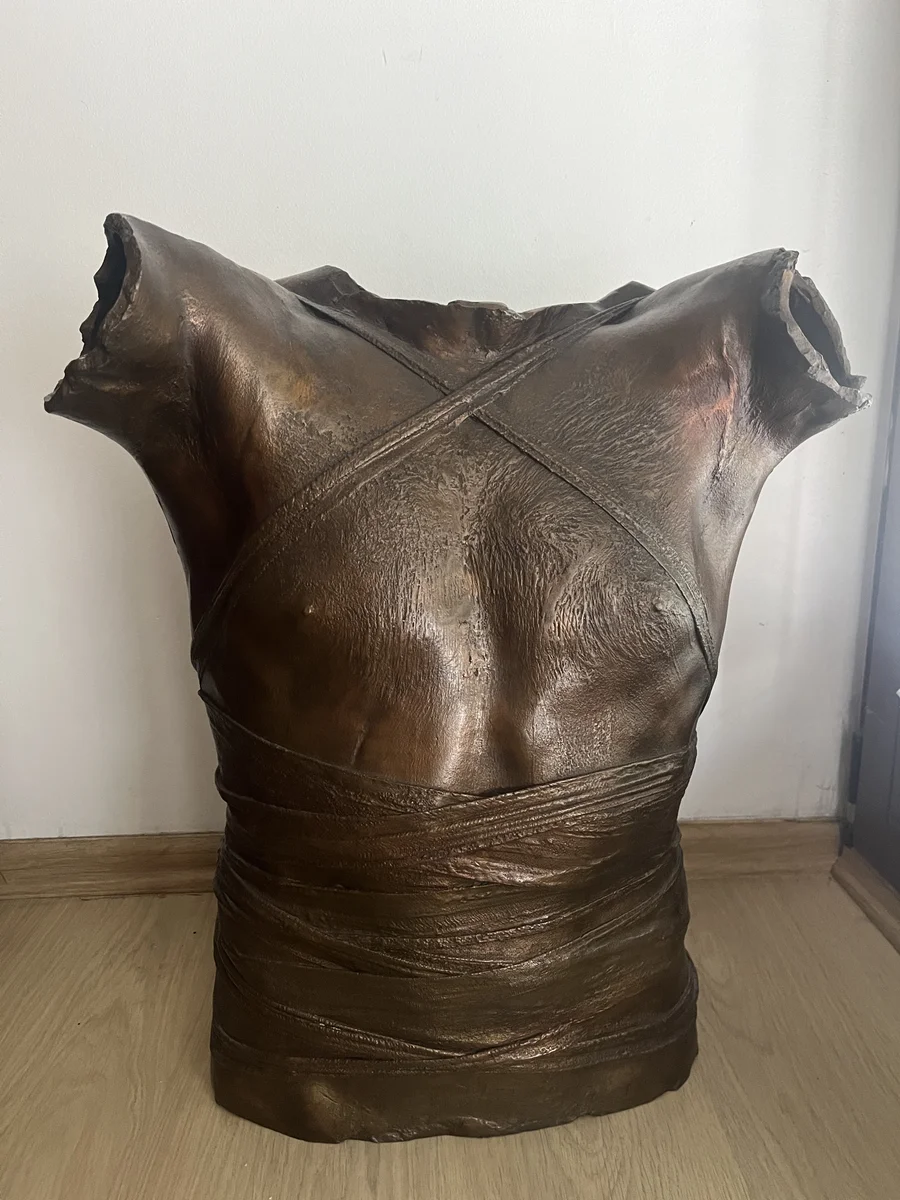
The Corazza Media — Medium Breastplate — is one of Mitoraj's most architecturally resolved bronze series: a truncated male torso encased in classical Roman armour, the body simultaneously protected and fragmented, the breastplate intact where the flesh is absent. Corazza is Italian for cuirass or breastplate, and the series explores the paradox that has been central to Mitoraj's work since the 1980s: the shell survives where the living body has not. The armour remains; the soldier is gone.
About the Corazza Series
Mitoraj produced the Corazza in several scales — from small desktop bronzes to monumental outdoor installations — and the surface treatment varies significantly between editions. The Media (medium) version is typically the most collected: large enough for the detail of the breastplate musculature and surface decoration to read clearly, compact enough for domestic and gallery display. The Corazza series belongs to Mitoraj's mature period, when the motif of armour — the body's external carapace — became a primary vehicle for his meditation on ancient heroism and modern fragmentation.
The breastplate itself is modelled with considerable archaeological fidelity. Mitoraj had extensive knowledge of Roman and Greek armour from his years in Pietrasanta, surrounded by the classical casts and fragments that filled the workshops and public spaces of Tuscany. The lorica musculata — the muscled cuirass that mimicked the male torso in bronze — was the armour of generals and emperors in antiquity, and Mitoraj's version preserves its anatomical topography: the stylised abdominal muscles, the pectoral reliefs, the shoulder-strap attachments. But where the ancient cuirass was a glorification of the body beneath, Mitoraj's Corazza is the armour alone — the body has been removed, leaving only its bronze impression.


Corazza Media — Technical Details
A freestanding armoured torso — the Corazza Media typically stands 40–60 cm in height in the medium edition, on a separate stone or bronze base. The surface shows Mitoraj's characteristic contrast between the highly polished relief areas of the breastplate decoration and the rougher, more open texture of the edges and breaks. The dark patina ranges from deep charcoal to warm brown. The signature appears engraved on the base or the lower edge of the torso. Italian-cast examples typically carry a Pietrasanta foundry stamp. Provenance for documented examples includes private collections across France, Germany, Italy, and Poland.
Armour as Absence: the Corazza and Mitoraj's Central Theme
The Corazza Media belongs to a cluster of works in which Mitoraj explores the theme of protective covering — armour, bandage, veil — as a paradoxical form of bodily absence. In the Eros Bendato (the bound Eros), the bandages simultaneously protect and erase. In the Visage Voilé (the veiled face), the veil reveals the face by describing what it conceals. In the Corazza, the breastplate — ancient Rome's ultimate protective technology — survives the body it was made to protect.
This paradox has deep roots in antiquity. The lorica musculata was itself a kind of portrait: it was cast to fit the wearer's body, preserving his musculature in bronze. To own the armour was, in some sense, to own an image of the body. Mitoraj takes this ancient logic to its conclusion: the armour as the last surviving trace of a body, the bronze impression that outlasts the flesh. The Corazza is not merely a sculpture of armour — it is a reliquary in which nothing remains.
Public Installations and International Presence
Monumental versions of the Corazza series appear in several significant public collections. Among the most prominent is the installation associated with the Lausanne Olympic Museum, where the breastplate torso's evocation of athletic and martial excellence connects directly to the museum's subject. In Italy, Corazza bronzes appear in civic spaces across Tuscany — in Pietrasanta, where Mitoraj maintained his studio, and in Florence and Lucca, where his work became part of the landscape of classical culture. The medium and small editions were acquired from these contexts, making the secondary market for Corazza bronzes particularly strong in Italy, France, and Switzerland.
Condition Notes for the Corazza Media
The Corazza Media is a structurally robust bronze — the compact, self-supporting form of the armoured torso offers no vulnerable projections and typically survives decades of display without significant damage. The main condition considerations are: patina stability (stable dark patinas are the norm; surface green oxidation is reversible with professional care), the base (separate stone bases may show edge wear), and the legibility of the signature and foundry marks. The breastplate relief, which is typically the most worked and detailed area, is also the most protected and rarely shows wear. I buy Corazza bronzes in all conditions.
Aveți întrebări despre această lucrare?
Întrebați asistentul AI — bazat pe paginile colecției, răspunsuri în limba dvs.
Do You Own a Mitoraj Corazza?
Send me a photograph — I reply within 24 hours with a genuine offer.
Any other Mitoraj work also welcome — any subject, condition, or format.
See also: Ikaria Pequeña (fallen Icarus) · Torso Bijou (decorative bronze) · All Mitoraj bronzes wanted · Auction prices guide
What the Corazza Is — Armour Without a Body
Corazza is the Italian word for cuirass or breastplate — the torso armour worn by Roman soldiers and generals, moulded in bronze to follow the musculature of the body beneath. In Mitoraj's hands the word acquires a second meaning: it names not the armour as protection but the armour as survivor. The body inside the Corazza is gone. What remains is the bronze shell that once contained it — the impression of a torso, preserved in the metal that was always more durable than the flesh it guarded.
This reversal — protection without a protected body — is the organising idea of the work and the source of its emotional power. The lorica musculata, the muscled cuirass of Roman antiquity, was itself a kind of portrait: it was cast to follow the contours of its wearer, preserving his torso in bronze. Generals and emperors were depicted wearing cuirasses that functioned as a bronze second skin, a permanent record of physical presence. Mitoraj takes this logic to its conclusion: the cuirass survives, the body does not. The Corazza is a portrait of an absence.
Compared to the Centurione II — which applies the same logic to the head and helmet — the Corazza operates at a different scale and with a different emotional register. The Centurione is intimate: a head that fits the hand, a face addressed at eye level. The Corazza is architectural: a torso that commands a room, the armour's surface read at a distance before the details of the relief are apparent. Both works share the conceit of armour-without-body, but the Corazza is more explicitly monumental — it is the fragment of a figure that was, in its original scale, larger than life.
Related works in the same thematic family include the Angelo Fasciato, in which the concealing and defining mechanism is bandage and wrapping rather than military armour — the medical or funerary register instead of the martial. All three works — Centurione, Corazza, Angelo Fasciato — are exercises in what Mitoraj described as the persistence of form after the disappearance of content. The shell outlasts the creature that shaped it. The armour survives the soldier.
Scale Variants, Patina, and Edition Details
The Corazza was produced in several scales over the course of Mitoraj's career. The small desktop edition, typically 20–30 cm in height, was produced for the collector and gallery market in the 1990s and 2000s and appears with some regularity at European auction. The Media (medium) edition at approximately 40–60 cm is the most commonly encountered significant version: large enough for the breastplate relief to read fully, compact enough for domestic display. Large and monumental editions in the range of 80 cm to several metres were produced in very small numbers for civic and institutional placement, and these rarely enter the secondary market.
The standard patina across all Corazza editions is a deep dark brown to charcoal-black, applied to emphasise the relief of the breastplate musculature. This dark patina creates a strong contrast between the high points of the surface — the pectoral reliefs, the abdominal ridges, the shoulder-plate borders — which take on a warm bronze tone where the surface has been lightly abraded or polished, and the recessed areas which hold the darkest patination. The result is a surface that reads almost like chiaroscuro drawing: light on the projecting planes, shadow in the hollows. Some editions show a warmer brown patina with more red in the bronze tone; a small number of gallery editions were finished in a green oxide patina that suggests archaeological recovery rather than foundry freshness.
Marble versions of the Corazza also exist, produced in Pietrasanta using the white Carrara and coloured stones that characterised Mitoraj's mixed-medium practice in his later career. These are significantly rarer than the bronze editions and are treated as distinct works by collectors and the market — the material entirely alters the emotional register of the subject. Where bronze reads as armour recovered from the ground, marble reads as ancient sculpture; the Corazza in white marble takes on the quality of a classical fragment, the kind of object that fills museum cases and archaeological storerooms across the Mediterranean.
All authorised editions carry the MITORAJ signature engraved on the lower edge of the torso or on the base, with the edition number in the standard n/total format. Foundry marks from Pietrasanta workshops — Fonderia Mariani and Del Chiaro are the principal foundries associated with the authorised editions — appear on the rear. Works accompanied by documentation from Atelier Mitoraj in Pietrasanta represent the strongest provenance position; documented auction history at major houses (Sotheby's, Christie's, Artcurial, Dorotheum) is a reliable secondary verification.
Exhibition Presence and the Pietrasanta Context
The Corazza series is inseparable from Pietrasanta, the Tuscan hill town where Mitoraj established his permanent studio in 1983 and where he worked until his death in 2014. Pietrasanta is the centre of Italian marble and bronze casting — its foundries supply sculptors from across Europe, and its streets and piazzas have been used as exhibition space for monumental sculpture for decades. Mitoraj was embedded in this environment: his studio occupied a former church, the Chiesa di Sant'Agostino, and the town became associated with his work in a way that few artists achieve with their places of residence. The Corazza in all its versions was conceived, cast, patinated, and initially displayed within this environment.
Italian civic and institutional collections have been among the most consistent collectors of Corazza bronzes. Monumental versions appear in the public spaces of Tuscan cities — Pietrasanta itself, Lucca, Florence — where the work sits in dialogue with the architectural heritage that Mitoraj spent his career studying. In France, where Mitoraj maintained strong gallery relationships from his years studying in Paris at the École nationale supérieure des beaux-arts, the Corazza series was exhibited regularly through Parisian galleries from the late 1980s onward. German and Swiss collectors — markets where Mitoraj's work commanded consistent interest throughout his career — acquired significant examples, and the work appears with regularity at Dorotheum (Vienna), Ketterer (Munich), and Sotheby's Zürich.
The 2011 Pompeii installation, in which Mitoraj placed works among the ruins of the Roman city, is the most resonant public context for the Corazza within the artist's own exhibition history. The breastplate torsos placed among Roman masonry, the armour of the soldiers who had built and defended the empire standing in the ruins of the city the empire had failed to protect, made Mitoraj's theme visible in the most direct terms. Collectors who own Corazza bronzes often cite the Pompeii installation as the context that clarified the work's full meaning for them.
Market and Authentication — Buying a Corazza
Within the armour-series works — Centurione, Corazza, Angelo Fasciato — the Corazza Media occupies a mid-market position by auction frequency. The Centurione small editions are more numerous in the market by volume; the large and monumental Corazza bronzes appear rarely and attract higher competition when they do. The medium Corazza occupies a position of relative strength: it is substantial enough to be a major acquisition and rare enough to reward patience. Collectors who acquire Corazza bronzes in the medium scale typically do so as part of a considered programme rather than as opportunistic purchases — the work requires space, a base, and a considered setting.
Condition considerations specific to large bronze torso forms are worth understanding before purchase. The primary concern is patina wear on the high relief points of the breastplate: the pectoral ridges and the upper abdominal reliefs are the most exposed surfaces, and on works that have been displayed in handling-accessible positions, these areas may show burnishing or brightening where the dark patina has been rubbed away. This is easily assessed from photographs and does not in most cases represent a serious problem — professional patination restoration is straightforward. More significant is base mounting: Corazza bronzes are typically mounted on a separate stone base via a threaded rod or pin, and base-torso separation can occur with age or poor storage. Confirm that the base is original and the mounting is sound before purchase.
The Atelier Mitoraj in Pietrasanta issues certificates of authenticity for authorised editions. These certificates include the work title, edition number, date, and a photograph matched to the specific cast. For the Corazza, as with all Mitoraj bronzes, the certificate is the strongest single authentication document, but it is important to note that many genuine, well-documented works were sold without certificates — particularly those acquired directly from galleries or through private transactions in the 1980s and 1990s when certificate practice was less consistent. In such cases, foundry marks, signature quality, and documented auction or collection history provide the evidential basis for authentication. I assess Corazza bronzes in all documentation states and buy directly without requiring perfect paperwork.
Despre această colecție
This site documents one private collector's search for works by Igor Mitoraj (1944–2014) — the Polish-French sculptor celebrated for his fractured classical figures in bronze and marble. Mitoraj studied in Kraków under Tadeusz Kantor, trained in Paris at the École nationale supérieure des beaux-arts, and established his permanent studio in Pietrasanta, Tuscany in 1983. His work is held in public collections across Europe and the Americas, and his auction record — €6.89 million for a monumental Tindaro Screpolato at Sotheby's Paris in 2019 — places him among the most sought-after post-war European sculptors. If you have a Mitoraj work available, please use the contact button to get in touch.
Doriți să vindeți o operă Mitoraj? Vizitați pagina noastră de vânzare →