
~4 min read
Igor Mitoraj — Sanguine Lithographs: Tindareos & Centurione Rouge

to open WhatsApp — then
send photos directly.
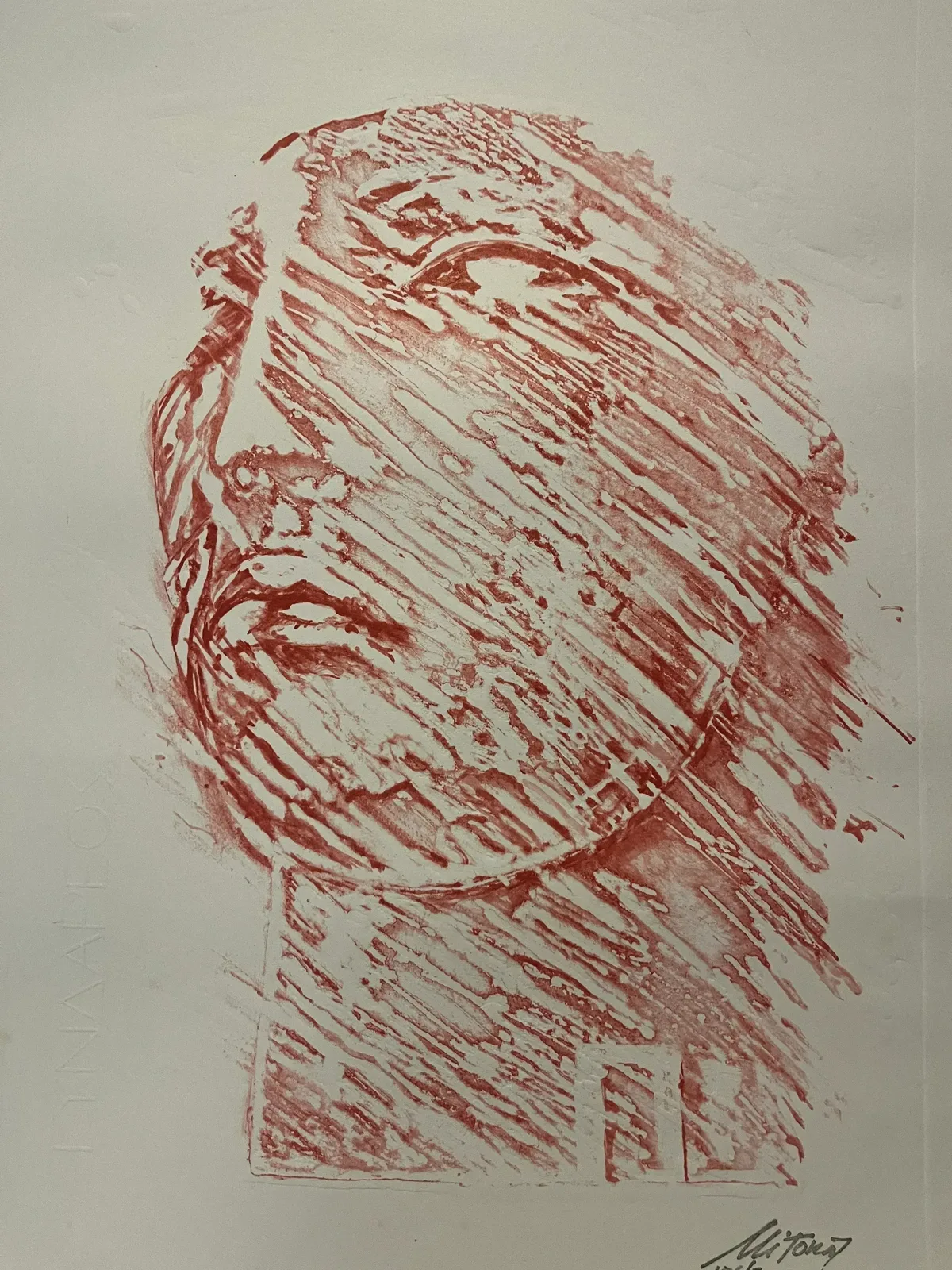


The image above shows a Tindareos sanguine by Igor Mitoraj — a red chalk lithograph depicting the mythological King of Sparta, rendered as a bandaged, fragmented head in fluid gestural strokes. Works in this technique, including the Centurione Rouge (sanguine lithographs of the Centurione subject), represent a distinct and rarer strand of Mitoraj's graphic oeuvre that I am actively seeking.
Lithograph Sanguine Signed Works on Paper Centurione subjectAbout Mitoraj's Sanguine Lithographs
Mitoraj's sanguine lithographs occupy a unique position in his output. The Tindareos — depicting Tyndareos, the mythological King of Sparta and father of Helen of Troy — shows the face as a bandaged, fragmented head rendered in characteristic red chalk tones. The Centurione Rouge applies the same sanguine technique to his most famous sculptural subject, the Roman centurion's head. Both works connect Mitoraj's visual world directly to the Renaissance tradition of red chalk figure studies.
The Centurione in Mitoraj's World
The Centurione is the work that made Igor Mitoraj internationally famous. First conceived in the mid-1980s, the image of the Roman centurion's helmet — a face behind bronze visor and cheek guards, bandaged in the manner of an ancient wound — became his most reproduced subject. It appeared in multiple bronze editions, in monumental public installations, and in a range of graphic works that explored the same themes of concealment, damage, and the passage of time across different media and scales.
On paper, the Centurione becomes something different from its bronze incarnations: more immediate, more gestural, more intimate. The lithographic process allows Mitoraj to work with tone and texture in ways that bronze cannot replicate — the sanguine medium in particular introduces a warmth and a sense of flesh that the cold metal of the sculpture deliberately refuses.
A signed sanguine of the Centurione subject is therefore not simply a reproduction of the bronze in a different format: it is a parallel investigation of the same themes by a different hand, in a different tradition, and in a medium that has its own history going back to Leonardo and Michelangelo.
Why Works on Paper by Mitoraj Are Rare
Mitoraj's market is dominated by his bronzes, and with good reason: the bronzes are what made his reputation. But this dominance means that his works on paper — lithographs, sanguines, ink drawings, watercolours — are chronically underrepresented in the market and in critical literature. The major auction databases list far fewer works on paper than bronzes, and signed examples in good condition appear infrequently.
This relative rarity is partly intentional. Mitoraj was primarily a sculptor and regarded works on paper as complementary to, rather than independent of, his three-dimensional practice. He produced them in smaller quantities, shared them with close associates, and they circulated less widely than his bronzes through the gallery system. The result is that a signed Mitoraj lithograph today represents genuine scarcity in a way that even his rarer bronze editions do not fully achieve.
Condition & Provenance
Works on paper require careful storage to maintain condition. I am interested in the Centurione Rouge lithograph in any condition — including works that have been framed for display (which can sometimes lead to minor edge toning or slight mat burn), unframed examples stored flat, or works with documentation of previous exhibition or sale. A certificate of authenticity, gallery label, or auction receipt significantly helps establish provenance but is not an absolute requirement for enquiry.
If You Own a Mitoraj Lithograph
I am actively seeking the Centurione Rouge specifically, but I am also interested in any other Mitoraj works on paper — other sanguines, black and white lithographs, ink drawings, or unique works. If you have inherited a Mitoraj work on paper, found one at auction, or are looking to sell from a collection, please contact me. I respond personally, the same day, and all enquiries are completely discreet.
Have questions about this work?
Ask the AI assistant — grounded in this collection's pages, replies in your language.
Do You Have a Mitoraj Sanguine — Tindareos or Centurione Rouge?
I am seeking this work specifically. Please send a photograph — I respond the same day and will make a genuine offer. All enquiries are discreet and without obligation.
See also: All Mitoraj lithographs & drawings wanted · Centurione bronze (ed. 250 and 1500) · Centurione II in depth · Mitoraj auction prices
Mitoraj Lithographs & Works on Paper
Alongside his sculptural practice, Mitoraj produced a substantial body of lithographs, drawings, and mixed-media works on paper throughout the 1970s and 1980s. These works revisit the same archaeological vocabulary — fragmented faces, helmets, draped torsos — but exploit the softness of lithographic ink to achieve a dreamlike luminosity distinct from his monumental bronzes. Limited editions were published in collaboration with French and Italian print studios and are today held in private collections across Europe. Because many works on paper were not registered in a centralised catalogue, careful cross-referencing with auction records, gallery invoices, and the Atelier Mitoraj archive in Pietrasanta is recommended before purchase.
Interested in this work?
Inquire about this work →You might also have


Thinking of selling a Mitoraj? See our dedicated sell page →